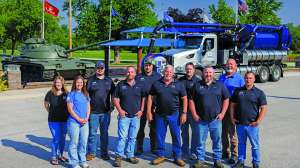
Wayne Thompson Jr. and his wife, Becky Thompson, were running an infrastructure contracting business with nine utility crews and a substantial fleet of heavy equipment when they started Crawler Pipeline Services. Their combined years of business and construction experience gave the enterprise a strong backbone.
“Our business plan initially was to concentrate on pipeline inspections, drainline inspection and cleaning,” Wayne says. “We had shut down the construction company we operated for 20 years, partially due to the economy, but also because we were looking for an opportunity to work in a section of the industry where we would not be required to have a large number of employees and would have a more manageable situation.”
Wayne grew up in construction and is licensed for highway construction in North Carolina. Becky holds a Plumber Utility license for waterlines and sewer lines and has corporate experience in human resources and as a chief financial officer. As majority owner in Crawler Pipeline Services, she is also in charge of finances and scheduling. Wayne uses his expertise to deal with equipment and on-site projects.
Their daughter, Lindsey, helped the startup family business by designing a website for the initial launch, and their son, Cody, has worked in the field with his father learning about the technologies.
Wayne describes their game plan: “Initially for our inspection operation we acquired a used camera system from CUES that we had worked with before. Then we added another camera system from Cobra Technologies (Trio-Vision) to enhance our capabilities.
“But other things kind of took over, and we decided if we were going to be a success, we would need to have a vac truck, and that would best be a combination truck because we were not sure where we would be going in the marketplace with Crawler Pipeline Services,” he says. “Things have progressed for us steadily from there.”
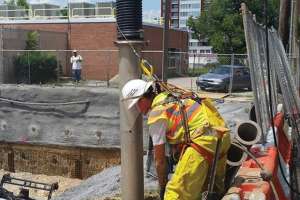
Wayne says he had his eye on hydroexcavation and saw it as a wide-open opportunity for expansion. They purchased and rehabilitated a 1998 Vac-Con and began a promotional program touting the process through their website. Targeted clients spanned a 200-mile radius covering North and South Carolina and Virginia.
“For all our drain inspection and cleaning, as well as the hydroexcavation, we were contacting the various customers we had dealt with in our previous experience,” he says. “Some had made it through the financial crunch, and others were still in the business but working for someone else. We did have a local competitor who had been in business for a long time, and is a good friend, so we were careful not to step on too many toes as we moved ahead. I knew this was an important and good relationship to maintain. We began to pick up more municipal work in other locales and to scout out the petroleum distribution industry.”
Although the petroleum distribution industry has long been on board with hydroexcavation as a safer procedure for exposing lines and other digging operations at their facilities, the Thompsons found an entirely different scenario for the municipalities they added to their customer list.
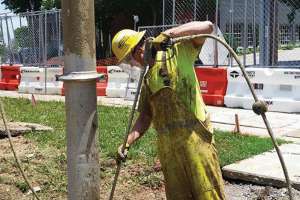
“We find that the municipalities are difficult to convince that hydroexcavation is something that would save time, money and would avoid damage to existing lines buried in the ground,” Wayne says. “There is something of a stigma about this being muddy and nasty. They stick to the notion that it’s easier to use the backhoe and then a shovel when they get close.”
Crawler Pipeline Services countered this resistance by revamping its website to include video demonstrations of the process. Wayne says that move has helped them gain the recognition and acceptance they need to grow the business.
“We would like to see hydroexcavation grow to 75 percent of our business,” Wayne says.
PIPELINE TERRITORY
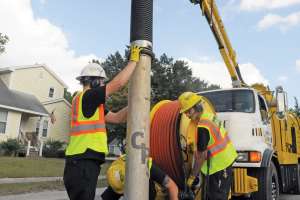
In the petroleum industry, where hydroexcavation is the only way to go, Crawler Pipeline Services is carving out an important niche. Digging with heavy equipment isn’t allowed on these sites due to the prevalence of fuel and gas lines, fiber optics and wastewater lines. Sometimes the client might be adding new lines below and above ground, and they need holes dug for support brackets (poles) for overhead lines. Crawler Pipeline Services also locates lines so that repairs can be made, and it sometimes handles new construction and pipe repair. All of these jobs depend on hydroexcavation.
Most hydroexcavation work is planned, with emergencies, such as a broken oil or sewer line comprising a small amount of the business.
When a long-distance job opportunity comes up, whether in the pipeline industry or with a private contractor or municipality, Wayne must decide whether to visit the site before signing on or evaluate the job based solely on provided information.
“With our background, we can make a good evaluation of the situation by getting as much information as we can and considering the client we will be working for as well,” Wayne says. “If there are any questions, I will jump into a vehicle and go to inspect the job. Probably about half the time we can make a determination without a visit.”
He says one of the most important issues once they take a job is to ensure they have support for the machinery with backup parts in case of a breakdown — a particular necessity for a company doing big things with a small field staff.
“We have a service truck where we carry a lot of parts. Things we think we might need. So this support is an issue,” he says. “We also have outstanding reaction from our vendors. Vac-Con has been particularly helpful. I can always pick up a phone and get someone. I can always get immediate support from Cobra Technologies; they have gone above and beyond to be there for us. We have a local vendor, Jet-Vac Equipment in Sumter, South Carolina, that we can count on. I can call in the middle of the night and get someone. We can turn to Public Works Equipment and Supply with locations in North and South Carolina and Tennessee. Whether we are 50 miles from home or 200 miles from home, this is vital for us.
“I can truthfully say our vendors have been total lifesavers in providing parts and service and in helping keep costs down and our customers happy. Even with our service truck, we can never be sure to have every part available.”
When the company is on a long-term project at a distant location, heavy equipment is only left on site over a weekend if it is in a secure location. Otherwise it’s taken back to the Raleigh yard.
POWER PUNCH
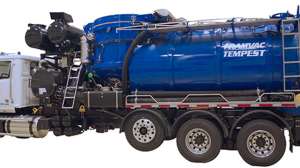
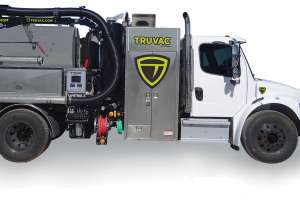
Crawler Pipeline Services hits the road with its 1998 Vac-Con combination truck with a 10-foot boom and hydroexcavation package and a 2009 Ford F-450 as the support vehicle.
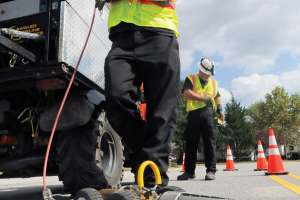
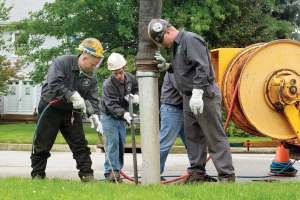
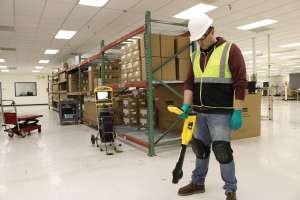
Crawler Pipeline Services’ 2007 Kubota RTV900 4x4 is equipped with a custom-made camera housing with crane. The company also has a 2012 Cobra Technologies camera system with 1,000 feet of cable, and three additional cameras and transporters for different pipe sizes. From CUES there is the Inspector General camera system with 1,000 feet of cable, plus an Ultra Shorty transporter with OZ11 camera as a backup system. The Crawler Vac is a custom-made hydraulic robot with a CCTV system for confined-space entry. Crawler Pipeline Services uses various push cameras with 1/5- to 4-inch capabilities.
Crawler Pipeline Services also has a custom-made rubber-tracked easement machine with a 700-foot hose reel and crane assembly for hard-to-reach outfall work.
ON CALL
The Thompsons run their 24/7 operation out of their home, with a nearby 1-acre lease for equipment. Wayne says his experience with equipment has been particularly helpful in the new company.
“Being on this side of the business, but with the utility background, I have been able to head off a lot of problems for other utility contractors as we interact on a job,” he says. “This has helped our contractors and co-subcontractors and also promoted our business. We can sometimes save them time and money.”
Wayne says he’s pleased with the progression of the business, even though there are things he would do differently if given the chance.
“I wish we had been able to spend more money on the vac truck — bought a newer truck. I would not have had to spend so much valuable time in the shop. That was a drawback. We did have to do a lot of rebuilding to get the truck to where we wanted it. I could have been out meeting clients and introducing Crawler Pipeline Services. But fortunately things have worked out. We are very busy. Becky does a great job running the office and dealing with myriad issues.”
Wayne’s last bit of advice for anyone in the industry: “Be there when you say you will be there, do quality work and always tell the truth.”
Breaking out on the web
Soon after opening Crawler Pipeline Services with a basic website, owners Becky Thompson and Wayne Thompson Jr. realized that to promote their services in today’s market, they needed a much more sophisticated product to keep the site updated and to track, integrate and use social media such as Facebook and LinkedIn.
Becky began the search for a website designer by talking with other people in the industry and seeking their experience and suggestions.
“We ended up with a package that was user-friendly and included training,” she says. “I had done a lot of reviewing other websites to see what we liked and what we wanted to do.”
It was important for Becky to be able to regularly make changes on the homepage and throughout the site.
“I can go in and click a button and add a word or change a picture,” she says. “I spend three to six hours working on our website every week. I can make sure all our information flows. I still have help from our designer as I learn the whole process.
“You need things on your website so that your name will come up. Keywords like ‘pipeline,’ ‘hydroexcavation,’ ‘drain cleaning’ — all the things people are looking for. The videos let people see your equipment in operation. In making the design, you need to attract people who are younger than 40 years old.”
She says their videos are taken in the field by their own crew, always adhering to safety issues such as gloves, boots, confined-space gear and proper attire.
She discovered that the cost of hiring a professional designer can vary widely depending on various factors. Much of the cost is based on the training involved and individual needs.
“In this day and time, we think that promoting our company with our website is the best way to spend our advertising budget, and being able to spend some of my time each week to keep things current is time well-spent and of great value.”