

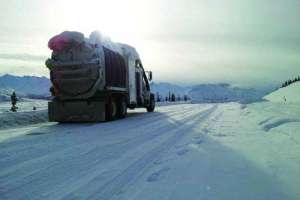
Seth Church, his family and partners all decided to use the experience of working in the cold weather to expand their company and start up operations in the Bakken Shale Play in North Dakota.
C Company, up until 2011, had only been operating in the Alaskan Play, but Church decided it was time to take advantage of the Bakken oil boom and expand into the region. He saw big opportunities and a lack of competition in the region’s hydroexcavation services.
“I thought they really needed a dedicated provider, so we committed ourselves to being that solution and providing quality hydroexcavation service in the Bakken,” Church says.
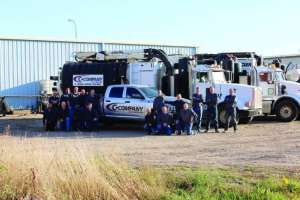
Church, along with his family and business partners Kevin Karella and Andrew Rossow, opened C Company’s Williston operations in 2011. What began as a one-truck operation has now turned into 30 employees, providing 24/7 service throughout the Bakken with nine trucks.
“For a company like ours to come to this area with one truck and only one customer, and today here we sit with nine trucks and master service agreements with over 65 percent of the producers here in the Bakken, is astounding,” says Darrin Kittelson, director of operations for C Company. “The proof is in the pudding. We went from the little guy on the block to one of the bigger hydroexcavation firms here.”
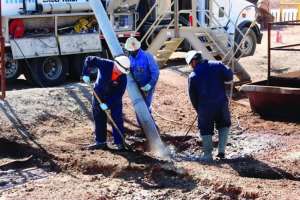
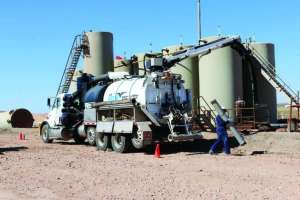
The company does everything from potholing and exposing underground utilities all the way to cleaning rigs and oil spills.
“Anything you can do with a hydroexcavator, we’re currently doing,” Kittelson says. “Hydroexcavators are very versatile pieces of equipment and we cover a lot of different types of work.”
Preparing for the weather
Cold-weather experience has helped fuel C Company’s success in North Dakota, allowing the company to pick up jobs that others aren’t equipped to handle.
“In winter, the supply side of service changes in the Bakken,” says Dave Long, general manager for C Company. “There are a lot of companies that either aren’t prepared or just aren’t willing to face winter conditions so they’ll head out and come back in the summer.”
Dealing with cold temperatures can be tough on employees and equipment, so the company has set up training seminars for dealing with the extreme elements. Kittelson says supervisors in the field are training employees on a daily basis in addition to the training that takes place at the company’s facilities.
“You’re training your operators to protect themselves and the equipment in the cold,” Kittelson says. “We are constantly implementing new training and awareness about how we operate in subzero temperatures and how it can affect our day.”
Personnel are taught how to dress for winter, Kittelson says. Employees have to pay more attention to what they wear to work, making sure they are layered up, but not dressed so heavily that they overheat.
“A good comparison for the weather here would be watering your lawn when it’s 60 below outside and windy. That’s what our operators face on a daily basis,” Kittelson says. “We’re dealing with water in some really poor weather conditions.”
Weather is also a big factor in equipment decisions. In the winter months, North Dakota can be blasted with heavy snowfall and can experience temperatures as cold as minus 60 degrees Fahrenheit. “You just need extreme technology and extreme weather protection,” Church says.
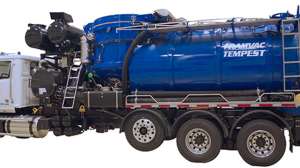
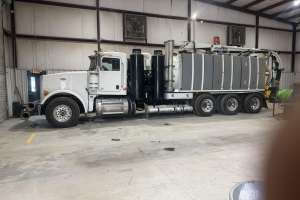
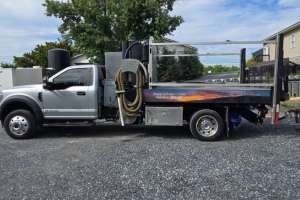
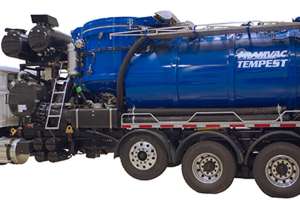
C Company utilizes hydroexcavators from two different manufacturers: Vactor and Super Products. The company has both Guzzlers and HXXs from Vactor, while on the Super Products side they run Mud Dogs.
All of the trucks are equipped with large freshwater tanks, Hotsy industrial pressure washers and isolated debris tanks that allow for proper disposal of hazardous waste.
Church says about 60 percent of their trucks are Vactors and 40 percent are Super Products. The newest Super Products hydroexcavator arrived at the shop in October.
“We’ve got some of the most cutting-edge technology as far as cold weather that Vactor has ever done,” Church says. “We’re talking directly with Vactor and Super Products on a regular basis and communicating our needs. We’ve had the president of Vactor in my pickup truck with his product developer riding along for a couple of days just showing them what our specific needs are. They’re making changes so that they can take care of us so we can take care of our customers.”
C Company also wraps and heats the hoses on the trucks. There are hot-water heaters on the trucks and the water in the tanks is constantly recirculated to keep it from freezing.
Crews must blow out all the water from every line and circulate anti-freeze through those lines each night to make sure the truck is ready for the next job, Church says. Crews also use pre-trip and post-trip checklists to make sure all the items are taken care of each day.
“Digging through hard, packed, frozen ground takes much longer than in the summer, but with the boiler units on our state-of-the-art equipment, we can handle even the toughest of jobs,” Church says.
When the weather isn’t so brutal, C Company is mainly cleaning rigs and hydroexcavating for utilities, Long says.
Staying busy
C Company has crews working in the oilfields 24 hours a day, every day of the week in every season of the year.
“We’re here to work. We’re here to provide a service, and if you need it at 3 a.m., we better be ready or we need to go home,” Long says, adding that he often tells his crews they can call at any time of night if they need him. “I’m the general manager, but they can call me anytime to help them work.”
Many jobs present tough safety challenges, including confined-space entries, hazardous chemicals and complicated equipment, and C Company puts a big emphasis on work site safety.
“We go all the way down to the job level. Job Safety Analysis [JSA] is something we perform on each and every job,” Long says. “Our team on the job is prepped before they ever leave the shop, when they get to the site and after.”
Before leaving for a job site, crews discuss potential safety hazards at the site they’ll be servicing. Once they are on site they’ll meet again and take a look at all the safety hazards and discuss those. Following the work, the crews will meet again and talk over what hazards they saw, what they were able to mitigate, what they were able to control and what they could eliminate.
“They put that all down on paper and we talk about it when they come back to the shop,” Long says.
The company also holds weekly behavioral management safety meetings where the safety officers review the JSAs and do spot checks on jobs to see how employees are performing.
“We’re looking at whether they’re following the rules, whether things could be done better, and we bring those back to the office and talk about those in our regular meetings and try to change our safety culture for the better every day and every week,” Long says.
Church noted one particular job in August took the confined-space safety program to a whole new level they hadn’t seen in the Bakken.
“It was a stretch for us, we had to bring up our game as far as safety,” he says. “We realized early on that this is a dangerous work environment. We need to be leaders in the field of safety from the very top level of management to the guys sweeping the floors and we’ve put a premium on safety.”
Expansion on the horizon
Church would like to see his company expand in the region, but that will depend in large part on how long it takes the company to train employees.
“First and foremost, our growth is predicated on the success of our performance and where we’re doing work,” Church says. “We would like to see continued work in the Bakken, the North Slope in Alaska, as well as Wyoming. We would like to move into Wyoming and then perhaps Colorado; that would be within the next three years. We’d like to see some solid but attainable growth.”
Long says he’d like to see the company grow, just like they have been, adding trucks each year.
“I’d like us to lock in a few more clients and never ever lose one,” Long says. “We’d like to see safety continue to grow. We want to keep seeing our guys wearing their PPEs and coming back with all their fingers and toes and more ideas about how we can do this better and faster and still be just as safe.”
Wave of the future
C Company provides hydroexcavation services for road builders, vertical construction contractors, utility companies, mining firms, fuel delivery companies, boring contractors and mechanical and electrical contractors.
“We’re trying to rely less on oil and gas,” Church says. “Right now we’re about 90 percent oil and gas work, but we want to move into the other industries too.”
Church doesn’t see oil and gas as the big industry for hydroexcavators, but instead its in underground utilities.
“That’s where hydroexcavation is going to become the standard, Church says. “I believe the oilfield is great thriving growth market, but the real market for hydroexcavation for the future is going to be every town, every city that has an electric cooperative or underground utilities will be wanting hydrovac.”
During a meeting with the president of Super Products, Church says he learned just how big hydroexcavation is in some areas of North America. Church was told that the Canadian province of Alberta has as many hydroexcavators as the whole U.S.
“Each year more people in more industries are learning about the benefits of using hydroexcavation,” Church says. “I have seen an increase use of hydroexcavation in the last five years, but I believe this industry is still in its infancy in the U.S. and will continue to become more popular as more uses are discovered and more companies place a higher premium on safe work practices.”
Continue reading for free