At the risk of having millions of gallons of sewage dumped within the city, officials in Miami Beach, Florida, knew they needed to come up with a solution to a pipeline showing its age.
A consultant informed the city that a 54-inch prestressed concrete cylinder sanitary sewage force main constructed in 1977 had points of potential failure. The reinforcing wires within the pipe carrying wastewater from Miami Beach to the county’s Virginia Key Treatment Plant were corroding and breaking.
In 2013, the city used a PipeDiver inspection tool (Pure Technologies US) to analyze the force main. The analysis determined that the line was on the verge of catastrophic failure. If it were to rupture, the sewage would not only flow into city streets, but also to cities farther south and eventually into the ocean.
“We were at the risk of having millions of gallons of sewage dumped in the city and with no place to go,” says Bruce Mowry, city engineer. “It was identified that this was a single point of failure concept, and we needed to put a redundant pipeline in. We needed to do this to get reliability and to allow us to do maintenance on a pipeline that had questionable integrity issues.”
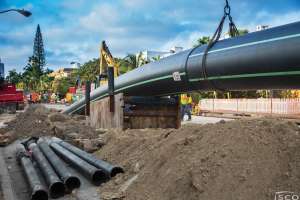
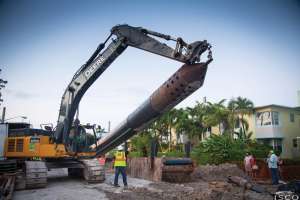
In just four months in 2016, the city and contractors installed a 54-inch HDPE pipeline using directional drilling to serve as the backup force main for when the old one would go offline for repair and cleaning.
NO TUNNELING HERE
City officials first approached the idea of using tunneling to install the new pipeline. A consultant working with the city said that could be accomplished for $10 million.
“After we secured the funding, we went out on the market to see which firms could actually do that,” Mowry says. “Firms submitted proposals, and when we opened the envelopes, we found that the project was 50 percent over budget. That put us in a little bit of a predicament in that we had a critical project that needed to move ahead, we had funding and we were short in terms of the actual cost of doing the job.”
The next step was to look at alternative installation methods.
“The commission gave us the authority to do this as long as we met the original objectives of the job,” Mowry says. “We could not shorten the pipeline, reduce the capacity or impose a technology that would give us a shorter life cycle. As long as we could achieve those, then the commission was open to allowing us to do it.”
That’s when local contractor David Mancini and his team at David Mancini & Sons came in with the idea of horizontal directional drilling. A job of that size and length — a 54-inch pipe of over 4,000 feet — had never been done anywhere before.
A CONFIDENT CONTRACTOR
David Mancini & Sons, based in South Florida, is familiar with the area’s ground conditions having worked with Miami Beach on smaller projects. With this project, Mancini and his team drilled geotechnical holes throughout the route to confirm where the rock was and its consistency.
“What everybody didn’t know was that for the last 15 years, I’ve drilled at least 10 jobs within a 5 mile radius,” Mancini says. “I do soil borings to make sure that what I know is there really is there; and it was — a good layer of soil. I wasn’t committed to doing it for the city for the lower cost or the drill method until a second set of soil borings confirmed my experience.”
After evaluating ground conditions throughout the route, figuring out the depth the pipe needed to be, and other factors, David Mancini & Sons officials sat down and evaluated the risk before committing to the job.
“He knew he needed to do his homework,” Mowry says. “He needed to take time, not to rush into it. He needed to develop a very solid plan, and he needed to have a team that had all the necessary experts in all the areas.”
PUTTING IN THE PIPE
Mancini chose 54-inch IPS DR-17 HDPE pipe because its low life-cycle cost and its lightweight and ductile properties made it the ideal material for HDD.
“The first thing we did was to make sure the entry hole was clean,” Mancini says. “That’s the biggest mistake most drillers make: They don’t clean the hole. We manifested every load of dirt that came out of the trench, so we had the right amount of dirt out of the hole.”
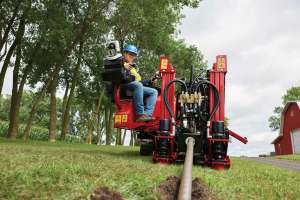
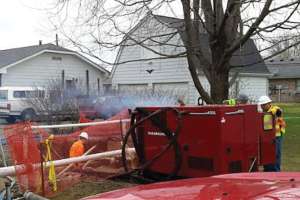
The new pipe was pulled in two segments using a 1-million-pound pullback Vermeer D1000x900 directional drill. A dual-string approach had two runs of pipe being fused and positioned in the center of the roadway. The pilot hole went down to 40 feet, leveled out and maintained that depth to the exit point.
“We were intersecting a pilot hole with monitoring holes just to double-check that we were on line and grade,” Mancini says.
He typically doesn’t do that type of soil bore testing on all jobs.
“This was pushing the envelope of what has been tried and proven,” Mowry says. “We were basically doing something that somebody hadn’t already done. In the carpeting business, you say measure twice, cut once. Well, in this industry, David wanted to confirm pilot holes and test results three times before he ever started committing because it was putting his company on the line. A job like this, if it goes bad, could have huge impacts.”
Mancini also monitored the tailings to make sure the drill was in the right layer of soil. “We were out there with a fish net, washing the fines out, just making sure it was the right layer — no sand, all rock — during the pilot,” Mancini says. “It’s a lot of TLC.”
WORKING THROUGH OBSTACLES
The work took place in the middle of the community of 90,000, which posed some challenges. “This is a highly developed area,” Mowry says. “These streets are fully populated, and we went through business areas and residential areas with the project.”
The route city officials selected for the pipeline — along a wide right-of-way — provided several benefits. The street had a boulevard where crews could work and stage materials, leaving lanes open on both sides to allow continued traffic flow.
“We had a public information officer on the job who was there to send out updates, talk with different communities, meet with the neighbors and so forth,” Mowry says. “We had identified things like pedestrian corridors and even built a staircase over the pipes on top the ground to allow easier pedestrian traffic. When you’re talking about pipes that are running over 1,000 feet long, it’s sometimes not easy to say, ‘Go to the end of the pipe, go around and come back.’”
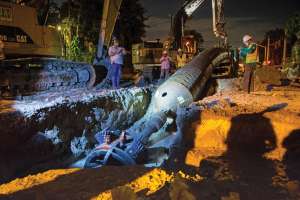
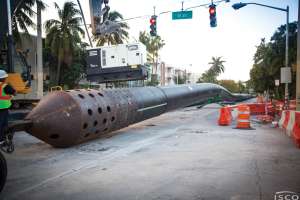
Cooperation was also needed when it came time to pull the pipe back over the highway it would intersect. Crews determined the best time to shut down the highway for the pullback overnight.
“There was a lot of communication between David Mancini & Sons, the city, law enforcement and the Department of Transportation to make sure alternative routes were set up,” Mowry says. “We couldn’t just lift this pipe like a bridge and allow cars to drive under it because it was so heavy. Everyone did their part, and it went smoothly.”
PUTTING THE PIPE TOGETHER
The pipe fusion on the project was done with a McElroy MegaMc 2065 fusion machine operated by a certified technician from subcontractor ISCO Industries. The highlight of the fusion operation was joining the two strings of 3,000 feet and 1,200 feet of pipe during the pullback process.
“All the welds to the pipe were more difficult than I imagined,” Mancini says. “We had to do one weld on the fly, and it took the tech almost seven hours to feel comfortable to make that weld. Between getting it lined up, getting the weights right, getting the forces right, and everybody there, it was stressing him out. I was watching it, and I told everyone to just leave him alone because that was the most important part of this whole job, making sure the weld was done right.”
THE NEXT STEP
David Mancini & Sons and its subcontractors — Spartan Directional and ISCO Industries — had the job completed in March 2016, just four months after starting.
“The pipe is now in operation, and it’s performing well,” Mowry says. “We haven’t taken the other one fully out of service and cleaned it yet, but we know now that we have a system that will work. We have one brand-new pipe that we have a high level of confidence in, and one that has weak points in it but is available to us.”
The next step for the city will be to take the old force main out of service and repair it. Mowry says the city will look at all available repair options from spray-in pipes to replacing sections of the pipe.
“There are a lot of new technologies out there right now,” Mowry says. “We’re not rushing into that at the moment because we have a new system in place and we have other things going on in the city.”
Meanwhile, Mancini and his crews are ready for the next big project and want to try a longer pull: “I wanted to pull the full 4,200 feet at one time on this project, but they wouldn’t let me. Absolutely I’m ready for the next one. I truly believe it was the team that made it successful and not one individual.”