Prestressed Concrete Cylinder Pipe is frequently used in trenchless applications, owing to its design which incorporates a steel cylinder for watertightness and a concrete core circumferentially prestressed with steel wire. The idea behind PCCP is to combine the best of concrete and steel into one package, but the design does have its weak points. Corrosion caused by contact with soils containing high levels of acid, chloride and/or sulfate can lead to PCCPs failing prematurely. Since PCCPs are often used as water mains, their failure can seriously disrupt the communities in which they’re buried.
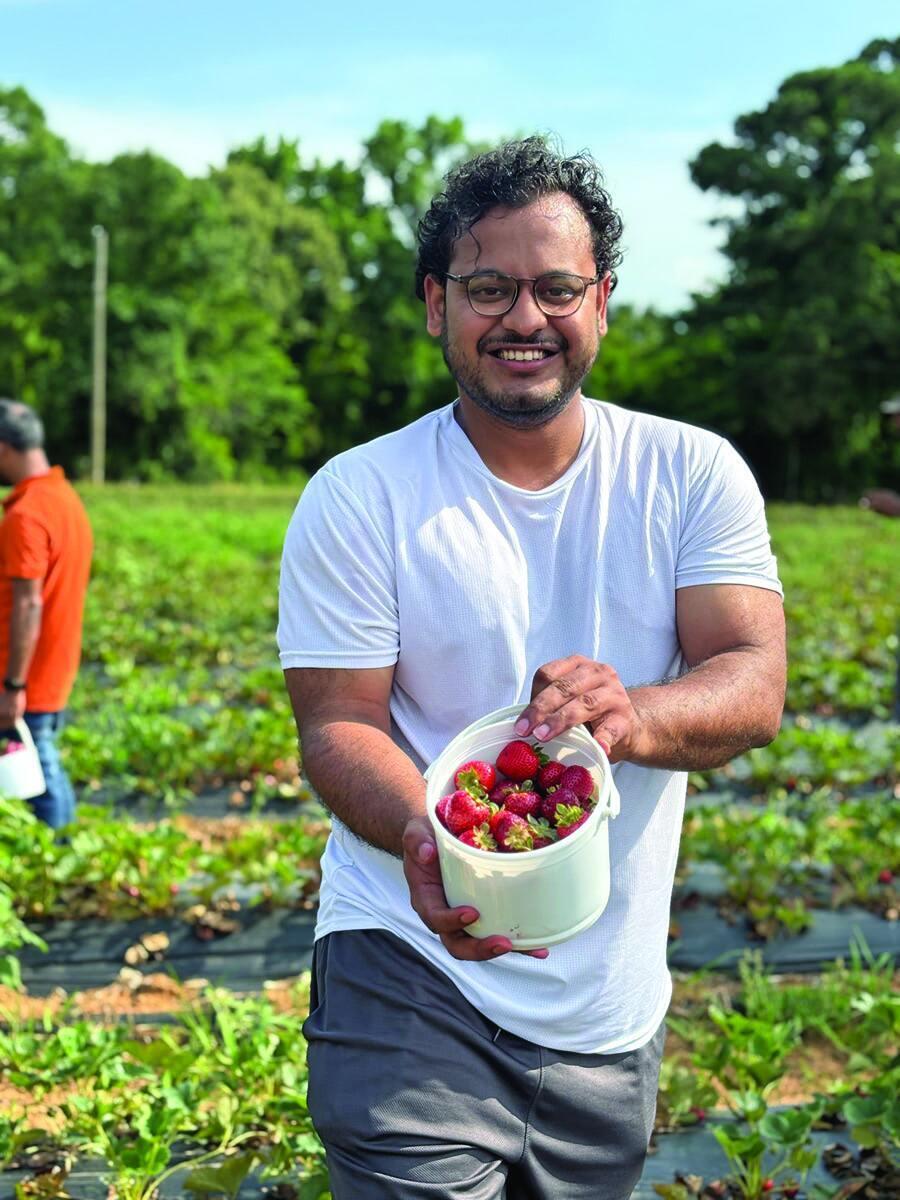
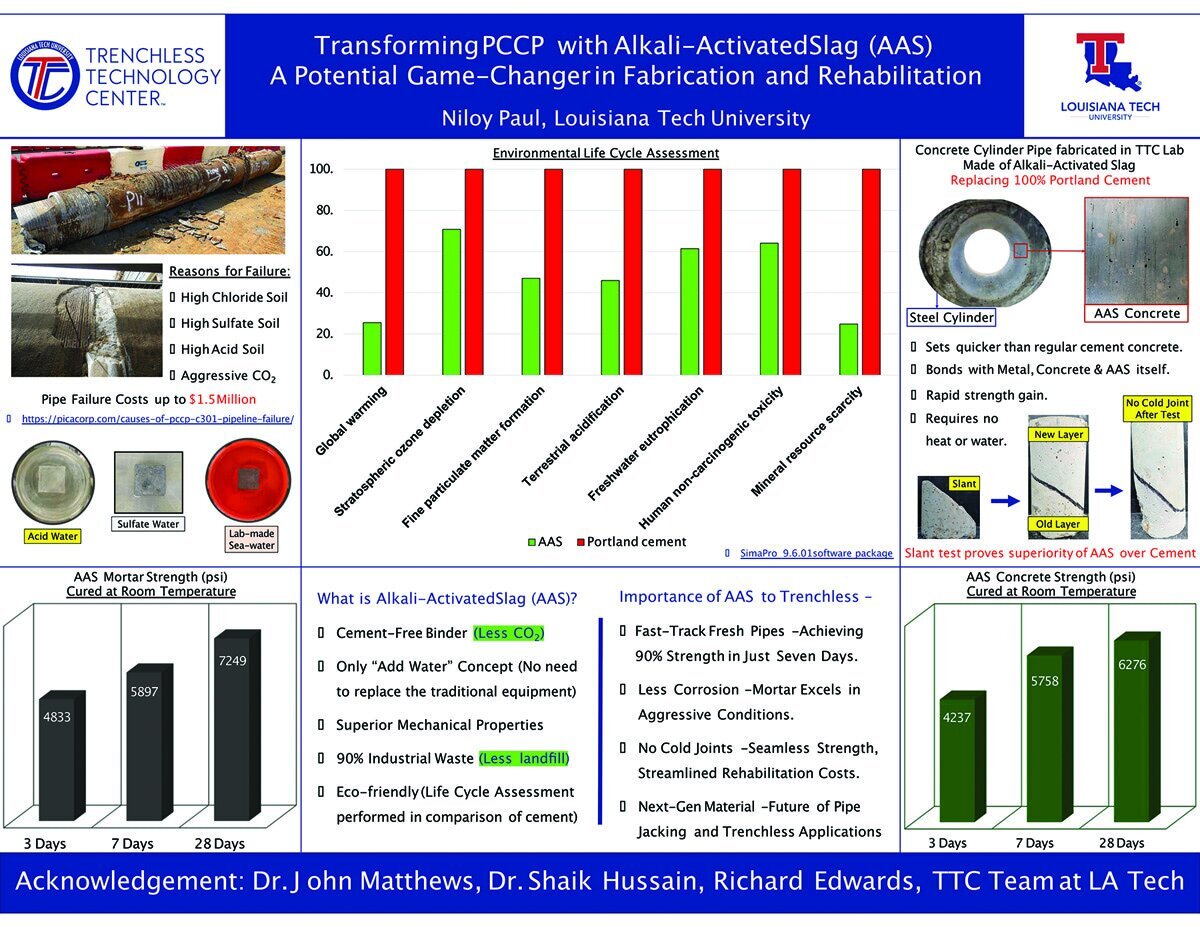
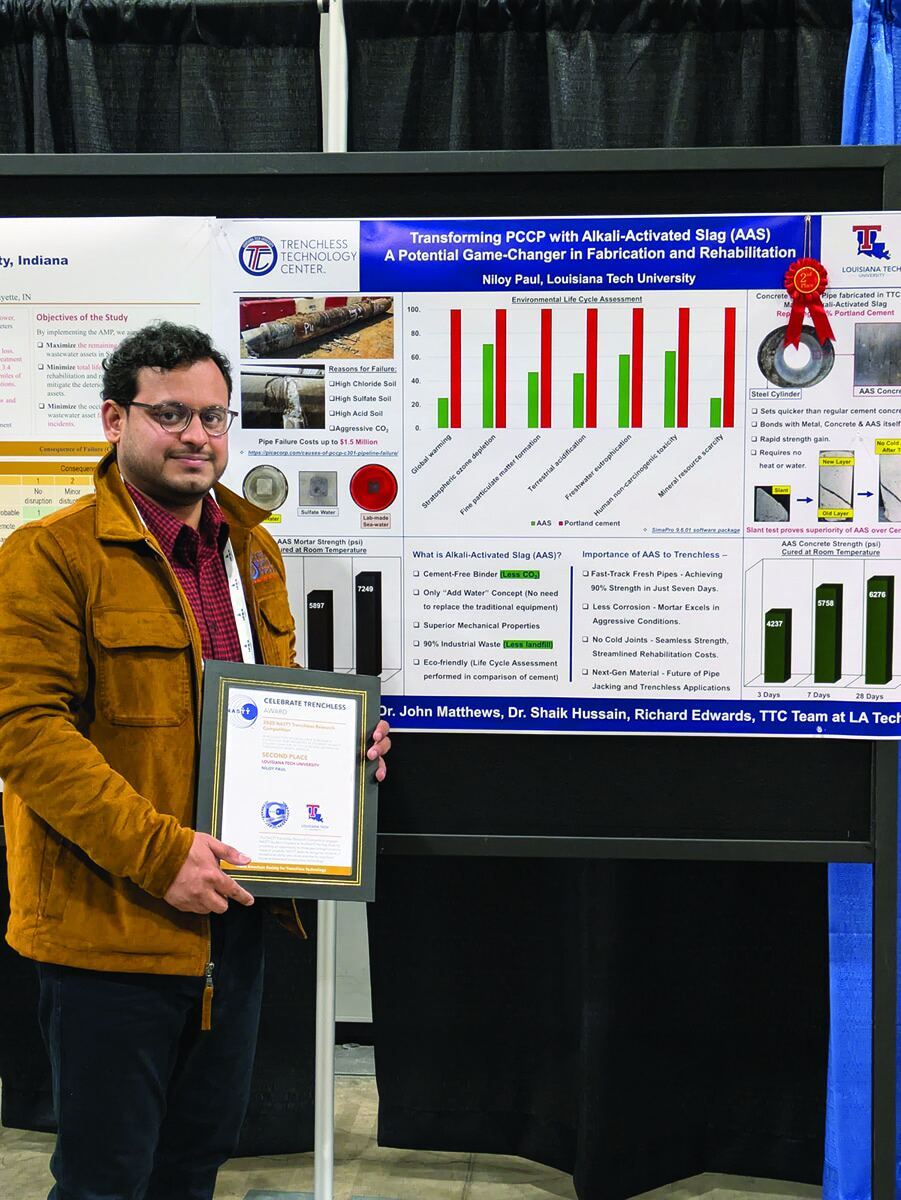
Coming up with a solution to this PCCP conundrum is Niloy Paul’s passion. He is a Ph.D. student in Micro and Nanoscale Systems Concentration at Louisiana Tech University, and a member of the NASTT Louisiana Tech University Student Chapter. He recently summed up his solution in a three-minute poster presentation titled “Transforming PCCP with Alkali-Activated Slag (AAS): A Potential Game-Changer in Fabrication and Rehabilitation.”
THE PROJECT
Paul gave his presentation as part of the NASTT’s 2025 Trenchless Research Competition — and won second prize. This competition was held during the 2025 NASTT No-Dig Show in Denver, Colorado, from March 30 to April 3, 2025.
Paul has been a graduate research assistant at LTU’s Trenchless Technology Center since spring 2023, under the supervision of his adviser Dr. John Matthews.
“It was my third time attending the No-Dig Show,” says Paul. “I presented my research on every occasion except in 2023, as I had only begun my graduate studies a few months earlier. That year, I watched many enthusiastic students from across North America showcase their work in the Trenchless Research Competition, so I decided to enter in 2024. I did not receive an award then because my geopolymer project didn’t align with the competition’s trenchless focus. Consequently, I refocused my efforts on a project better suited to trenchless applications: a novel alkali-activated slag material to replace cement in both the inner concrete core and outer mortar layer of prestressed concrete cylinder pipes.”
Paul had three goals in using alkali-activated slag in place of 100% Portland cement in PCCPs.
“My primary goal in using this novel material was to accelerate pipe production by leveraging its rapid strength gain and reduced curing time,” he says. “My secondary goal was to divert industrial waste from landfills, and my tertiary goal was to cut carbon dioxide emissions by minimizing cement usage, since cement manufacture generates significant CO2. Additionally, this material is particularly effective at rehabilitating aging pipes thanks to its exceptional bonding properties with metal, concrete and itself.”
The facts speak for themselves. The PCCP Paul made in the lab using AAS set quicker than regular cement concrete and did not need heat or water in the manufacturing process. The AAS-based PCCP also bonded easily to concrete, metal and other AAS. As well, it rapidly gained strength as it cured, achieving 90% strength in just a week. Finally, the AAS-based PCCP is far less prone to corrosion in extreme soil conditions than cement-based PCCPs and generates 90% less waste for landfill.
Despite Niloy Paul’s strong case for AAS-based PCCP, he was nervous about presenting his findings during the NASTT’s 2025 Trenchless Research Competition.
“Since I began attending the No-Dig Show, at least one Louisiana Tech student has won an award in the Trenchless Research Competition,” he says. “This year, as the sole representative of my university, I felt anxious about whether my research would meet the judges’ expectations. When they announced me as first runner-up, I experienced an immense sense of relief and pride.”
PRIDE IN HIS WORK
For Paul, attending the No-Dig Show is just as compelling as winning a prize in the Trenchless Research Competition.
“I spent four years in industry before starting my Ph.D. journey, which exposed me to the unadulterated divide between academic theory and the real-world demands of infrastructure projects,” Paul says. “At the No-Dig Show, I saw researchers, engineers, contractors and manufacturers side by side, deploying innovative methods — like cured-in-place liners, microtunneling and HDD — to renew or install pipelines quickly, cost-effectively and with almost zero surface disruption. That seamless fusion of cutting-edge research and practical trenchless solutions — solving urgent problems while keeping communities running undisturbed — is exactly what captivates me about trenchless technology.”
So what’s next for this researcher who has solved the issues associated with cement-based PCCPs? Paul says he will integrate academic research and industry practice by finishing his Ph.D. and working with trenchless technology partners to test and improve their laboratory’s novel sprayable material for rehabilitating aging pipelines.
“Next, I’ll step into an R&D role to deliver field-ready solutions, lead best-practice workshops, contribute to NASTT standards committees and mentor emerging researchers,” he says.
Continue reading for free