

As more underground utilities are being put in, it has become increasingly important to know the exact depth and location of the different lines in the ground. States have put measures in place to prevent the devastation that could result from the accidental crossing of utility lines.
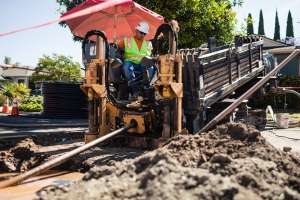
“Imagine if you were digging a sewer line and accidentally hit a gas line,” says Art Gutierrez, safety manager at California Boring in Anaheim.
The consequences could be horrific, and contractors are determined to avoid this scenario. Beyond the safety of the crew and the site, if a line was hit and the protocol was not followed, the contractor could be fined upwards of $50,000 as well as be responsible for the repair of the damaged line and infrastructure.
Checking the sites
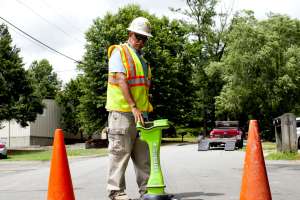
Gutierrez emphasizes that the answer lies in “checking parameters and then checking them again.” In Southern California, all contractors are required to notify the Underground Service Alert of Southern California (USA/SC or DigAlert) prior to starting a dig. The USA/SC provides parameters including depth and location of live utility lines so contractors can locate all of the lines they’re crossing before they start boring.
“Everyone in California knows you have to have a DigAlert ticket before you dig,” Gutierrez says. Digging without a USA/SC ticket could bring a $50,000 fine. Contractors make the phone call at least 48 hours before they’re ready to start, and they go out and mark their facilities appropriately for the specific utility lines being installed.
The USA/SC has implemented these best practices with the goal of streamlining the process and providing contractors with a means to get the job done accurately and safely. California is not the only state that’s determined to prevent cross bores from occurring. Georgia also has very specific guidelines for contractors to follow whenever boring is necessary.
Georgia’s “call before you dig” program is called Georgia 811, and like USA/SC, its goal is to ensure public safety and that of the underground facilities.
Matt Davis, of Davis Underground Solutions, starts by contacting a utility operator and providing an address and the type of utility work that’s to be completed. Georgia 811 hires a location company who goes out and white lines the site at least 48 hours before the dig. Davis is then able to provide his crew with a map of all registered utilities located at the specific job site. He’s given a legal date to start the dig, and depending on the scope of the job, he typically has the information necessary to get it done within the two-week allowance.
Keeping eyes open
Clearly, states like California and Georgia recognize the importance of preventing cross bores at all costs. However, no process is ever completely free of loopholes.
“It’s a good system, but it has the impossible task of telling everyone what is what,” Davis says. He adds that one of the biggest problems can be locating sewer mains. “They are 100-plus years old, and nobody has a clue where they are. You’re not allowed to hit them, but they aren’t marked. Not to mention they are made of old clay pipe, so they’re fragile.”
It’s the crew’s job to be ready to handle a surprise at any given moment. Ground-penetrating radar technology has improved the process of locating old lines, but it’s not foolproof. Being on the lookout for unmarked pipes becomes second nature to every operator. Davis and Gutierrez say that city digging is among the most problematic. Considering the infrastructure that has been there for decades as well as the close proximity of buildings, sidewalks and roads, boring can be incredibly difficult and even dangerous.
“Traditional methods don’t work. You have to cut through concrete, and the underground is congested because so much is in there,” Davis says. “The biggest risk becomes knowing where to put the new line and sometimes having to squeeze it in between two different utilities.”
In the City of Los Angeles, there are many abandoned underground utility lines that aren’t seen on the USA/SC map. It’s impossible to know what’s what, but it’s the contractor’s responsibility to handle each and every situation. “If an old line is exposed accidentally, the first thing to do is to identify the utility. Once we know what it is, we call the utility company to come out and deal with the line,” Gutierrez says.
Knowing the protocol and being able to handle situations that aren’t predicted are a necessity.
“Keeping your eyes on the line you’re going to cross is always the goal. This isn’t always feasible, however, because you don’t always find the line,” Davis says. “If you can’t spot the utility that’s located on the map, you have to dig smartly with either shovels or pothole machines and be aware of what you’re doing.”
Continue reading for free