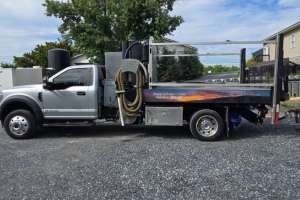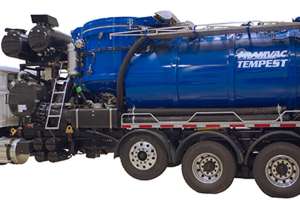

Much of what the water and wastewater industry does is on the backs of commercial-size trucks. Commercial trucks require drivers with commercial driver’s licenses. Our insurance company always tells us the trucks are the largest exposure we have due to the number of trucks we have on the road every day. It is imperative to the success of your company to never take CDL regulations and training lightly.
It starts in the office
Does your company have a person (or persons) knowledgeable in the federal and state regulations for commercial vehicles?
Your office has to have records not only on the vehicles, but on the commercial drivers themselves. Were the drivers properly vetted through the clearinghouse system? Is the clearinghouse checked on a regular basis to find out updates on the drivers? Does each CDL truck and trailer have their annual inspection sticker or report?
It is highly recommended that a company of any size bring in a third-party expert to make certain your policies and records regarding your CDL program are compliant. Depending on the size of your company, you don’t need a full-time person handling a CDL program, but obviously if you have dozens of CDL drivers, a full-time person might be warranted. What a lot of companies do is hire an expert to come in on an annual basis and train CDL drivers for a day and check that records are being properly maintained. This practice is highly recommended. Our state onsite association brings in experts to speak on truck regulations and safety at our annual conference.
In the event that one of your CDL drivers is involved in an accident, the condition of your records at the office will be extremely important.
Are your employee rules for the drivers airtight? Have your drivers signed acknowledgements that they will abide by the rules?
Have your CDL drivers been trained in the importance of the pretrip and post-trip inspections? Have your CDL drivers been trained in the minimum requirements of the pretrip? Are they aware of the additional requirements when pulling a trailer?
Load securement
Our company brings in a third-party training company to review rules, regulations and best practices on load securement. At the end of the day, our drivers are certified in load securement. Our insurance company was quite impressed when they audited our safety program and saw each driver was certified.
Load securement is important for several basic reasons. Obviously, the first is safety. You certainly would not want anything on the vehicle to become a risk while driving. Proper load securement is important because if there is an accident and a load was not secured properly, it would be a very bad issue.
I once saw a guy hauling a mini-excavator get pulled over. I could see that load securement was wrong as I drove by. Two hours later, on my return trip, I noticed the same truck and trailer still pulled over on a side street, and the officer had the driver lay out each chain and binder on the road and start over with his load securement. I think he was getting a lesson. Train your drivers properly before they head out on the road.
Please know that if a trailer is not clean, if there are piles of dirt clumps and stones off the tracks of the machine laying loose on the trailer bed, those are considered unsecured, and can be an initial reason to get pulled over. Sweep off your trailers before you head out on the road.
A DOT officer that recently spoke at our annual conference said that the most common reasons to pull over a commercial truck are rolling through stop signs and failing to obey signs.
The same speaker said that the top cause of CDL crashes is inattentive driving/driver behavior issues.
Common CDL violations include failing to obey signs, failing to secure loads, failing to connect breakaway devices properly and failing to connect or check lights.
The DOT inspector stressed the importance of the pretrip inspection, and of having the annual inspection sticker on or in the truck or the report in the truck.
Drivers cannot use phones while driving. Pull over out of traffic and stop to use phones.
One of the lessons I always use when training about pretrips is an example that a DOT inspector used at a training session. A driver with a long, clean driving record was involved in a horrific accident. The other vehicle did as many things wrong as you could even think of. The driver with the clean record was just in the wrong place at the wrong time. The attorneys for the other vehicle could find nothing on the CDL driver until they were able to show that the CDL driver failed to note a nonfunctioning tail light on his pretrip that morning. You would think that was a minor issue, but with the severity of the case, they were able to make it a much bigger deal. Please make sure pretrips are taken very seriously by every driver.
There are a lot of rules and regulations that must be followed by CDL drivers and companies that employ them, for good reason. Take your company's CDL program very seriously so that your drivers and those around them remain as safe as possible.
About the author: Todd Stair is vice president of Herr Construction Inc., with 34 years’ experience designing, installing, repairing, replacing and evaluating septic and mound systems in southeast Wisconsin. He is the author of The Book on Septics and Mounds and a former president of the Wisconsin Onsite Water Recycling Association.
Continue reading for free