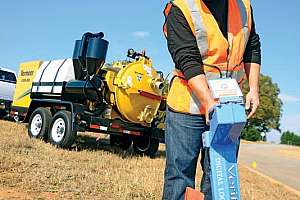
Filtration tubes used to remove sediment from pond
Pipe scanning technology uncovers sewer defects
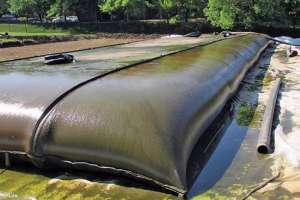
Filtration tubes used to remove sediment from pond
Problem: A community pond in Lenexa, Kansas, was in poor state due to decant water. The pond could no longer sustain aquatic life and was a community eyesore. It was determined that approximately 6,000 cubic yards of sediment would need to be removed to bring the pond back to a healthy status for aquatic life.
Solution: In order to properly remove sediment and clean the pond with minimum erosion and haul-away, Envirotubes from Industrial Fabrics were used. The tubes were staged so that the 12 mil reinforced single-piece liner was placed on the lowest terrace that had a 24-inch earth berm built on three sides around it. The liner was draped over the berm and placed up and over the terrace to the next level. A sump well 24 inches deep was excavated in the corner closest to the project pond to collect decant water and return it back to the pond using a 4-inch, self-priming diesel pump. All terraces were graded completely flat for the tube with a 5-foot perimeter graded at a 1/8-inch-per-foot slope to drain the water to the next lower terrace, or in the case of the lowest terrace to the sump corner.
Result: The sediment was removed, and after a 120-day dewatering and dehydration period, the material shrunk at a ratio of 3-to-1 so that only 2,000 of the 6,000 cubic yards removed had to be dealt with. Since the neighboring property was looking to add elevation to a sunken area, the remaining hardened sediment was used as fill. 800/848-4500; www.envirotubes.com.
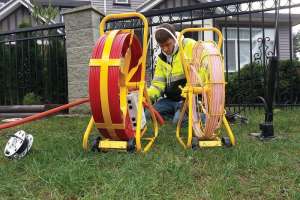
Pipe scanning technology uncovers sewer defects
Problem: The City of Surrey, British Columbia, Canada, sanitary sewer system serves approximately 130,000 customers with over 930 miles of sewer pipes ranging in diameter from 6 to 48 inches. Infiltration and inflow issues stem from aging infrastructure. The city sought quantitative data regarding its infiltration issues.
Solution: Electro Scan partnered with Superior City Services to assess a total of 27 sewer mains ranging from 6 to 16 inches in diameter and a total of 65 sewer laterals ranging from 4 to 6 inches in diameter. This assessment included 102 municipal facilities, representing a total of 1.4 miles of sewer pipe completed in four days. Electro Scan locates pipe defects by sending a probe, which emits a condensed electrical current, through the pipe and measuring the amount of current able to escape the pipe.
Result: The scan located 1,055 total defects with a total defect flow of 7.62 gallons per second. The majority of this defect flow stemmed from the sewer mains. Additionally, Electro Scan determined that the 10 worst sewer mains were responsible for 4.4 gallons per second, or 71 percent of the defect flow, from the 27 mains evaluated. The 15 worst sewer laterals were responsible for 1.27 gallons per second, or 91 percent of the defect flow, from the 65 laterals evaluated. The city is currently assembling a rehabilitation program to address the issues. 800/975-6149; www.electroscan.com.