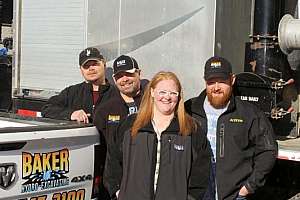
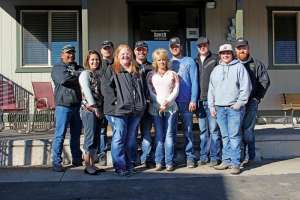
Kenny and his brother Kevin worked at the sawmill along with their dad, while younger siblings Wendy and Allan grew up around it.
Their father passed away in 2000, and the family lost control of the sawmill the next year. The four siblings were forced to find other work, but after 10 years in separate jobs, they joined forces again to start Baker Hydro-Excavating, based in Mountain View, Wyoming.
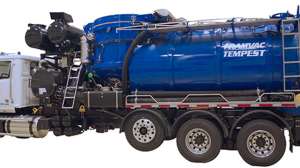
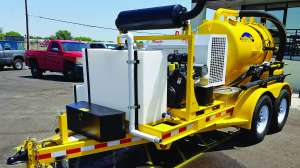
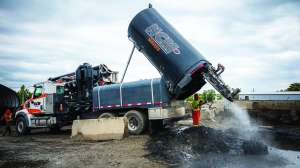
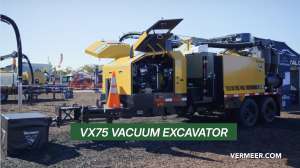
The company started doing work in the oilfields with just one hydroexcavator, but by mid-2012 there were five trucks in the inventory. Now, the company also does utility and construction work and the fleet includes 11 hydroexcavators and 13 support trucks.
FINDING NEW WORK
After the passing of their father, Baker and his siblings — Kevin, Allan and Wendy — had to relinquish control of the mill to another family who also had ownership in the business.
The family members picked up new jobs — Kenny and Allan in nearby mines, Wendy as a certified nursing assistant and Kevin with several hydroexcavation companies.
In late 2010, Kevin approached Kenny with an idea to start a hydroexcavation business. He talked it over with the rest of his siblings and wheels went into motion. “It was scary starting something new,” Baker says. “Our mom had received a settlement from the sawmill business, and she allowed us to use a portion of the money to start this business. It takes a lot of money to get started in this work.”
They purchased their first hydroexcavator in November 2011, and business took off from there. “We decided as a family that we would get one truck and see how the business went,” Baker says. “Within a month, the demand was so high that we purchased our second hydrovac. We had to stay ahead of the work.”
The company steadily expanded to 11 trucks and now has a second location. Besides its headquarters in Mountain View, Baker Hydro-Excavating has a satellite office in Casper, Wyoming, run by Kelly Webb. The company works throughout Wyoming, Colorado and Utah.
OILFIELD TO UTILITIES
At startup, Baker Hydro-Excavating found itself in the middle of an oil boom, making that industry an obvious focus.
“Oil and gas are still our biggest industries served, but we go to a lot of the mines and do a little work there,” Baker says. “We work with utility companies and we do work for the local highway department.”
In the oil and gas industry, Baker Hydro-Excavating does jobs such as rig cleaning, pit cleaning, pressure washing, oilfield tank cleaning, waste removal, remote digging and hot-oil services.
“I found more and more as we worked in oil and gas that we needed to diversify,” Baker says. “Oil prices just tanked out, a lot of people are struggling and oil companies are holding off on projects. We wanted to diversify a little bit more so we didn’t have to rely totally on the oil and gas industry.”
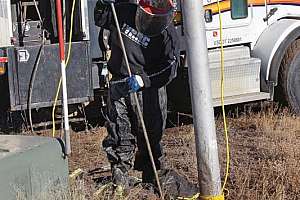
In utility work, the company does slot trenching, daylighting and culvert and cattle guard clean-outs. Cattle guards are obstacles used to prevent livestock from passing along a road that cuts through fencing surrounding a piece of land. The cattle guards consist of a depression in the road covered by a grid of bars or tubes, normally made of metal.
“Throughout the year, water and dirt accumulate in the culverts and cattle guards, blocking the flow of water or filling in under the cattle guard,” Baker says. “We get called out to clean the debris that has settled in the pipe. We have a rotating head that propels itself through to clean out the pipe.”
Baker has seen the popularity of hydroexcavation in utility work grow over the years as a safer option than conventional digging: There are so many lines underground that it is more efficient to use the hydroexcavators.
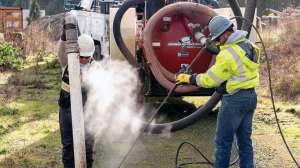
“Every day, more and more contractors are striking lines when they dig with a backhoe or shovel, and the lines break,” Baker says. “That will cost the contractor a lot of money. With us, we use pure water pressure, and it won’t break the line if it’s done properly.”
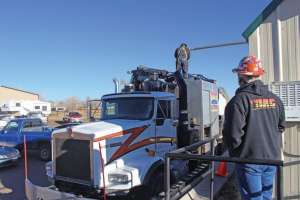
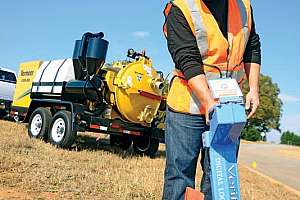
Hydroexcavators also enable crews to use the hose to get in where backhoes and other large equipment can’t reach. On a typical workday, the company has all of its hydroexcavators in the field with two-man crews in each truck. The number of units in the field does depend on the client demand.
“Lately with the oil and gas prices the way they are, we’ve been running four to six crews out there a day,” Baker says.
FINDING TOUGH JOBS
A focus on hydroexcavation can bring some challenging jobs. Recently at a compressor station company crews were hired to expose 32 natural gas lines running into the station and find the main power line to it. “We were asked to get this done in two days because it was where all the lines from the wellheads were running into,” Baker says. “They didn’t want it down very long because it would shut down the wellhead then.”
Another problem at the site was mobility: The site was fenced in with barely enough room for trucks to move around. The company had five trucks digging, each one taking a section and exposing the lines within it.
“The debris was clay with some hard shale that we dug through to expose the lines,” Baker says. “We were able to get it all done in time and it took a lot of teamwork.”
Another recent job had the company digging holes for cement pillars. The client couldn’t get a drill inside the location where the pillars were to go. Baker Hydro-Excavating crews remotely dug the holes using the hydroexcavator’s hoses.
“The pillar holes had to be precise so they could pour in the cement,” Baker says.
SAFETY BRINGS WORK
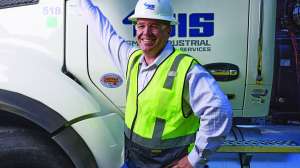
A big part of landing clients for Baker Hydro-Excavating is the use of services such as ISnetworld, Veriforce and PEC Premier — companies that track contractors’ safety compliance certifications. Potential clients can look up contractors through those services’ websites.
“A lot of the companies we work for require us to have one of those three services,” Baker says. “These companies are a resource for prospective clients, informing them about your company.”
Employees who work in the field must undergo Safeland training before even stepping foot on a hydroexcavator. The company also requires employees to take part in weekly safety meetings and conducts daily job safety analysis reports on each job.
“We take the safety of our workers and the others on location very seriously,” Baker says. “Safety is our top priority.”
The company puts new employees through several weeks of field training with experienced crews.
“If a greenhorn comes in with no experience, he will go with a crew of two and work with them for two weeks until he feels comfortable running that whole truck and knowing the safety procedures,” Baker says. “Before he can go out on his own, he must demonstrate to us that he can handle it.”
SLOWING DOWN
Now that the company has grown so fast in just four years, Baker says it’s time to slow down: “We don’t want to grow too fast. We want to settle down, and the goal is to get everything paid down.”
The company was scheduled to get three or four new trucks in the near future, but decided to wait until the market settles — especially on the oil and gas side. In the meantime, Baker plans to implement a “How’s My Driving?” incentive for the employees. If they receive a good review from a customer, they’ll receive an award.
“Our employees are a big part of our growth,” Baker says. “They do their job in a timely manner while keeping safety in mind.”
Baker believes the hydroexcavation industry is still in its infancy in the U.S., and he’s excited to see what it becomes: “In this line of work there are going to be a lot of changes with how hydroexcavators are used. There are a lot of utility lines and pipelines going in the ground, which makes it perfect for hydroexcavation work.”