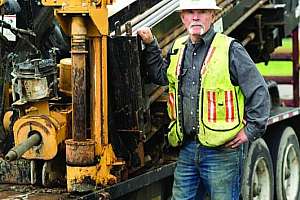
“I’m 60 years old and I jump out of bed every morning,” says Chuck Ulmer, owner of Ulmer Contracting in Coquitlam, British Columbia, Canada. “I love it.” Originally a carpenter by trade, Ulmer says his construction background served him well leading up to his current line of work in underground utility drilling.
“Carpenters are supposed to be well-rounded, where they know everybody’s trade so they’re able to do a little bit of everything,” he says, and this has informed his own philosophy now that he owns a company. “When you’re a good crew, you should be able to do a little bit of everyone else’s job.”
Prior to branching off and beginning Ulmer Contracting, which specializes in traffic light installations, upgrades and utility locating using trenchless technology, Ulmer says he hired the first directional driller in British Columbia while working for Kingston Construction — a general industrial contracting company that handles major infrastructure projects including bridges, port facilities, hydroelectric stations, and water treatment and wastewater facilities.
This directional driller had more than enough work to keep him busy, Ulmer soon noticed, so before long he decided to join in and learn more. After Ulmer finished up at his day job he went to work for the directional driller at night. “I figured this is the way to go,” he says, “and I eventually started my own business.”
REVAMPED CLIENT FOCUS
Founded in 1998, Ulmer Contracting rode the wave of work available at that time. “That was when fiber optics were rolling pretty big,” Ulmer says. “Everybody bought a drill and away you go. Drill on.” While there are now plenty of companies throughout North America that handle directional drilling, there aren’t all that many that specialize in it, according to Ulmer, but his company does.
Over time, the fiber optics related work has faded away, but Ulmer Contracting has become the go-to driller for several municipalities in the Greater Vancouver area, where the focus has turned to going underground and installing pipe as cheaply as possible in order to compete with open-cut methods, which Ulmer says are becoming costly.
Currently, Ulmer Contracting is signed up with six area municipalities and has experience handling construction related to water, sanitary, storm, sewer, natural gas and telecommunications projects. Civil construction contracts have led to work modifying and rebuilding existing intersections, building new intersections, installing and upgrading traffic and street lights, and installing sidewalks.
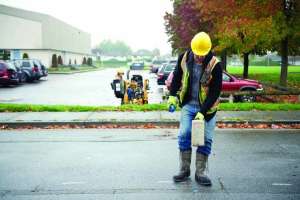
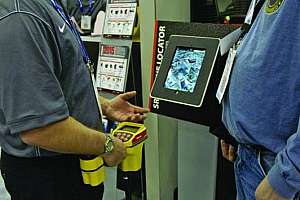
Underground utility locating and daylighting round out the company’s line of services. Ulmer Contracting is able to perform utility investigations and reports the location of buried utilities using advanced magnetic field detection technology in order to prevent the types of missteps that could lead to destruction, injury and even loss of life.
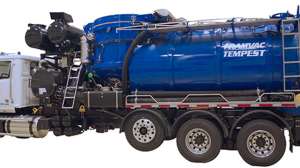
When even more precise depths and locations are needed, nondestructive excavation methods such as daylighting are utilized. For this type of work, the company utilizes a Vac-Tron 850-gallon diesel unit and a “brand spanking new” Vactor.
SERVICE AND QUALITY
The focus on meeting the needs of municipalities has served the company well in a number of ways, Ulmer says. Getting paid and getting paid on time is important, and that hasn’t ever been an issue while working for cities. In addition, it has essentially eliminated the need to seek out work.
“I don’t have to bid very much work out there,” Ulmer says. “I just wait for the phone call. I don’t chase work. I haven’t chased work in 10 years.” In fact, he estimates that about 80 percent of their jobs come by request, and the company has developed long-term relationships with a number of entities such as Cobra Electric, PW Trenchless and Fraser City Installations, to name a few. “They only hire me,” he says, “and they’ve only hired me for years.”
There’s a catch, though, Ulmer says. This type of dream-like setup with regular work rolling in consistently doesn’t just happen by accident. “You’ve got to be extremely good,” he says, “and I’m extremely good.
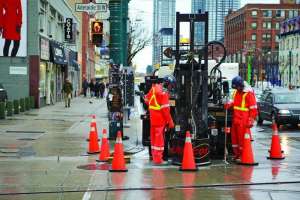
“The other day we just put a 12-inch line and a 16-inch line in with a wee tiny machine in downtown Vancouver,” he says. It was 11 feet deep coming out of a building and going into the sanitary and the storm. “They didn’t have to even close the lanes. We opened up both sidewalks and kept the traffic going. It’s on a major bus route with overhead trolleys and all of that.”
This ability to minimize the social costs associated with open-trench installations such as the disruption of traffic flow or damage to roads and sidewalks is important, and Ulmer says his crew’s work ethic is part of the secret to the company’s success. “We get phone calls in the middle of the night, and we get stuff done,” he says. “When they pull the trigger, the gun’s gone off and I’m off to the racetrack. I’m going to get it done for them. They can’t stop us once they say go. That’s the way we run.”
The other essential ingredient, he says, is the quality of their work, which is in stark contrast to a number of other fly-by-night companies that have popped up and then quickly disappeared. “There are four contractors who went broke here in town and shut their doors,” Ulmer says. “They thought the machine was a money-maker. Well, it is, if you do it right.”
Although inexperienced drillers can be cheaper at face value, he adds, they are not necessarily cheaper in the long run because of the extensive damage that can be caused by hitting existing utility lines.
CHALLENGE ACCEPTED
Some of the main challenges faced by Ulmer Contracting include changing ground conditions and working around a network of existing utilities. Some get into ground conditions that they can’t get out of, he says, but as time goes on the equipment has evolved to the point where it has become more and more possible to tackle these tough environments.
During drilling operations, his crew has the ability and expertise needed to change the drilling fluids right along with changing earth conditions. “If you can do a tough job in tough ground, I kind of like that,” he adds. “The machines are so capable nowadays.”
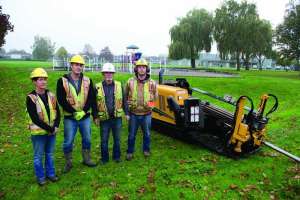
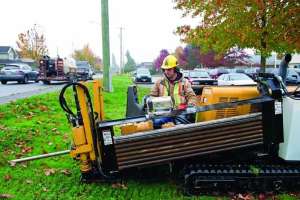
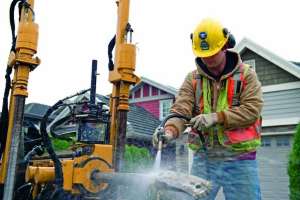
To get the job done, Ulmer Contracting relies on Vermeer horizontal directional drills, including a 9x13 and 20x22; the company recently sold off its 24x40. The self-contained rigs are each capable of bore lengths of all sizes up to 1,000 feet of 10-inch-diameter HDPE pipe. A Komatsu backhoe rounds out the list of company equipment.
Ulmer says when it comes to his machinery, he ensures that they are cared for and respected above and beyond the norm. All electronics are sent in for regular calibration, maintenance and updates on software, and on-grade installations are completed with added accuracy using the company’s survey experience and procedures.
“Nobody looks at them except for dealerships,” he says. Although he admits he may pay a higher cost at dealerships, Ulmer says if a mistake is ever made it’s corrected without question. He also says he appreciates the 30-year relationship he’s been able to develop with his go-to dealership.
EXCITING WORK
Despite the get-it-done attitude and work ethic the company brings to its customers, Ulmer says when he considers the culture of his company, enjoyment is top of mind. “We have a lot of fun,” he says. “The staff members know one another well, and there’s a family-like feel that’s developed over time.”
Part of this translates into helping others have fun as well, he explains. When kids come up to take a look at the equipment, for example, he’s quick to hand out a sticker and a traffic bag. “They have a blast with it. They love that stuff,” he says. “Curiosity is unbelievable for these little fellas and girls.” It’s one thing to see the machines from afar or to see pictures in a book, he says, but seeing it up close and personal is a whole other ballgame. “I think that’s what really gets them going.”
Ulmer’s own sense of curiosity and adventure has been kept alive and well through the chance to continue to take on new and inventive projects. The company is being called upon to see if they can get a small machine into a small hole in order to handle a large job, for example. “It’s tough and you need combinations of stuff,” he says. “You’ve got to work with people to do that.
“I really like the feeling I get when I receive calls from contractors to do unique jobs,” he says. “I’m even getting calls to try new things to see if it works.”
It’s that type of challenge and the excitement that goes along with it that continues to keep Ulmer and the rest of his crew jumping out of bed every morning.
Small Package, Big Delivery
When asked which piece of equipment he has come to rely on and appreciate most, there’s no hesitation in Chuck Ulmer’s reply: “The 9x13,” he says. “The guys love it. They’d rather take that out there than all the other drills I’ve had. They just grab the 9x13. It’s small, it’s light and it’s easy. Everything you do is just easy.”
The Vermeer D9x13 S3 horizontal directional drill features a Kubota V1505-T-E4 diesel engine and boasts 9,000 pounds of thrust/pullback power along with a rotational torque rating of 1,300 ft-lbs. Standard features include a breakout system, stakedown system, strike alert, remote lockout and operator presence.
A 26 percent increase in carriage speed over its predecessor means shortened cycle times and enhanced productivity. A maximum ground drive speed of 3.5 mph — a 37 percent increase over its forerunner — makes it a class-leader in that category.
“I do millions of dollars worth of work with it,” he says. “It’s just a small little piece of equipment, but if you put it in the right ground it’ll do anything you want. Anything. We just put a 16-inch plate in downtown Vancouver with it. What can I tell you?”