Here’s the latest scoop from the nation’s capital: Quality Pipe Cleaning is on the job, digging into things, exposing hidden failures, righting wrongs and generally trying to make systems come clean. It’s a big job, Washington being Washington, but after 31 years in the trenches, Quality Pipe knows a thing or two about dirt.
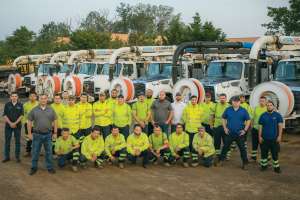
And business is good. Essentially a one-man operation when Thomas Buchwald launched the company in 1990, the Sterling, Virginia, company now has a dozen hydrovac trucks rolling to jobs each workday. In addition, five closed-circuit TV system vans are kept busy. One municipality has just contracted with the company to perform a three-year video inspection of its pipelines.
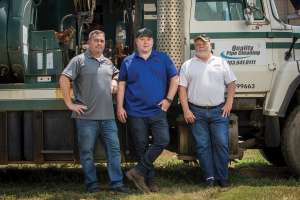
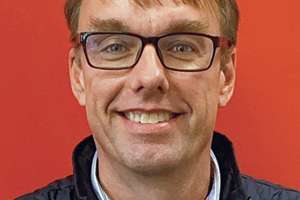
“We’ve experienced steady growth,” says Eric Tyler, company president. Buchwald brought Tyler on four years ago and has pretty much turned over day-to-day operations to him. The operations range across the region, including parts of Maryland, Virginia and West Virginia, as well as the District of Columbia.
Yes, recent calls have been to the White House, the Pentagon and other storied venues, but the company’s trucks and vans are just as apt to be working on a municipality’s storm drainlines or sewer infrastructure at a data center. There is no shortage of work opportunities for the company — primarily government, institutional and commercial. Residential jobs are limited to new construction site work.
WORKING WITH TECH
This being the District of Columbia, every small business in the metro area is somewhat insulated from the economic ebb and flow that roils most other regions of the country. The seat of federal government is mostly immune to downturns. That stabilizing factor is augmented by such economic engines as thousands of technology companies in northern Virginia.
In Loudoun County alone, structures for data centers total 25 million square feet.
“Those centers have a lot of underground infrastructure and sensitive underground facilities,” Tyler says.
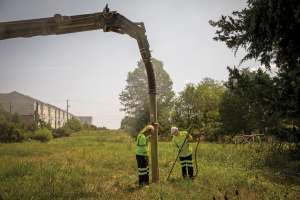
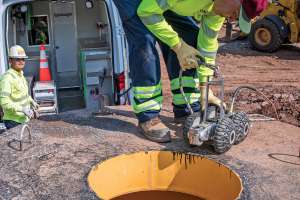
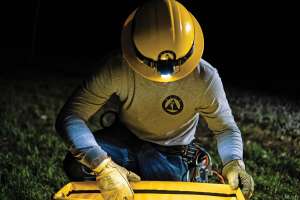
Quality Pipe was called to video one of the center’s sanitary sewer lines and determine why there was a flow issue. Tyler sent out a crew, who in turn sent one of its Envirosight sewer inspection cameras into one end of the line. It encountered rock. Sent in from the other end, the video result was the same. Rock. To get to the bottom of it, Quality uncovered the area of flooring above where the obstruction was discovered and hydroexcavated down to the level of the pipe.
“It turns out there was no pipe,” Tyler says. “When the center was constructed, two contractors laid the pipe from opposite directions. Somehow, they both missed laying about 30 feet of line. That’s why the center was having an issue: no pipe. We excavated the area and one of the contractors was called back to complete the job.”
POWERFUL EQUIPMENT
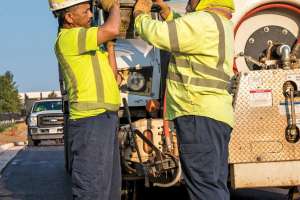
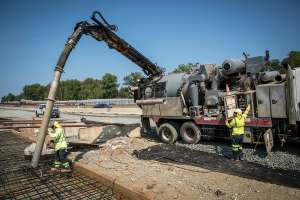
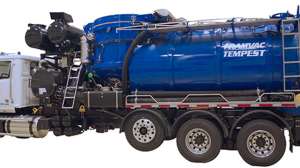
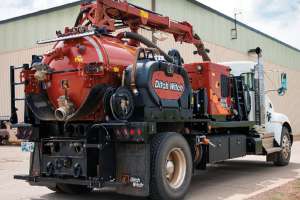
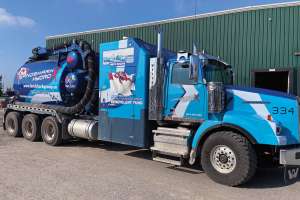
Three-quarters of Quality Pipe Cleaning’s overall work uses its hydrovac equipment. The rigs are employed in diverse ways. Ten of the firm’s 12 trucks are combination jetter-vacuum units. While those trucks are configured similarly — with front-mounted hose reels and a hydraulic boom, for example — they each are outfitted to perform certain kinds of cleaning jobs.
“Some have six-cylinder auxiliary motors, instead of four-cylinder, producing more power for deeper or longer excavations,” Tyler says. “Some have 120 gpm water pumps versus 80 gpm pumps. Two of them are designated hydroexcavation trucks.”
And two of the rigs are special-built “HyRail” rigs adapted for use on railroad tracks.
“We drive them on the tracks for ballast removal or for cleaning pipes next to the tracks or to find a utility line along the track,” Tyler says. “We do a lot of that and work for all the big railway companies in the area.”
Tyler adds that he hasn’t seen any other cleaning company’s HyRail trucks in the area. “I think we’re the only one doing it here. I know this for sure: Vac-Con has only built three of the trucks and we have two of them. The third one is in Canada.”
Quality Pipe Cleaning’s relationship with Vac-Con dates to the very beginning. The company’s first brand-new truck purchased was a 1995 Vac-Con V390 sewer-cleaning rig with a 1,000-gallon water tank and a nine-yard debris body. Though the truck is still runnable, it’s parked outside the company headquarters today as a reminder of the company’s roots.
No other brand of hydrovac truck besides Vac-Con has ever carried the company’s logo, according to Tyler. Why the loyalty?
“Vac-Con always is willing to work with us, to design new equipment for us,” he says. “When we’ve had a problem and needed some help, they always were there for us. We’ve been with them a long time. When they sold their first couple hundred trucks, we were buying some of them.”
Tyler and other company executives periodically travel down to the Vac-Con manufacturing facility in Green Cove Springs, Florida, to talk about engineering issues. One such trip was scheduled in October to check out a new piece of technology. Company reps also visit Florida whenever an ordered truck is being assembled.
“We see the truck as it’s built,” Tyler says. “We watch the features we’ve asked for being installed. A lot of the standard stuff Vac-Con offers on its products were first designed for our trucks.”
An example of that is the option a customer has of removing a hot water heater. Tyler asked that the heater be removable in summer months, Vac-Con developed the feature and now offers it to all its customers.
WORKING WITH THE CREW
A company begun with a single employee has, on average, hired three or four people each year to fill positions — when Tyler can find qualified candidates. The trades workforce complaint is a familiar one.
“I could take five or six more people right now,” Tyler says. “I just can’t find anyone who wants to work. We have the equipment and the workload. The missing piece of the puzzle is equipment operators.”
On the other hand, retaining employees is not a problem. The company still is small enough that it can take care of employees in a personal way. A few weeks back, employees and executives went together to a DC United professional soccer game, with reserved seats close enough to the field to let workers meet the players.
“We treat our employees very well because we’re still kind of a mom-and-pop shop. Anyone can walk in my office or Tom’s office and talk with us. There’s no hierarchy. I’m president but I’ll go out and dig a hole just like anyone else,” says the 33-year-old executive.
In fact, before he joined Quality Pipe, Tyler was an active competitor of the company. He’s worked in the industry in northern Virginia since 2008, operating a hydrovac truck for several years. He also was a truck mechanic, so he knows the nuts and bolts of the business.
Why company operators are comfortable with the president is easy to see. Just as evident is the esteem in which the president holds his crew. “It’s all about our employees and their dedication. They come to work every day and give 110%,” Tyler says. “They believe in doing quality work, Quality Pipe Cleaning wouldn’t be where it is today without them.”
Where the company is today is coming off the best year in its history — because of or despite the pandemic, no one can say for sure. It has become the dominant hydrovac company in the metro area, according to Tyler, partly because larger national outfits with a presence there generally focus their work on routine pipe cleaning.
Whereas Quality Pipe Cleaning has carved out a higher profile niche doing difficult or extreme excavation tasks. “We sort of specialize in taking on off-the-wall hydro work while other companies prefer to locate lines and perform miscellaneous small excavations,” Tyler says. He adds that the company is not the lowest bidder nor the lowest priced, “but we’re comfortable with that. We frequently get calls from customers asking us to go in and get a job done right after a low bidder has worked on it.”
CONTINUED GROWTH
This reputation as a problem-solver seems to be working for them. The company headquarters was moved across town two years ago to a nearly five-acre property with a 6,000-square-foot headquarters building and a 7,500-square-foot mechanics shop. A second warehouse and office were opened in Maryland so the company could more easily service municipal hydroexcavation accounts in that part of the service area.
Now, with a market growing south of the metro area around Fredericksburg and Virginia Beach, a transition to the Tidewater area might be in the offing, perhaps with a satellite office in Richmond. A transition in ownership might also occur in the relatively near future, with the founder cutting back his involvement and the 33-year-old president preparing to take the reins.
With inflation heating up and other economic indicators wavering, this might not seem like an ideal time for business expansion. However, Tyler is confident that Quality Pipe Cleaning is well-positioned to weather whatever comes. “I’m not too concerned about it,” he says. “We have a good amount of contracts. We’ll be all right.”