One definition of growth might be this: 533% in five years. Or one could express the same thing another way: Pro-Vac. The Puyallup, Washington, underground infrastructure maintenance and hydroexcavation company is experiencing startling growth and not at all by accident.
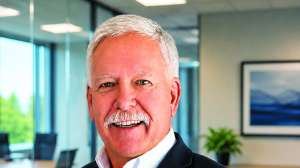
“When I took over, we had about 75 employees,” says Graham Gill, Pro-Vac’s CEO, citing the numbers behind the 533%. “Now we have about 475 employees. We had 30 hydrovac trucks. We’re now at 150 vac trucks.”
Almost as significant a growth indicator, though not as statistically impressive, is that the firm now is operating in 11 states in the western half of the country, up from two states (Oregon and Washington) in 2018. It has employees and trucks meeting the needs of customers in Wyoming, Colorado, Kansas, Oklahoma, Texas, New Mexico, Louisiana, Arkansas and Mississippi, as well as the two original states.
All of that didn’t just happen. The growth was by design. Gill says expansion has been in the forefront of his mind since he moved into the CEO position five years ago. “What the company was doing was really exceptional, as far as offering a full suite of infrastructure services, and I wanted to expand it across the country.”
What puts an exclamation point on his expansion of the company footprint is that it mostly has occurred in the last two years. “The company had made a name for itself in Washington and Oregon and I built upon that reputation during the first three years after I became CEO,” he says. “Then we began real expansion into other areas in the Northwest and the Southwest.”
A final relevant observation is that much of the Pro-Vac growth has occurred during the COVID and post-pandemic years that impacted business cycles. According to Gill, the Seattle metro area was among the first to be impacted by the virus and the ensuing disruptive response. Pro-Vac did experience an initial slowdown in the April-May 2020 period, but it was a short-lived downturn. “We continued to see growth during 2020-21 and 2022.”
The Pro-Vac juggernaut kept rolling along.
BUILDING UP
Two brothers, Mike and Steve Olson, started Pro-Vac in 2002. It began as a service company offering sewer and wastewater pipe-cleaning and CCTV inspection. Those were still the principal company services when Gill joined the firm as a laborer about 15 years ago. He worked himself up to supervising projects before moving over into sales, being promoted to sales manager and, eventually, becoming general manager.
The family business became an investor-owned enterprise in 2016 and two years later Gill moved into the top spot upon the retirement of the owner and founder. His systematic transformation of the local/regional company began in earnest. He is 39 years old.
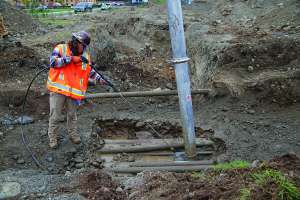
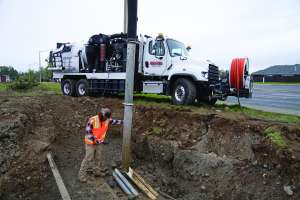
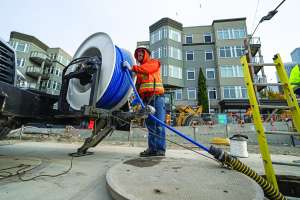
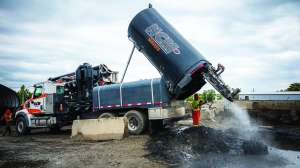
Hydroexcavation entered the picture in 2010 and has grown into the major component of Pro-Vac’s book of business. “Hydroexcavation work continues to grow,” Gill says. “The way contractors are digging, having less space than before in which to dig, and doing it all without a dump truck, that all leads to hydro.”
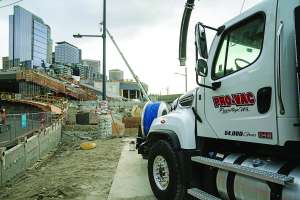
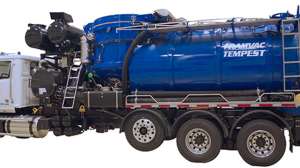
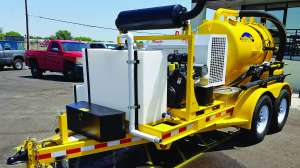
Of the 150 trucks in the Pro-Vac fleet, 65 are Vac-Con combo trucks, The remainder are reserved for hydroexcavation and are a mix of Vactor and GapVax manufacture. Generally, the rigs have debris bodies with 10 to 12 cubic yard capacity. In addition, Pro-Vac has seven air-vac trucks for when dry debris is preferred for customer reuse.
The company’s move out of exclusively the Pacific Northwest and into climes as different as Denver, Colorado, and Austin, Texas, had some impact on how the trucks are set up to operate. For example, the Rocky Mountain elevations in Colorado and Wyoming brought the need for boiler units in some of the trucks to keep water from freezing. Because different soils impact excavation, cutters became more specialized to locales.
“The trucks are pretty universal though,” Gill says of the fleet. “We try to max it out (in configuring the trucks) across the board and then dial it down in softer soil.”
For the CCTV work, Pro-Vac relies on CUES cameras and systems, with the gear spread among a dozen camera-inspection trucks. In its pipe coating projects, Epoxytec and Strong-Seal (The Strong Company) are the go-to products. Jetter heads vary among the excavation trucks according to operator preference.
ACCELERATED EXPANSION
One of the customer appeals of Pro-Vac, says Gill, is the sheer variety of services offered. Yes, hydroexcavation is the mainstay, along with pipe jetting and inspecting. But the gamut of services also includes, among other things, street-sweeping (the gutter debris eventually finds its way into sewers, after all), water containment tanks on construction sites (another contributor to sewer flow) and such relatively exotic products as cathodic (anti-corrosion) protection systems for underground pipes.
All of these newer services came through acquisition of existing companies, most of them in Oregon, Washington and Colorado. “We wanted to create a larger suite of services, so we brought on a sweeping services company. Temporary storage tanks were advantageous for us, so we started acquiring those tanks and then invested in a company with an existing customer base for them,” Gill explains.
While organic growth of existing services has been strong, consciously looking for companies to acquire has accelerated the company’s expansion, according to the CEO. “Having a skillset that would benefit them, we’ve reached out to other good companies and invested in them as part of Pro-Vac.”
This has been a winning formula for Pro-Vac: A respected company investing in other respected companies — some of them having been around longer than Pro-Vac — at the same time building out its native client base. With hydroexcavation as its foundation, the firm has in this way constructed a framework of services that is scalable and viable in a variety of urban and industrial markets.
MAINTAINING THE CULTURE
One danger for any company that augments organic growth with inorganic growth — that is, that absorbs other companies — is that the original character of a company can be lost. Sometimes an original culture is diluted that way and a standard of performance eroded. Gill says the opposite has occurred with the growth of Pro-Vac.
“We try to create and maintain our culture,” he says, but it is not a static system. “Sometimes we look at other businesses and find they are doing something a better way, so we mesh it all to create a new Pro-Vac way, our way of selling a job, booking the work, dispatching, maintaining — we try to standardize all of that and hold people to our expectations and our standards. We have seen a lot of success doing that and it still evolves as we grow.”
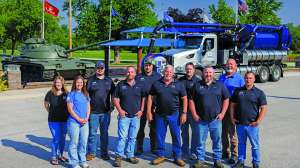
He notes that bringing new companies aboard really means bringing in new people. “We are building this company off of the great people we have working here. They are what makes Pro-Vac the company it is. Since I’ve been here, we’ve grown from 30 people to 475. That’s a lot of talented individuals coming into the company,”
So, the Pro-Vac way: What distinguishes the firm from its competitors? Besides the employees who comprise it, Gill cites two things: quality of work and the variety of services it offers.
“We really are a one-stop shop. It’s easier for a vendor to call on a third party to do it all — hydroexcavate and clean the pipe and run a camera through it — than to call two or three people. We also try to build relationships with customers by getting out front to meet their needs. You know, ‘What do you have coming up and how can we do different things with our equipment to make your job easier?’ The quality of our work and our partnering with customers is driving our success.”
THE END GAME
Growth brings challenges, of course. The company now must manage 13 branch offices scattered among several states, for instance. But growth also has energized the company, the CEO says, by bringing in people with fresh ideas and different angles on approaching challenges, a vitality that replenishes itself day by day.
Gill acknowledges that the company’s endgame is to expand across the country.
“Our ability to grow and flex separates us from some other companies in the industry,” he says. “Through organic and inorganic growth, we want to continue to move our operations down the West Coast, into the central states and on to the East Coast. We are looking for the right opportunities to keep growth in the forefront.”