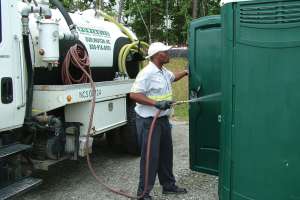


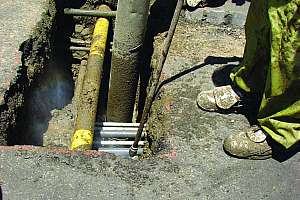
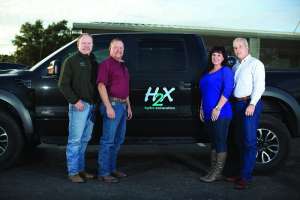
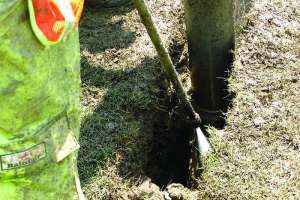
Watching Kelly Clark cut an inspection trench with a 2,200 psi vacuum tube and water nozzle, it’s difficult to imagine him in a suit and tie trying a case in court. But it was his job as a lawyer that led him to start H2X hydroexcavation in 2000.
Instead of advising a client to sue for unpaid invoices from a contractor, Kelly recognized the lack of competition in a promising market and partnered up with the client to start a hydroexcavation business. It didn’t take long for Kelly’s brother, Mike, to leave his 25-year television career. A year and a half later, the Clarks bought out their partners and have been running H2X ever since.
Though there is some crossover, Kelly, the COO, maintains the operations side and works in the field. Mike, the CEO, covers the administrative and office end of the business.
Turns out Kelly – who calls himself a recovering attorney – had good instincts. The company has grown to 70 employees and 30 trucks working in locations all over the Southwest and into other regions of the country.
Selling themselves
The jump from courtroom to construction site wasn’t as dramatic as it sounds. The Clarks come from a three-generation oil family.
“When I was 17, I started working derricks on a drilling rig,” Kelly says. “That paid my way through college and law school.”
He figured hydroexcavating was a sure thing when he learned how it had boomed in Canada since 1990, and that the industry was just getting started in the U.S. With laborers wielding shovels as the only option in many situations, Kelly knew companies would be interested in a faster alternative that wouldn’t damage underground lines. His first client was BP, a large oil company that had changed its ground disturbance policy in Colorado – any excavation deeper than 4 inches near its facilities had to be hydroexcavated.
“They had line strikes and damage and had seen property damage. They wanted to eliminate that,” Kelly explains.
He credits Neil McLean of Hydro Excavation Consulting for training him how to run the equipment for his first job. Kelly recognized the industry’s potential and shared his enthusiasm with his brother Mike.
“It took a few times of him explaining what this was,” says Mike, who also had worked in the oilfields as a college student. “Finally, after about the fourth conversation, I knew what he was talking about and thought it was a good idea. I was ready for a change.”
He and Kelly exchanged their office clothes for work clothes, and warm offices for the great outdoors at -20 degrees Fahrenheit in January in Colorado.
“Kelly and I said we wouldn’t ask anybody to do something that we weren’t willing to do,” Mike says. “We wanted to see how it works and make sure we understood it and what the issues were because we were going to be hiring more people. We just felt like we needed to be knowledgeable.”
With skills and equipment in place, the only thing needed was customers.
“When we first got started in 2001-2002, we weren’t just selling our business, we had to sell the industry,” Kelly explains. “I put 100,000 miles on my pickup in a year, and it was boots on the ground.”
His strategy often included free demos. He offered two hours of free work, and then the company could send him packing or pay him and keep him working. While the higher per hour cost of hydroexcavation (about four times backhoe rates) initially scares some clients, Kelly explains that it is 10 times faster than hand digging and is cheaper than the wages paid to the laborers. It’s also safer because no one has to go into a hole.
He’s made true believers of many clients when they discover how much money he can save them in losses.
Near misses
“It’s taken awhile for bigger companies to understand that they might spend $800,000 on hydroexcavating this year, but if they hit something, they might spend $5 million,” Kelly says.
He recalls a project where his workers were trenching an area for a big refinery’s addition. Management started getting nervous about the cost and told the crew to stop. Kelly negotiated another half hour of work, and they uncovered a high-pressure fire hydrant waterline.
“Literally, the backhoe was 10 feet from it ready to go. And if we hadn’t done that, those guys estimated it would have cost them between $5 million and $10 million because they would have had to shut down a third of the refinery,” Kelly says. “We made a believer out of them.”
He recalls another company putting in a new pipeline that didn’t believe in the value of the process. Kelly stopped to hand out business cards when he saw a large fleet of equipment and 30 to 40 workers. The next day they hit an oil pipeline, burned up equipment and a house, set a gas well on fire and melted highline wires that put 350,000 customers out of electricity. It was a $10 million day – in the red.
About 60 percent of H2X’s work is with the oil industry, working in the field, at pumping stations and small gas plants.
H2X provides three main services. Workers hydroexcavate holes to look for utility and pipelines. They dig inspection trenches as narrow as 4 inches around the perimeter of areas to be excavated. And they dig pier holes or foundations in areas where safe digging with traditional methods is impossible.
“We can dig a very precise hole, such as a hexagon that’s 10 feet across,” Kelly says. Such holes often become forms for pouring concrete.
He adds there is no cutoff to the size of the project. Hydroexcavation is all about safety and is specific to the area. Bigger projects have included digging a 60- by 90-foot hole 22 feet deep. The job had six trucks working 24 hours a day for 17 days.
Growing the fleet
H2X has grown in plateaus – six trucks for the first three years, then 12 to 18 trucks until the economic downturn. The company held its own for a while, then grew again to the present with 30 hydroexcavators, including a few rentals.
“What we try to do is keep a 10 to 20 percent cushion with rentals. If we have four or five months that slow down, we can send a few trucks back to the rental company. If the growth is sustained, then we order trucks,” Kelly says.
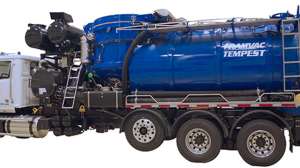
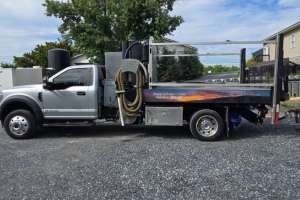
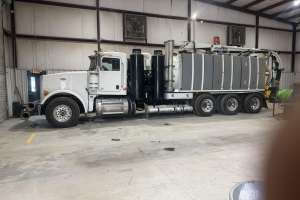
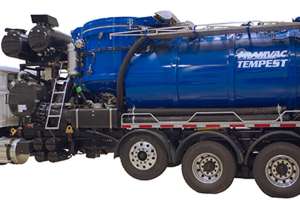
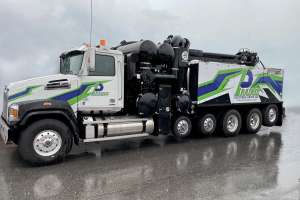
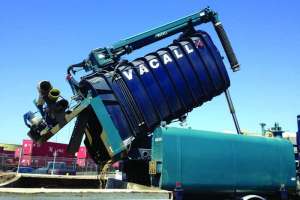
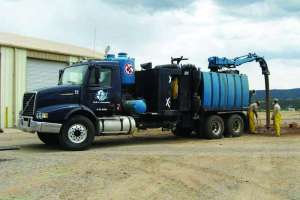
The 10 newest hydroexcavators in the company’s fleet are Vacall units built on Peterbilt 367 chassis with ISX Cummins engines. H2X owns both warm- and cold-weather packages so they can work in the South and in the Bakken and other northern areas. Most of the trucks have 5,400 cfm blowers, General 25 gpm pumps, 12-yard debris bodies and 1,300-gallon tanks. When the nozzle and water flow are set right, the water runs out at the same rate the debris tank fills, usually in about half a day.
The Clarks work on nozzle designs with StoneAge Inc. in Durango, Colo. They have a mix of straight two- and three-jet nozzles and turbo nozzles, which are more suitable for clay soils.
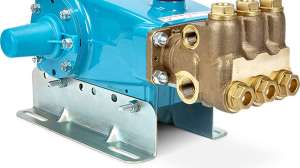
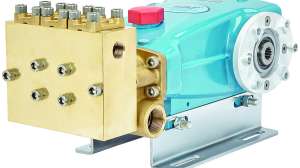
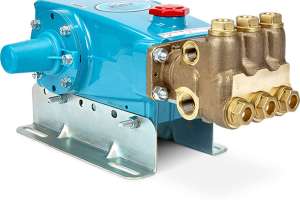
The oldest unit in the H2X fleet is a 2006 Hi-Vac Corporation hydroexcavator on a Volvo chassis with a Cat pump. The Clarks also worked with Vactor Manufacturing to design the HXX, a unit built specifically for hydroexcavating.
The company’s fleet also includes vacuum boxes for projects where material can’t be stockpiled nearby. The company also has low-friction aluminum vacuum pipe for special projects, such as the 4,000 yards of earth they moved to dig tunnels under a nursing home to solve a soil problem wreaking havoc on the septic and plumbing systems. Crew members always wear retractable fall protection gear when working on deep hole projects.
Talented crew
“One of our keys to success is having an employee base that is experienced in many different working environments. They are able to adapt and use what they’ve seen elsewhere to get the job done,” Kelly says. “Some of our guys take it to almost a form of art.”
They take pride in developing skills to combine the right pressure, water volume and movement for precise, efficient digging.
Workers receive specialized training when needed, such as the 40 hours required to work HAZWOPER (Hazardous Waste Operations and Emergency Response) jobs removing contaminated soil. They are trained to follow specific site rules, policies and protocols, such as wearing H2S or four-way monitors when working in the oilfields.
But much of the training is on the job, working with experienced employees.
“We move our guys around on purpose. We’ll have guys in California doing municipal work. If it looks like they are working out, then we send them someplace else like a mine in Casper, Wyo.,” Kelly says.
Some of H2X’s employees have been with the company for a decade. To retain them, the Clarks treat them fairly, pay well and provide health insurance. They are also working on setting up a 401(k) plan.
“Personnel is one of our biggest challenges. We’re competing for the right people with some big names in the oil business,” Mike says. Fortunately many of the workers prefer working for a smaller company where the owners know their employees.
“Both of us know how we want to be treated,” he adds. “We instill a sense of pride in the work we do.”
Because of that, H2X often gets bids based on their workers’ productivity and safety records, not because their per hour rate is less.
Digging into the future
Kelly notes that 70 percent of today’s clients are familiar with hydroexcavation. The rest call because their engineer requires it. Clients learn about H2X through its website, marketing staff and contracted sales people in different parts of the country.
H2X recently built new facilities for its headquarters in Decatur, Texas, to be closer to an airport and opportunities in the Eagle Ford oilfields. They have satellite operations in the Southwest, California, Colorado and North Dakota. While they expect plenty of work in the oil industry, municipal and industrial projects offer diversity. For example, H2X is working on the rail system project near LAX, and they transport trucks on barges to work on the islands off the port of Long Beach, Calif.
“The more people use hydroexcavation, the more they want to,” Mike says. “The levels of liability just keep going up and up. It’s a matter of time before everyone is using it. Canada is already there. We are just at the beginning of a steep growth curve.”
Kelly notes that there are 600 to 700 trucks in Alberta, with a population of only 2 1/2 million people, while Texas has 25 million people and only 150 trucks.
“We just put on one more salesperson, and we’re going to bring in another one, because we see a couple of areas that are ripe, and we’re going to move into those areas,” he says. “I see a 25 percent increase next year.”
Not bad for a recovering attorney and a creative brother.
Continue reading for free