In terms of demand for product and need for employees, the new year is looking good for those in the growing oil and gas industry — or those hoping to enter it. And experts expect wages to follow those trends as well.
Survey results from Rigzone.com showed the majority — 53 percent — of hiring managers in the oil and gas industry intend to hire more energy professionals in the first half of 2014 than the previous six months. That’s up from six months ago when 48 percent of hiring managers said they planned to boost hiring in the back half of 2013.
Economic optimism is a major reason for the hiring increase, but an important factor of wages is, of course, job creation. According to the Bureau of Labor Statistics (BLS), as of October 2013, the oil and gas workforce surpassed the half million mark, with 501,900 workers. In 2013, the industry added 23,000 positions.
“That’s a slower pace than 2011 when the industry added more than 60,000 jobs, but a good sign of continued growth,” says Paul Caplan, president of Rigzone.com, a hiring and recruiting online community for the oil and gas industry.
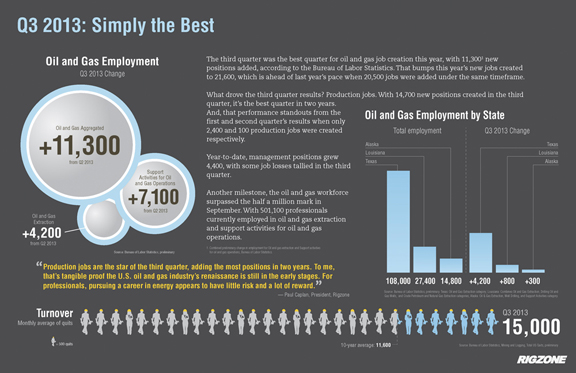
The third quarter was the best quarter for oil and gas job creation last year, with 11,300 new positions added, according to the BLS. What drove those results? Production jobs.
With 14,700 new positions created in the third quarter, it’s the best quarter in two years, notes Caplan. And, that performance stands out from the first and second quarter’s results when only 2,400 and 100 production jobs were created respectively. Year-to-date, management positions grew 4,400, with some job losses tallied in the third quarter.
Caplan credits the growth to the increase in drilling and exploration, also an increase in offshore drilling in the United States. “That’s created a lot more demand for professions in the industry,” he says.
Among those jobs most needed are engineers. In another Rigzone survey, respondents were asked the top 10 jobs they’d be recruiting — eight out of 10 of the jobs listed were engineers, followed by health and safety positions, and finance and accounting.
“You need more advanced education,” Caplan says. “Trying to fill any engineering role is pretty difficult these days.”
Show me the money
According to a Rigzone salary survey, the average annual compensation for respondents in the industry was $98,000 — with results from the last four years hovering between $88,000 and $93,000.
That falls in line with the average compensation listed by region: $94,722 in North America (compared with around $99,000 in Europe and $120,000 in Australia/Oceania). The lowest average salaries outside North America were reported in Asia ($98,399) and the Middle East ($94,000).
The top three positions in terms of remuneration were drilling, geoscience and maritime, followed by management, production and engineering.
Continue reading for free