
Hauling brine water from the oilfields of North Dakota for road dust control could mean extra cash for transport companies — but only if they follow the rules.
A program to allow the use of brine water for deicing and dust control on unpaved roads is in the early stages, says Scott Radig, director of the waste management division of the North Dakota Department of Health. He characterizes the program as barely out of its pilot program stage.
Eastern states — New York, Ohio and Pennsylvania — have already permitted the use of brine water from oilfields to be applied as a deicer on roads based on its chemical composition, application rate and other criteria. However, some local governments have banned fracking and waste disposal, which ultimately prohibits brine water for dust control on roads.
In Pennsylvania, operators, municipalities, road owners or service companies must submit a plan to the state Department of Environmental Protection annually for approval to spread brine water on unpaved roads for dust suppression and road stabilization.
 Pennsylvania pumper Blair Miller and his wife, Sabrena, own Miller Brine & Septic Service, a septic and brine pumping business covering a service territory of a 75-mile radius from the town of Columbus, Pa.
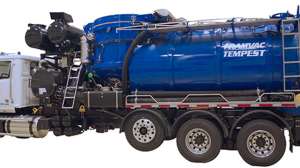
Blair uses a 2012 Peterbilt with 4,200-gallon stainless steel Pik Rite tank service natural gas wells in the area.
“Saltwater brine is a byproduct of the gas wells,” he says in a 2010 Pumper article. “I work with the drilling rigs; I haul in freshwater and haul out salt brine.”
Blair has secured permits from local municipalities to spread the brine on 200 miles of rural dirt roads in the summer to control dust. He uses it on his local racetrack for the same purpose during the Cornfield 500, an annual Labor Day weekend event that draws more than 5,500 people to Miller’s Warren County farm.
Free with limitations
Using brine water to control dust or eliminate ice on roads has attracted the attention of several counties in North Dakota and states nationwide because of a relatively low cost. Applying magnesium chloride to control dust costs $7,000 per mile, Radig says. Brine water is free, though it might require more applications.
Brine water composition varies based on well location and original fracking fluid makeup, and all types have not been approved for this use. “Not all brine is created equal,” says Dave Glatt, chief of the environmental health section of the North Dakota Department of Health.
The health department, after much testing, has approved a handful of wells whose brine might be used in measured quantities on roads, Glatt says. The department will continue testing sites where the brine is being used.
“We didn’t find any problems, and we don’t think we will now,” he says.
Individual counties in North Dakota — or whoever owns the roads where the brine will be spread — must contact the health department for permission, which is similar to states that currently permit the beneficial reuse. Municipalities might use their own workers to spread the brine or hire others to do so. Though road owners are responsible for contacting the health department, companies transporting brine water to or from a well must follow the rules and guidelines.
The upfront expense of a permit to transport or spread brine water is a pittance compared to the price a hauler might pay without it. In North Dakota, the permit costs $75 initially and $25 annually thereafter.
The penalty for not having a permit, should anything happen, is $1,000 per incident per day. “That $75 vs. $1,000 is really cheap,” Radig says.
Before the brine water is transported, it’s important that workers and drivers be properly trained to prevent spills or contamination.
If there is an accident, trucking companies must report it immediately. The company will be responsible for cleanup, but there might not be a penalty, says Radig. It’s important to get the health department involved from the beginning to lessen the impact (as well as the penalty).
In addition to the permit, Glatt reminds transporters that the use of brine water is approved in measured amounts only. “If you spill it in the ditch, that’s not a measured quantity,” he says.
Read more about Miller Brine & Septic Service at www.pumper.com/editorial/2010/02/rednecks-racing.
Continue reading for free