
There’s no doubt Wisconsin has some of the best sand in the world. The state’s Department of Natural Resources knows it — they are even quoted as such in a 2013 article on WisconsinWatch.org relating to the sand mining industry.
According to the Wisconsin Center for Investigative Journalism, which sponsors the website, the Badger State is the nation’s number one producer of sand used in hydraulic fracturing — accommodating at least 124 permitted or operational facilities to mine, process and ship the sand to other states.
With all that mining comes some controversy, of course. Citizens often speak out about possible negative impact on the environment, health, roads and property values. Others, however, laud the growth of jobs. For the mining companies, it’s a balancing act, for sure.
Community perception is a main reason why being a good corporate citizen has become an important and necessary way of doing business for many of these companies.
Among those firms is Badger Mining Corporation, whose roots in the state date back to the early 1900s when the company starting mining industrial silica and bank sand in the Berlin area. The current iteration of Badger, a privately held family-owned corporation, has been in existence since 1979 and has 220 employees and two large plants in Taylor and Fairwater, Wis.
“We’re blessed with the geology here that provides a product in good demand,” says Marty Lehman, associate with Badger Mining. And, he adds, the company can’t just pick up and move. “We’re kind of locked into where the resource is.”
With a longstanding history of successful mining, mainly on the sandy Western edge of the state, Badger is cognizant of maintaining a presence that enhances both its company and the community.
“We believe that we’re a good member of the community,” Lehman says. “When we plan a mine, operate a mine, we improve the environment as we go along.”
Processes change
Larry Beuthin worked in quality control/technical services for Badger for 25 years and is now part of the Emergency Government team in Fairwater, a village of 350 where Badger has a 1,000-acre site.
“I was there early on (early 1970s),” he says, “and Badger Mining has always been very concerned about dust emissions; they’re very safety conscious and developing new technologies.”
In the early days, drilling and blasting may have disrupted some of the area, but he adds, “The process has changed. There is no blasting going on anymore; it’s all hydraulically mined.”
Badger has also mined in Taylor since the 1970s. “They’ve been infiltrated into our community for a long time,” says Taylor Village Clerk Wendy Bue.
Small but mighty
“They’ve definitely been good neighbors; they’ve donated in many ways,” Bue says, including funding the local food pantry, walking bridge and athletic scoreboards. “There was some increase in railroad activity in the beginning, but nothing that outweighed bringing jobs to our area. Losing them would be a big loss to our area.”
Taylor is a small village of about 500 people, so hiring has been a big boon. “The new frack sand stuff is really coming into play in the area; there have been a lot of permits,” Bue says.
While processes may have changed to make the mines more efficient and community friendly, Beuthin says one thing has not changed. “The original owners of the company were always very community oriented,” he says. “It’s kind of a mindset that has carried through.”
Since 1986, Badger has been funding a scholarship program for students intending to pursue degrees in mining engineering, other engineering curriculums or environmental science. Each year, one $10,000 scholarship is awarded to a student in the regions where Badger has a facility. “Our company has been very supportive of education in all areas,” Lehman says.
In addition, Badger has teamed with UW-Eau Claire’s Responsible Mining Initiative, designed to help students learn the science.
Badger was recently awarded the Wisconsin Manufacturers & Commerce 2014 Business Friend of the Environment Award — an award the company also won in 1997 and 1999. This honor recognizes the company’s geomorphic land reclamation at the Taylor plant. Their innovations reduce erosion and water pollution, minimize long-term maintenance and allow for a seamless transition into the surrounding landscape.
“It’s always nice to be recognized for what you are doing right,” Lehman says.
While environmental and land stewardship programs tend to receive notice, Badger also sponsors and runs community programs — the “fun” programs, Lehman says — like walking trails and disability hunts.
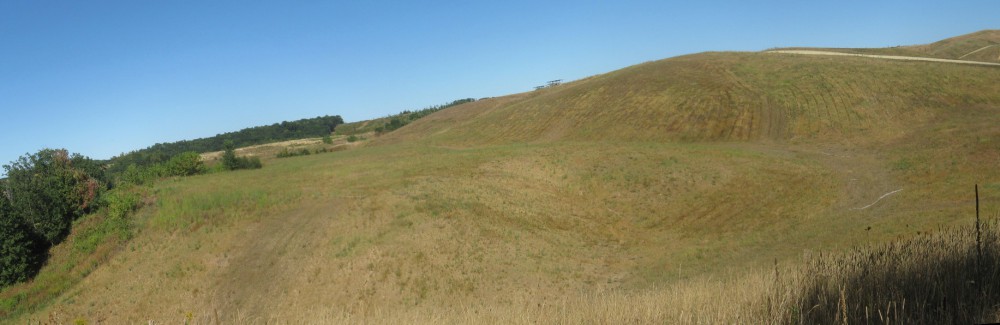
The company’s Berlin headquarters was built on an abandoned landfill, restoring that land. It also offers tours, has created bluebird trails, built wood duck houses and planted prairies at that site and has released trout in ponds at its reclamation site in Fairwater.
Beautification and reclamation, along with community service, have allowed Badger to remain a good neighbor in the Wisconsin communities in which it works. But Lehman says it’s not a mission only for sand mining companies.
“It doesn’t matter if you’re making widgets or mining sand,” Lehman says. “You have to be responsible stewards. Do the right thing, and you’ll be in good shape.”
Continue reading for free