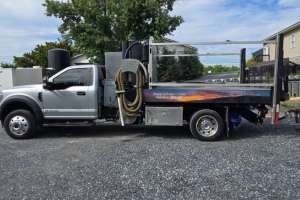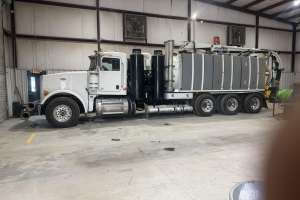


When Dwaine Ruckman decided to take the plunge into hydroexcavating in 2003, he sought three things in a hydrovac truck: reliability, ease of operation and technology that would maximize productivity. He found exactly what he was looking for in Tornado F4 trucks, made by Tornado Hydrovacs.
“The F4s are very operator-friendly, which enables us to train operators quickly,” says Ruckman, the owner of DR Hydrovac in Rosebud, Alberta. The company primarily does hydroexcavation work for pipeline companies, exposing underground utility lines for pipeline repairs or installation of new infrastructure. “The truck’s design is very simple … only two air switches in the entire rig-up and the hydraulic system is high-tech without being overkill, so there are less things that can fail. There’s no need to get fancy when simplicity works well enough. These trucks are designed less for show and more for go.”
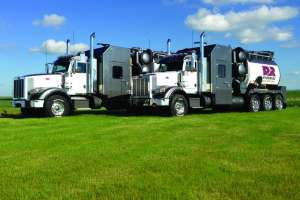
Ruckman currently owns four trucks, all made by Tornado (which is a part of Petrofield Industries, a division of Empire Iron Works Ltd.). In all, he says, he’s purchased nine Tornados in the past 11 years; he typically sells them after six years and says the units retain solid resale value.
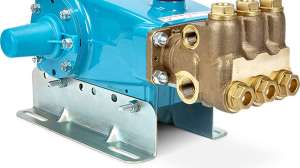
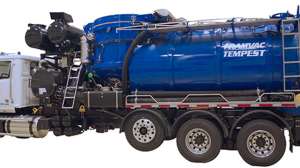
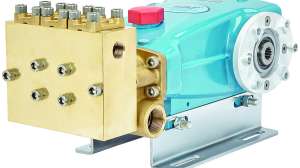
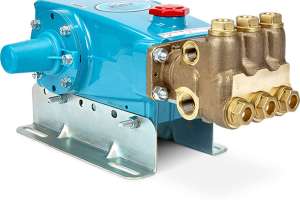
Each truck features a 12-yard debris tank; a blower with vacuum power of 4,000 cfm at 27 degree Hg (one manufactured by Hibon Inc., an Ingersoll-Rand company, and the other by Roots Systems Ltd.); a 2,100-gallon water tank; a 980,000 Btu boiler for hot-water excavating; a Model 3560 triplex water pump made by Cat Pumps (25 gpm at 3,000 psi); a Peterbilt chassis; a Fuller transmission from Eaton; rear tri-axle configuration; and a 26-foot-long boom that can reach 23 feet down vertically and swing 340 degrees.
Ruckman says he prefers larger debris and water tanks, which maximize productivity by reducing the number of back-and-forth trips for disposal and reducing the need to haul water to remote locations.
“I also spec three drive axles in the back, rather than tandem axles, because they allow us to carry more weight,” he explains. “They also provide more traction on soft ground and minimize soil compaction. We often work on private farmland right-of-ways, so we want to leave the ground as undisturbed as possible.”
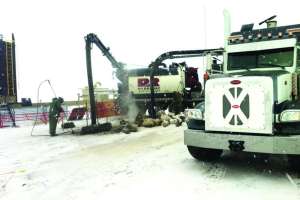
The 26-foot-long boom enables crews to reach locations in tight spots where the truck can’t get close to an excavation site. “The boom rotates from the driver’s side of the cab to the passenger side, which gives us a lot of flexibility in the field,” Ruckman notes. “You can’t always park the truck and work off the back, so that versatility comes in handy.”
Ruckman also lauds the Tornado’s unique debris-removal system. Instead of employing a conventional hydraulic hoist for gravity dumping, the F4 utilizes a mechanical sweep to push dirt and water through a 48-by-52-inch rear door. The sweep provides 50,000 pounds of force and typically empties the debris tank in two passes. To aid debris removal, the floor of the tank slopes down toward the rear. Moreover, this design eliminates the weight added by a hoist, vacuum piping and a subframe under the truck, which allows more payload capacity.
“It doesn’t take any time at all to unload and get back to work,” Ruckman says of the mechanical-sweep system.
The Tornado F4 also increases efficiency because its design eliminates the need to attach hoses or extra dig tubes for hydroexcavating, which reduces job setup time, Ruckman says.
The peak season for DR Hydrovac runs from September through March. As such, the hot-water boiler is a must. The frost zone usually extends down about 8 feet in southern Alberta, where most of the company’s work is concentrated. But the boiler heats water to 160 degrees, allowing crews to keep working in frigid conditions.
When hydrovac trucks break down, the revenue loss is significant, Ruckman points out, plus it can damage customer relations. That’s why he prefers the Tornados, which he says are very reliable. He also likes the fact that, aside from improvement tweaks here and there, Tornado doesn’t radically change the truck’s design from year to year, so drivers don’t need retraining every time the company buys a new unit.
“I build relationships with people I can trust and that can back me up when I make promises to my customers,” Ruckman says. “Tornado builds the equipment and provides the support I need to achieve that. We pride ourselves on being strong, efficient, safe and on time, and we can do all that because of our Tornado hydrovac trucks.”
Continue reading for free