

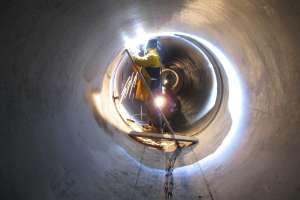
Hard rock and a 4-mile long bore could not keep the joint venture team of Renda Contracting, Southland Construction and SAK Construction from successfully completing a vital water pipeline in the suburban Washington, D.C., area.
Last February, the Bi-County Water Tunnel began carrying 100 million gallons of water daily to Montgomery and Prince George’s counties in Maryland, enabling the Washington Suburban Sanitary Commission (WSSC) to guarantee adequate supplies and pressures to that area in the future.
The pipeline travels 5.3 miles from a WSSC water main at the eastern end to a main on the western end, at depths of 90 to 200 feet below ground, depending on terrain.
WORK COMPLETED
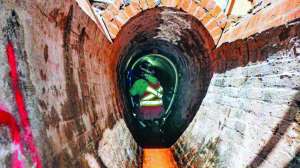
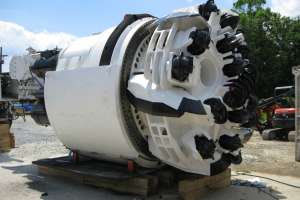
Entry shafts of 25 to 35 feet were dug at each end along with a third shaft a mile from the eastern end. Once that shorter eastern section was bored, crews faced the much harder task of boring the tunnel more than 4 miles from the middle shaft to the western end. The tunnel had a diameter of 10 feet.
Spiral-wound steel pipe sections that were 50 feet long were inserted at the middle shaft, then carried by a specially built railroad to the western end, according to Jim Delmonte, Southland’s project manager.
Installation proceeded back to the middle shaft, piece by piece with Northwest Pipe supplying the pipe. Moving the pipe was Durango Mining Equipment. Welders from National Welding walked back through the pipeline to reach section ends, which were butt-welded together.
The entire pipeline was completely grouted, with the annular space between the pipe and the tunnel wall filled with concrete. Pacific International Grout Company batched the grout on site and pumped it through ports in the interior pipe walls.
A cathodic system protects the pipeline against corrosion, with cables attached to the pipeline wall at the entry shafts and four additional shafts drilled especially for that purpose. At the surface, the cables connect to read-out stations.
At each end the line ties into the water mains through valve vaults, each equipped with a 72-inch gate valve.
PLANNING THE PROJECT
Planning and public input for the pipeline took place in 2004-05. The joint venture (JV-RSS) began digging the first entry shaft in August 2009 and the eastern section (0.8 miles) of the tunnel was dug between July and November 2010. Crews began digging the western section in February 2011, but the tunnel boring machine was taken down for repairs for several months until digging resumed in August 2011.
According to SAK spokesman Scott Linke, the long length of the western section and the extremely hard ground conditions overwhelmed some of the parts and affected the main bearing of the tunnel boring machine.
Digging of the western section was completed in early 2013. After pipe installation and grouting, the line began carrying water last February.
NEARLY DONE
The project was the result of diligent planning and public input sessions. “We looked at a number of alternatives early on,” says John Mitchell, project manager for WSSC. “When we added in all the environmental and community impacts in addition to cost, tunneling became the best option for us to use.”
Cost of the project was about $113 million and was funded through WSSC’s “systems development charge.” Mitchell explains that the fund consists of a development fee the utility charges for new connections. No federal or state funds were used for the project, and the utility incurred no additional debt.
Mitchell says WSSC still has some site restoration work to finish up. “We’ll be back in this fall to plant some trees,” he says. “Overall, we’re very pleased with the results. The new line has already provided us with an immediate increase in supply and pressure as well as the redundancy we needed.”
Continue reading for free