

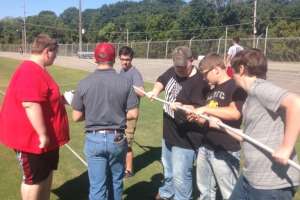
Experience with tools and equipment is valuable for students to gain while in high school. Greg Felkins’ electrical classes at Barren County Area Technology Center (BCATC) in Glasgow, Kentucky, got that hands-on training right at the start of the school year.
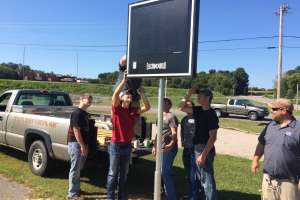
Barren County High School, one of four feeder high schools to BCATC, asked Felkins’ classes to install play clocks on its football field for the upcoming season.
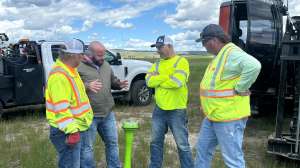
Students worked on all phases of the project, from trenching for the conduit, to running and helping connect the wiring. “It was a pretty big project,” says junior Will Jackson. “It was good experience for us.”
That experience is priceless, Felkins says: “A lot of kids now, in this age of games and phones, don’t get that opportunity. Every time we can put their hands on real tools and real parts, real machinery, it’s a positive.”
THE PROJECT
Leaders of Barren County High School wanted to help its football program by installing two play clocks — a rarity for high schools. They proposed the project to Felkins and his students.
“Anything that’s real, we like to let the kids get their hands on it,” Felkins says. “We’ve wired Habitat for Humanity houses, we’ve worked on projects for the local Boys and Girls Club and other nonprofits.”
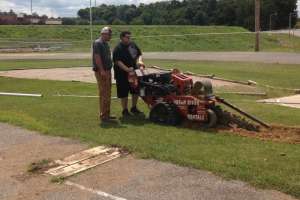
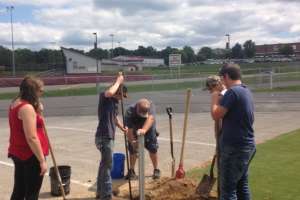
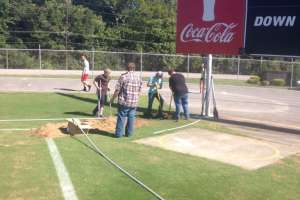
The project, which took four days (Aug. 24-27), began with running a trencher the length of the field and along the end zone. Following the trencher were other students laying CPVC conduit for the wiring.
To run the wire, students used a string blower. They then wired the play clocks with supervision from licensed electricians.
The clocks were used for the first time on Aug. 28 for the football game that night.
Barren County Schools provided the materials and equipment rental, giving BCATC about $600 worth of free instructional material. “We saved in the shop and it saved them probably $1,000 in labor to get it done,” Felkins says. “We were able to get to them immediately instead of having to wait on a contractor.”
USING THE TRENCHER
Learning to use heavy machinery was a highlight of the project — it’s something most high school students never get a chance to do. “Each student got to use the Ditch Witch trencher, a big piece of power equipment,” Felkins says.
Jackson says using the trencher wasn’t as easy as it looked. “It was kind of difficult because it would jerk and hit rocks,” Jackson says. “We were trying to make it look neat with a straight line.” Eventually, it did get easier to control the machine.
Few of the students had used a trencher before; most were intimidated at first. “I had it going and it jumped up and came out of the ground,” says junior Haley Runyon. “But it went back in. It was a little scary, I actually let go of it when it happened.”
Letting go of the machine if something happened was one safety tip Felkins gave the kids. “We told them when in doubt to just let go of the controls and the machine will stop in its tracks and that way nothing bad happens.”
Safety was a priority; students were required to wear safety glasses and operate the trencher with maintenance personnel close by. “We made sure it was done in a safe way,” Felkins says. “We had the students do a walk-around of the equipment first to learn it. Then when they went to use it, we went over the controls with them again.”
Jackson says being able to use the trencher “was pretty valuable to me. I got a lot of good experience out of it and I’ll use it down the road.”
A FUTURE FOR THE STUDENTS
Felkins hopes the work the students are putting in now will help them after they graduate.
“In five or 10 years from now if somebody asks them if they have ever used a trencher, they can say that they have,” Felkins says. “That might set them apart from someone who hasn’t used one, and that’s what we’re shooting for.”
The students enjoy learning about and using the tools. “My first semester, I learned a lot about tools and how to use them properly,” Runyon says. “And it’s a good experience. We get to go out and do jobs a lot. I could potentially get a job out of this class.”
Continue reading for free