
Sometimes the best way to dig differently is to not dig at all.
Trenchless technologies, as the name implies, is a family of means, methods and materials that can be used to install new pipes or rehabilitate and renew existing pipes. As the nation’s aging infrastructure continues to deteriorate and fail, technologies must be employed that can provide long-term life renewal to existing assets but also lower cost and impact.
CIPP, or cured-in-place pipe, has been the leading trenchless rehabilitation method throughout the world for more than 40 years. However, many in underground construction are unfamiliar with a spin on traditional CIPP, which installs a new liner pipe formed inside of the existing pipe in only a localized section of the pipe.
This provides a sectional repair that can extend the usable life of that asset and its value to its owner.
In most cases the most valuable asset a utility owner owns is the conduit, or “hole through the ground” — not the pipe itself. By eliminating the need to excavate a trench, haul material in and out of the project site, and lay a new pipe, cost can be reduced and the impacts to residents, business and commerce, and the environment are greatly reduced.
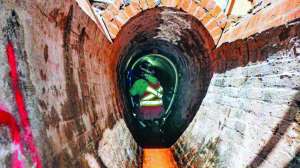
Sectional point repairs can structurally rehabilitate sanitary and storm sewer pipes and culverts ranging from 4 inches to 54 inches and larger. A municipal sewer collections system operator called on me to evaluate a broken segment of VCP sewer line that fed directly into a sanitary sewer pumping station. The pipe was broken with a large hole, and soil was visible to the CCTV operator.
To further complicate the scenario, the pipe was over 15 feet deep and ran parallel to a 48-inch storm drain and a 20-inch water main. Digging would prove costly and present significant risk to the owner, general contractor and other utility owners.
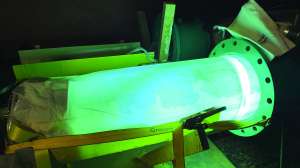
A sectional point repair consisting of a fiberglass and felt composite mixed with a resin system — which is wrapped on an inflatable rubber bladder — is pulled to the point of the defect and cured by ambient temperature in approximately 90 minutes. The repair was done from a manhole, providing a new structural “pipe within a pipe,” bridging the broken section of pipe and restoring the system back to its original design without the need to excavate.
Repairs of various lengths and diameters can be customized for the actual pipe conditions, and it is common to span a defect as well as the adjacent pipe joints. If the defect is near a service lateral, a sectional point repair that includes a mainline to lateral seal can be installed, which will structurally wrap the main and insert it into the lateral on a customized bladder.
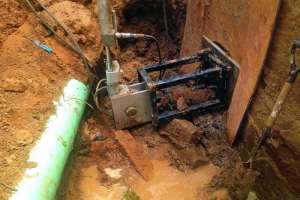
A keyhole sectional point repair technique, using vacuum and hydroexcavation equipment, can be used in some instances to repair a section of pipe that has collapsed and cannot receive a CIPP sectional point repair. The vacuum excavation equipment can be used to remove enough of the soil and damaged pipe to allow the bladder and repair materials to be pulled in place and cured. This will prevent the need to perform a full excavation, install trench shoring and manually enter the trench to make repairs.
This technique can only be accomplished if the soils surrounding the pipe are consolidated and can remain in place while the vacuum excavation takes place.
Although this technique will require excavation including asphalt removal, this truly is a different way to dig and can solve a complex challenge by utilizing the advantages of various technologies to provide a long-term solution.
Although the above project is a great example of a niche use for sectional point repair technology, many utility owners are building them into their long-term capital improvement plans. Most asset management plans (AMP) include an evaluation of buried sewer and storm drain infrastructure by robotic CCTV and defect coding using NASSCO PACP structural defect codes.
By evaluating and integrating these defect codes into a GIS system, many pipes need only segments rehabilitated to provide long-term service life. When compared to traditional lining from each manhole to the next, funds can often be stretched, only critical defects repaired and the new asset value and life expectancy updated in the AMP.
As stewards of the underground industry, it is our responsibility to use the technologies available to us to solve the problems of municipal and industrial utility owners, as well as to evaluate combining technologies to create hybrid solutions while managing risk and maximizing long-term benefits.
Remember: Sometimes you have to dig, sometimes you don’t have to dig, and sometimes you simply need to dig differently.
ABOUT THE AUTHOR: Matt Timberlake is president of Ted Berry Company in Livermore, Maine.
Continue reading for free