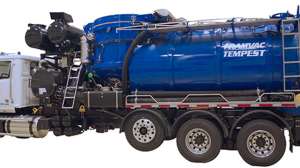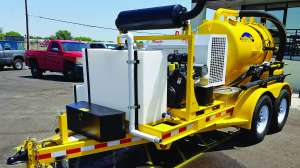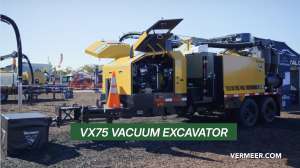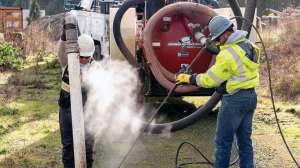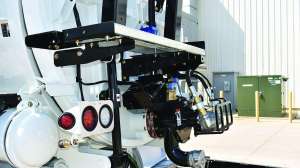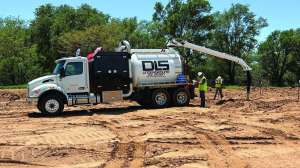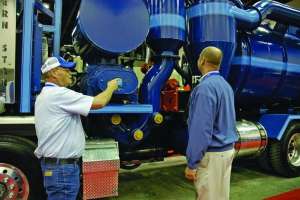

The PAT 1249 medium-sized combination truck from Polston Applied Technologies provides a stand-alone cleaning system for large-diameter pipes, digesters, grit and frac tanks, lift stations, wastewater treatment plants, ponds, lagoons and other difficult-to-clean environments. The new model made its debut at the 2015 Water & Wastewater Equipment, Treatment & Transport (WWETT) Show in Indianapolis.
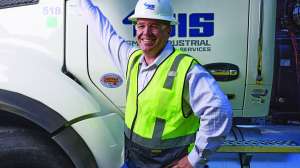
“The people in the wastewater industry know us, but it’s always exciting to talk about a new product with them,” says Pat Polston, company co-founder and chief technical officer. “This product takes what we’ve proven works and improves it even more.”
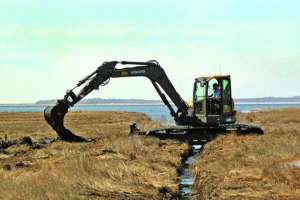
Polston’s Combination3 technology found on the new truck breaks down to three components — a vacuum, a jetter and a downhole system. The downhole system allows equipment to clean in deep or submerged environments and remove high-viscosity material. The service can be performed while a wastewater treatment plant remains fully online — a capability that Polston says gives his units a leg up on the traditional vacuum truck.
“The process filters the water, leaving sand and grit to dry for normal disposal,” he says. “It’s basically separating sand from water as it runs through our unit, allowing machinery to remain in operation the whole time. It’s a fit for anyone dealing with sludge cleaning, from municipalities to industrial wastewater treatment operators.”
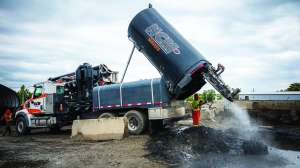
Debris dumps into the truck’s pressurized 12-yard steel tank or a roll-off container. After treatment, water is pumped right back out of the unit, ready for reuse.
The debris tank has a full-opening rear door (power up/down) and a 45-degree dumping angle with manual door locks, level indicator and internal float shut-off. A fully baffled tank provides water for the fully automated multi-directional jetting system with up to 1,000 feet of jetter hose on the reel.
“This truck can pump to 25-yard debris boxes for quick disposal, allowing it to remain in constant operation,” says Polston. “There’s never a need to shut anything down.”
A hydrostatically driven, boom-mounted 6-inch submersible pump with six-blade impeller sits in the water, grabbing material and pushing it into the truck. Powered by a 400 hp engine, the unit can pump and separate grit from water at depths of more than 27 feet. The truck has a 49-foot hydraulic articulating knuckleboom crane with telescoping tubes for hard-to-reach places, wireless remote control, and 180-degree rotation. Its hydrostatic drive vacuum system delivers 16-inch Hg at 3,600 cfm, and the jetter nozzle produces 180 gpm at 2,000 psi. The complete process can be performed remotely by one operator, saving time and manpower, and eliminating the need for confined-space entry. “This is an efficient, safe process,” says Polston. “Once people learn about it, they’re hooked.”
Polston says the 2015 WWETT Show was a big success for his company. He is already planning to make an even bigger splash in 2016. The PAT 1249 serves as a medium-sized model to the company’s smaller PAT 949 and the larger PAT 360HD Combination3 trucks, and Polston wants to introduce another truck option geared toward municipalities as well as a training program designed to increase the reach of the Polston Process. He sees WWETT as the opportunity to do that.
“I’ve been coming here to this show since 1986 and have built a lot of trucks,” says Polston. “This has always been the best place to get the product in front of customers.” 844/765-7866; www.polstonprocess.com.
Continue reading for free