

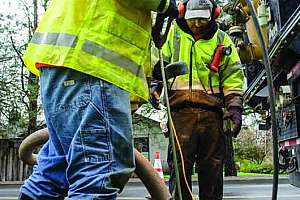

Communication on a construction work site is vital to not only getting the job done, but getting it done safely. With construction sites known for being loud places, talking with other co-workers isn’t easy, so more companies are looking to wireless headsets as a solution.
Technology advances make headsets easier to use than ever before, says Matt Cannell, director of marketing for Sonetics Wireless Headsets. Sonetics uses a proprietary DECT7 wireless technology in its headsets, providing users with clear audio that is full duplex, which means workers can talk to each other as if they were on a conference call.
“There’s no buttons to push, just put on the headsets and talk to each other,” he says, adding that the headsets pair to a wireless base station. Each station has five headsets, and users can have five separate channels on the base so they can have secure conversations as needed. “It’s completely secure and encrypted so users can trust that they won’t be picking up frequencies from other technologies and they won’t be overheard on someone else’s channel.”
Cannell says work site communication is vital for both safety and worker productivity.
“The No. 1 factor for on-the-job accidents is communication breakdown. When you’ve got multiple bodies on a job site and heavy equipment or operations that require precision and attention, a user can’t afford to miss hearing instructions, signals or warnings,” he says. “But when instructions are missed, not only are risks increased, productivity goes down because either you have to stop what you’re doing to make sure the crew hears you over the equipment, or mistakes are made and you have to correct operations, resulting in duplicate efforts and slips in schedules.”
Before headsets were common on construction sites, most crews used hand signals or shouting to communicate with each other. Those methods weren’t the most reliable and instructions weren’t always clearly interpreted, which is a huge issue if individuals need to react quickly in a safety situation, Cannell says.
“Another big benefit is stress relief. When crews are shouting or trying to interpret hand signals, if things don’t happen quite as intended, the stress goes up,” he says. “When the ‘all-stop’ is called, when the headsets are on, everyone hears it. This sometimes can be a matter of seconds to react or someone could get injured or even killed.”
Headsets not only help improve communication, they can also protect workers’ ears from construction site noise. The many pieces of construction equipment on job sites combine to create significant noise volume levels, which over time can lead to hearing loss.
Sonetics’ headsets include 20 dBA of hearing protection and automated noise suppression, which means if an employee is standing next to a loud piece of equipment, the noise will be canceled out and the user will just hear what other members of the crew are saying. The headsets also include listen-through technology, which allows users to let in the right amount of environmental noise, Cannell says.
“If users need to hear equipment warnings, signals or even traffic, they are not cut off from their surroundings. This is critical for users who deal with traffic or highly dynamic environments where situational awareness cannot be sacrificed,” he says.
Loud noises can also be stressful on the body, and by lowering the sound levels, Cannell says it makes the work site less hectic.
“We keep folks in clear communication at all times, lower the loud noises, remove the need for shouting and the job environment suddenly gets more calm, more productive and more enjoyable,” he says.
Wireless headsets are also replacing another construction site staple — two-way radios. Cannell says the headsets allow workers to talk and work at the same time.
“A lot of guys and gals depend on two-way radios on the job site, but the challenge is either they can’t hear the radio when it’s clipped to their vest, or when they do hear it, they have to push a button to communicate back,” he says. “That’s tough when your hands are tied trying to work or operate equipment. The headsets have no buttons to push, no interruptions.”
That last piece is essential because if two workers push the button on a two-way radio to communicate at the same time, they can lock out the channel.
“That means nothing gets communicated, and if that’s when there’s an all-stop, it can be a real challenge,” Cannell says.
Workers can also integrate their portable radios with their headsets or add Bluetooth technology so they can connect to cellphones or listen to music while working. The headset works just like any Bluetooth device — as a call comes in, the user is prompted and can push a button to take the call. During the call, the worker is locked out of the wireless conversation so it’s kept private, Cannell says.
“When the call is done, they push that same button again and hang up the phone and they’re back live in the conversation with the headsets,” he says.
The standard Sonetics headset works for 24 hours and can be charged from zero percent to full strength in just four hours.
When it comes to the headsets’ range, they typically work up to 1,600 feet, Cannell says.
“If users need more range or want to integrate their portable radios, they can plug those in to the com hub or headset and push-to-talk over the radio. This gives users who need more range an easy way to go further,” he says.
For workers who just want a personal headset and don’t need or want a mic boom for talking, there is a style available that provides the high level of hearing protection with the listen-through technology, Cannell says.
Continue reading for free