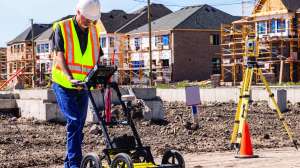
Over the past couple of weeks, I traded my keyboard for a magnetic locator and spent many hours walking fields, roads and open spaces at the Hodag Country Festival grounds in Rhinelander, Wisconsin.
My mission was simple: find small pieces of metal pipe buried in the ground.
These were not large markers. Each piece was only about 3 inches long and roughly an inch in diameter. Yet those tiny pieces of pipe represented something much bigger — the layout of thousands of individual campsites that would soon be filled with festivalgoers from across the state and country enjoying a week of music and camping.
Using a magnetic locator, my volunteer crew of mainly high school students and I carefully searched for each marker, verified its location and staked out sites so everything would be organized when campers arrived. Across thousands of locations, a few inches could make the difference between a smooth setup and a problem.
It was a good reminder for me of something that utility contractors like you deal with every day: knowing what is below the surface before you start moving dirt.
AN IMPORTANT STEP
For contractors, the consequences are much greater than finding a small campsite marker. Before any excavation begins, proper utility locating is one of the most important steps in protecting workers, equipment, infrastructure and the public.
A missed utility can lead to damaged utilities leading to massive repair costs along with possible project delays and safety risks. That could bring a loss of trust with customers and the community you are working in.
That is why a quality locate is not just a box to check before a job starts. It is the start of a successful project. Locating utilities should not end when the excavation begins, though.
As work progresses, contractors need to continue paying attention to the conditions around them. Plans can change and unexpected obstacles do appear. Existing utilities may not be exactly where records show them, which means crews need to communicate, verify and adjust as needed.
The best contractors understand that locating is an ongoing process.
DOCUMENTATION MATTERS
The same applies after installation. A new utility is only as good as the documentation that follows it. Taking the time to accurately record the depth, location and path of newly installed infrastructure helps the next contractor, the property owner and the community in the future. The maps we use for locating campsites are updated annually if measurements change or when we need to fix an measurement error that we found.
The underground world is constantly changing as new waterlines, sewer systems, fiber networks and other infrastructure continue to be installed. Without proper records, every future excavation becomes a guessing game.
YOUR TURN
My time walking around with a magnetic locator looking for small pieces of pipe was a simple task compared to what contractors face every day. But it drove home an important point: what is hidden underground still needs to be found, understood and documented.
Know what is there before you begin.
What tips do you have for utility locating? Email me at editor@digdifferent.com.
Enjoy this issue!
Continue reading for free