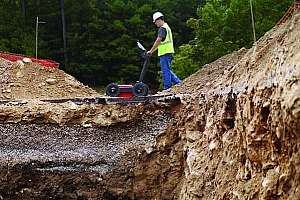
Torrential rain. Sewage-filled streets. Submerged vehicles. Flooding as much as three times in a matter of two weeks. These are some of the issues that affected two low-lying neighborhoods in Washington, D.C. And now, after nearly a century of flooding, the neighborhoods of Bloomingdale and LeDroit Park can see the light at the end of the tunnel — the First Street Tunnel.
The First Street Tunnel, a $157 million project, began construction in late 2013. It’s a portion of the District of Columbia Water and Sewer Authority’s — also known as DC Water — Clean Rivers Project. The goal is to reduce combined sewer overflows, improve water quality in local rivers and support flood protection in the District of Columbia.
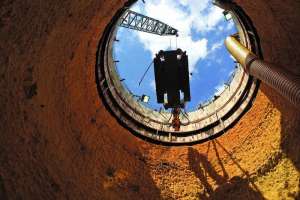
Once completed, the tunnel will stretch more than 2,700 feet — slightly longer than the Lincoln Memorial Reflecting Pool. Its 21-foot-diameter tunnel will store as much as 8 million gallons of stormwater — or about 12 Olympic-sized swimming pools. The city will store the water inside the tunnel and pump it into the sewer system once the storms subside to help prevent sewer backups, overland flooding and water pollution.
SORTING THROUGH OPTIONS
DC Water needed a contractor that could finish the project quickly and efficiently to save the communities of Bloomingdale and LeDroit Park from further flooding. In October 2013, Skanska USA, one of the largest construction and development contractors in the world, won the First Street Tunnel design-build contract as a joint venture with Jay Dee Contractors.
The tunnel project is in the center of one of Washington, D.C.’s longstanding neighborhoods, loaded with charming townhomes and narrow tree-lined streets — resulting in the need for strict working hours for the assigned contractor.
“The project required compact, versatile equipment to enable us to construct the shafts efficiently and safely,” says Scott Hoffman, First Street Tunnel project manager for Skanska-Jay Dee.
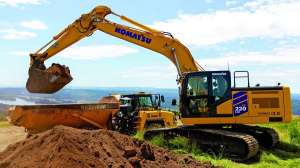
In the midst of excavating the first neighborhood shaft — one of three shafts that would convey rainwater into the new tunnel — Skanska-Jay Dee began searching for alternative excavation options. Skanska-Jay Dee’s first method, an excavator, was sufficient, but its bulky size made it difficult to maneuver inside the shaft. And its diesel exhaust was a concern in the tight quarters.
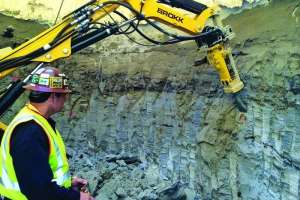
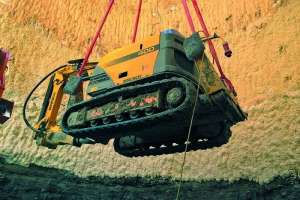
Skanska-Jay Dee was familiar with Brokk machines and scheduled a demonstration of an 11,000-pound remote-controlled Brokk 400, which can excavate a 26.5-foot-diameter shaft at twice the production rate as a conventional excavator.
The Brokk 400 is compact. At only 14 feet long and 5 feet wide, it is small enough to move freely inside the relatively cramped space of the shaft, while still delivering exceptional maneuverability and power. Beyond maneuverability, the equipment can handle a breaker that generates nearly 775 ft-lbs of breaking force. This was ideal for Skanska-Jay Dee, as it allowed them to break through extremely hard material, such as frozen ground. Its 23-foot reach and 360-degree turning radius provided unmatchable flexibility and precision in each shaft. It achieved the desired radius — more than 13 feet in each shaft — in a fraction of the time of alternative methods.
GET READY TO BROKK
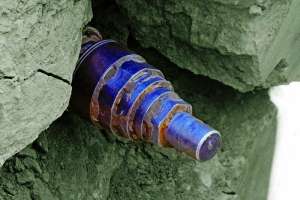
Armed and ready with Brokk by its side, Skanska-Jay Dee continued working on the First Street Tunnel. To start, Skanska-Jay Dee excavated the remaining two shafts. The shafts required additional support, which they achieved through a ground freezing method. Skanska-Jay Dee worked with Moretrench, a geotechnical contractor out of Rockaway, New Jersey, to deploy a frozen ground system with three chiller units. Moretrench accomplished this by circulating chilled liquid brine through preinstalled vertical piping around each shaft. This process effectively froze the soil down to about 160 feet and converted the soil’s viscosity to a solid mass ready for excavation.
Using the Brokk machine provided maximum efficiency, greatly reducing the duration of time on the job. The Brokk only requires one operator, allowing additional crew members to work on other fundamental tasks.
After the soil was frozen, an operator equipped Brokk’s three-part arm with an Atlas Copco SB 552 breaker, and a crane slowly lowered the Brokk 400 machine into the shaft — working vertically — chipping away frozen clay-sand material. The crew swiftly removed 2,500 cubic yards of material out of the shafts, later hauling it to backfill quarries.
Brokk’s team did more than bring the equipment; they supported Skanska-Jay Dee’s crew with equipment training as well, such as finding the most precise methods and tools to complete the project efficiently.
Beyond the Brokk 400’s flexibility and strength, its electric drive eliminated exposure to exhaust fumes in the remaining shafts. While the excavator was equipped with scrubbers to reduce exposure to fumes in the first shaft, the Brokk machine is powered by an electric motor, providing added safety to operators in the remaining shafts.
“The air is cold and heavy, which makes it difficult for the fumes to escape,” says August Scalici, Brokk field sales application expert. “The Brokk’s electric drive saves their crew members from harmful exposure to toxic fumes.”
KEEP TUNNELING ON
In less than three months, Skanska-Jay Dee completed the shaft-digging phase of the project, from ground freezing to excavation.
“With the shaft excavation complete, we anticipate the First Street Tunnel construction to be finished in 2016,” Hoffman says.