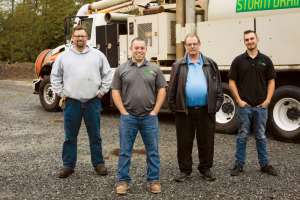
In 2013, Jacob Sabin decided to quit his job and start his own excavating company, Greenfield Services, in Puyallup, Washington. Aside from a pickup truck and some rakes and shovels, all he had to work with was a love for operating heavy machinery — and some ambitions buttressed firmly by bullish determination.
“I had to rent all my digging equipment,” says the 38-year-old entrepreneur. “It was basically just me and a pickup truck.”
But in just three short years, the company’s annual revenues have grown almost eight-fold, from $350,000 in 2013 to about $3 million in 2016. Moreover, the fledgling company now boasts a full complement of excavating machinery, including a Vac-Con combination vacuum truck with a hydroexcavating package, built on a 2004 International truck chassis.
The formula for this remarkable growth spurt? Hire great employees. Offer diverse services. Create an I’ve-got-your-back company culture that promotes teamwork. And invest in quality equipment that boosts productivity and, in turn, increases customer satisfaction.
“We probably have hundreds of guys doing excavating in western Washington,” says Sabin. “The only way to compete is to outperform everyone else. And we do that by investing in quality equipment and keeping it well-maintained, as well as hiring quality employees.”
One more thing: Don’t hesitate to ask successful business owners how they achieved success and always do quality work. “I’m always asking successful people how they did it,” Sabin explains. “I try not to have to reinvent the wheel. I’ve found out that at the end of the day, a key factor in success comes down to taking care of people to the best of your ability.”
Sabin also points out that he never low-balled on job bids in order to buy market share and gain a foothold in his service area. “I’ve never worked cheap,” he notes. “I’m not a cheap guy, I’m a quality guy. I believe that quality sells itself. If you do a good job for everyone you work for, they’ll tell other people about it.”
HISTORY OF HEAVY METAL
The seeds of Sabin’s career were sown in high school. He worked on farms and discovered he loved to drive tractors. Because he struggled academically, he knew college wasn’t in the cards. So upon graduation, he instead took a job as a heavy-equipment operator, building logging roads. “It was an awesome experience,” he says. Eventually, he worked for other companies and learned how to operate excavators and bulldozers and drive dump trucks. He also learned how to do excavating for laying new water and sewer lines.
Along the way, he also learned something else: He’d rather work for himself than for somebody else. “The truth of the matter is that I’m not a great employee,” he candidly notes. “I’m headstrong and opinionated and that usually doesn’t go over well.
“Too often, someone would ask me to do something the wrong way — cut corners and do things on the cheap,” he continues. “I struggled with that, because I take a lot of pride in what I do. The bottom line is if you don’t want a quality job, you’ve hired the wrong guy.”
So Sabin decided to strike out on his own. It wasn’t a completely daunting task, since he’d already developed relationships with potential customers. Between that and word-of-mouth referrals, he soon financed the purchase of a Caterpillar 304 mini-excavator. “It was a very versatile piece of equipment, but still was small enough that I could tow it with a pickup truck,” he explains.
From there, he gradually added more equipment, primarily through rent-to-purchase arrangements. “That way, if I finished up a job but had no more work lined up for that particular machine, I could turn it back in — no harm, no foul,” he says. “It takes a lot of risk out of the initial purchase.”
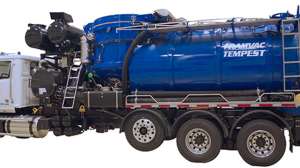
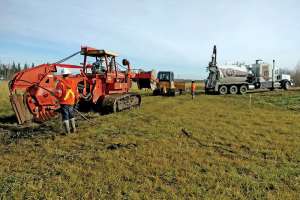
Today, Greenfield’s fleet of excavating equipment includes: the Vac-Con combo vac truck/hydroexcavator, equipped with a 12-cubic-yard debris tank, a three-stage blower, a 1,300-gallon water tank, a water jetter (3,000 psi at 80 gpm) and an extra-long boom; a 600-gallon water trailer made by Multiquip Inc.; a 2004 Komatsu 308 excavator; a 2014 Caterpillar 304 rubber-tracked mini-excavator; a 2014 Caterpillar 420 backhoe; and a 2004 Fiatallis FT110 bulldozer with a six-way blade.
Other equipment includes several pipe and slope lasers made by Spectra Precision, a 1990 Peterbilt 379 dump truck with a 12-cubic-yard dump body manufactured by Knight Trailer Sales, a dump trailer built by Knight Trailer Sales, a tri-axle trailer made by Trail King Industries, three Jumping Jack soil compactors made by Wacker Neuson, and three hot saws manufactured by Stihl.
DIVERSIFIED SERVICES
As the equipment fleet grew, so did the company’s range of services. At first, Sabin concentrated on services such as residential and environmental excavation. Today, the company does everything imaginable: land clearing, excavation work for laying water and sewer lines and installing grease traps, digging construction footings, exposing buried utility lines, remediation of contaminated soil, sewer line jetting and vacuuming and cleaning car-wash sumps, to name a few.
“Excavating is by far our biggest division,” Sabin says. “But that’s because we have way more excavating equipment.”
Sabin strove to diversify the company because more services make the company more attractive to potential customers who’d rather hire a one-stop shop than deal with multiple contractors. Moreover, as the saying goes, one thing inevitably leads to another. “They absolutely do complement each other,” he points out. “Hydroexcavating creates work for excavating and vice versa, for example. We go out and jet a line, for example, and find a break in the line that needs repair or replacement. So then we can send out an excavation crew. That’s a good example of how these two divisions complement each other so well.”
Diversified services also help to offset cyclical highs and lows, especially in boom-or-bust markets like construction. “I like to be diversified so it evens things out — there’s not so much up and down in terms of business cycles,” he points out.
GROWTH IN HYDROEXCAVATING
Hydroexcavating work generates only about 20 percent of the company’s gross revenue, but it produces higher profit margins than any of the company’s other services. As such, Sabin is interested in expanding hydroexcavating work.
“I have every intention of growing that division,” he says. “I’d love to buy another hydroexcavating truck every year. I recently promoted one of our excavating foremen, Nick Watkins, to a superintendent, which will free up more of my time so I can focus more on that.
“Nick is a great employee,” Sabin continues. “He went from working as a pipe layer to equipment operator to foreman and now to superintendent. I’ve got really good employees — I’m very blessed. They’re really loyal, honest and hardworking people.”
Sabin also praises John Raring, manager of the company’s hydroexcavating division. He not only operates the hydrovac truck, he also helps out with sales and customer service.
“Since he runs the truck, he’s out on the front lines — the guy who makes it all happen,” Sabin says. “He’s really kicking butt and is willing to work long hours without compromising quality.
“John also frees up my time to focus on managing, which is critical,” Sabin adds, noting he used to operate the hydroexcavating truck. “I strongly believe that profit margins are won or lost based on how well you manage operations.”
FUTURE LOOKS BRIGHT
Bolstered by what he calls a good, healthy regional market, Sabin expects the company’s growth to continue — at least in the long run. But in the short term, he plans to tone down expansion efforts in 2017 and instead focus on improving profit margins.
“Growth is expensive,” he notes. “Because of our rapid growth and the growing pains that come with it, I’m planning on slowing down a little in 2017 and focusing more on profitability.”
In the long run, Sabin says he’s motivated to keep building the business so it’s a strong and healthy entity when one or more of his four kids are old enough to take over, provided they’re interested. “I like the idea of building something my kids can take over — passing along a legacy to them, if they chose to become part of this industry,” he explains.
“The other part is that I’m greedy and lazy,” he says with a laugh. “It’s going to be awesome when I grow up some day and become comfortable financially. But in the meantime, I’m going to keep hustling and busting my butt every day — until I don’t have to anymore.”
Power, reliability make hydrovac truck a key revenue contributor
Equipment breakdowns are the bane of hydroexcavating contractors. They not only erode profit margins, they irritate customers and jeopardize repeat business, too. Or so Jacob Sabin has heard, anyway.
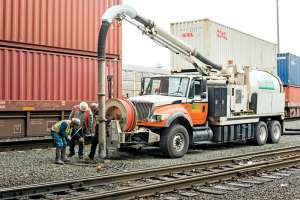
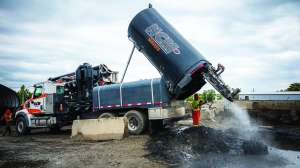
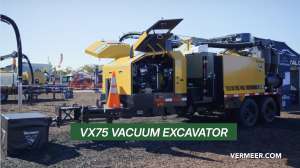
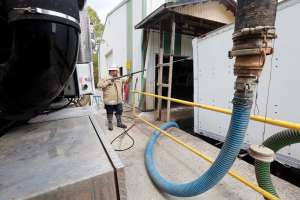
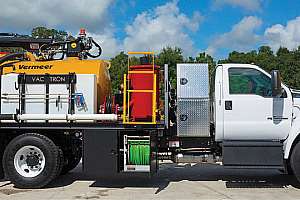
As the owner of Greenfield Services in Puyallup, Washington, Sabin’s pride and joy is a Vac-Con combination vacuum truck with a hydroexcavating package that is largely immune to breakdowns. Built on a 2004 International truck chassis, the unit features a 12-cubic-yard debris tank, a three-stage Vac-Con blower, a 1,300-gallon water tank and a water pump that generates pressure of 3,000 psi and flow of up to 80 gpm.
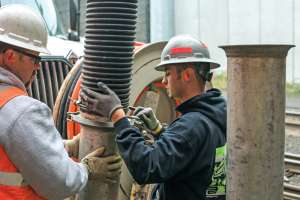
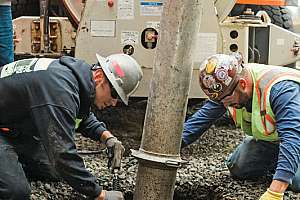
The hydrovac truck is used for a wide array of services, ranging from excavating and removing contaminated soil to exposing underground utility lines, to cleaning municipal water and sewer lines. And it keeps customers happy by running. And running. And running.
“I have prior experience with Vac-Cons and I think they’re the best product out there,” Sabin contends. “For a machine with so many moving parts moving at high speeds, it’s amazing how durable it is. Everything on it is made to last.”
Maximizing equipment uptime has been a critical factor in Greenfield’s success. “The truth of the matter is if you have a new customer and you have to call them and say, ‘Sorry, our truck broke down,’ they won’t give you a second chance — you won’t get invited to the party again. Instead, they’ll just go down the list and the next guy up is going to get the chance to form that new customer relationship.”
Sabin says the Vac-Con moves more air volume than any other unit with which he’s worked. That, coupled with the high-pressure water pump, makes short work of tough jobs.
“Almost every week, we get a job where we’re digging, say, 20 feet deep and you’re 200 feet away from the truck,” he explains. “In fact, I’ve pulled 300 feet of distance with 15 feet of head pressure (elevation difference) and the truck still performed like a champ. And that’s without having to upgrade any features — it’s a really high-performance machine right out of the gate.”