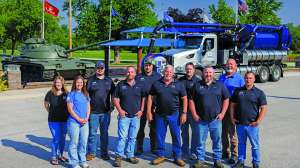
Back in 1969, Marcia and Arvid Veidmark Jr. and his parents established Specialized Services Co. as a traditional opencut excavating company. Their assets consisted of nothing more than a used pickup truck, a Ditch Witch trenching machine and a trailer — and a contract to install underground residential telephone cables in Phoenix, Arizona.
A quick fast-forward to today reveals a company now known as SSC Global, with nearly 40 employees, about $5 million in revenue in 2016, and roughly $4 million worth of advanced trenchless excavating equipment. Moreover, the company’s primary geographic market now includes the entire southwestern U.S.
What happened during those 47 years underscores the importance of investing in new technology — in this case, horizontal-auger boring machines and air-excavation vacuum trucks — and adapting to evolving market conditions. It also reflects the importance of diversification, both in services offered and customers served, not to mention less tangible but still critical elements: A strong entrepreneurial spirit and the ability to learn from mistakes.
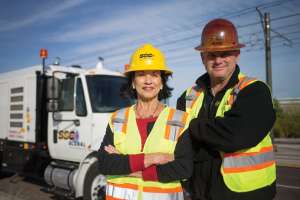
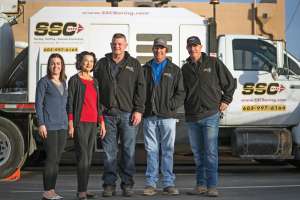
“From a field perspective, you have to be open to trying new things — and be willing to fail,” says Arvid Veidmark III, the son of Marcia and Arvid Jr. He co-owns the company with his mother and his brother, Abe Veidmark. Marcia is the majority owner and serves as company president, Arvid III is the executive vice president and Abe is the vice president. (Arvid Jr. is retired.)
“Like most entrepreneurs, we learned as we went along,” Marcia says, noting they knew very little about excavating when they started the company. “At times, it was both daunting and gut-wrenching. Not everything worked, but we have good minds and were willing to persevere, as well as hire [experienced] outsiders to help us solve problems. We’re not at all ego-driven.”
TAKING THE PLUNGE
Marcia and her husband were still in college when the opportunity to start the company came along. Why did they decide to do something they’d never done before? For starters, a potentially large volume of spin-off work if things went well. In addition, the work was relatively simple and straightforward. “The guys knew equipment and I knew about business, to an extent,” she explains. “We knew how to pull things together and make it happen.”
More work did indeed follow, and the foursome — which included Lois Veidmark and her husband, the late Arvid Veidmark Sr. — ran the company until 1976. Then Marcia and Arvid Jr. managed the company until 2002, when he retired. At that point, Arvid III, Abe and their third son, Aaron, were already employees. Marcia’s niece, Michelle Walker, has been with the company for 18 years and is now the vice president of finance and administration. And two of her nephews, Curtis Zwar and Steve Walker, also occupy management positions.
The Veidmark’s business acumen faced a stern challenge in 1989, when they realized that the market for opencut excavating was becoming over-saturated with competitors.
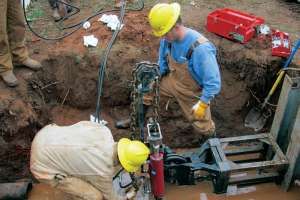
“When we started out, we didn’t realize how risky it was (to be so dependent on one customer and one type of service),” Marcia notes. As competition increased, low-ball bids made it harder to win contracts and profit margins suffered, Arvid points out. The solution? The company shifted gears and invested in an American Augers horizontal-boring auger machine.
“Only two other local companies were doing that kind of work at that time, while there were at least 20 or so opencut competitors,” Arvid says. “We realized there were better profit margins in horizontal boring, plus it opened up other markets and customers for us, enabling us to diversify.”
“Opencut excavating was labor-intensive and required many employees to physically perform the work at a low (profit) margin, whereas the auger boring allows for fewer, more highly skilled workers to use the specialized equipment and complete the work at a higher margin,” Walker explains.
The shift in market focus “changed the face of SSC forever,” Marcia adds. It also allowed the company to downsize to a more manageable 35 or 45 employees.
DIVERSIFICATION CONTINUES
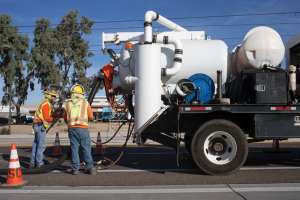
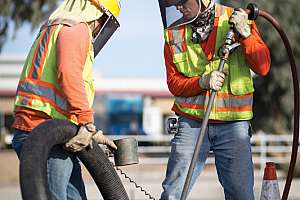
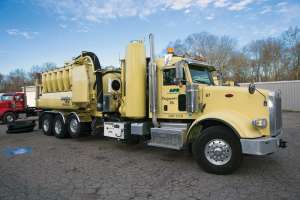
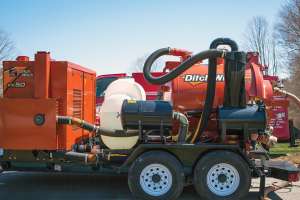
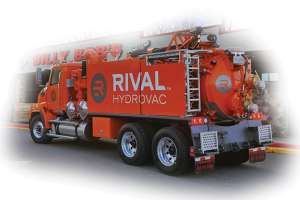
In 2003, market conditions — this time a dip in demand for horizontal boring — once again forced the company to evolve. In response, the company invested in its first air-excavation vacuum truck, a VACMASTERS 3000 unit, aimed at capitalizing on the market for potholing. Air excavation is faster and easier than hydroexcavating because the spoil is immediately reusable as backfill, as opposed to the time and expense involved with vacuuming up and disposing of wet, hydroexcavated spoil.
The company bought the VACMASTERS truck because management realized that investing in one would actually be less expensive than what it was already paying annually to subcontract the work out to another company. As years went by, the company further diversified by asking customers what other complementary services they required. A good example is shoring boxes for boring pits, which are needed to operate horizontal-auger boring machines, Arvid points out.
“Our customers told us it would help them out if we could do excavating and shore the bore pits,” he says. “That’s why we now own the excavators and the shore boxes. Back in 1989, we only installed steel casing (for utility lines). Now we turnkey the entire trenchless portion of a project because we have that capability. That’s what separates us from our competitors.”
“We wanted to be a one-stop contractor for our customers,” Marcia adds. Moreover, after weathering three recessions in the 1980s, 1990s and the most recent economic downturn that started in 2007, management saw more and more value in diversifying its services so the company wasn’t so heavily reliant on one revenue stream (from opencut excavating).
But only related and complementary services get consideration. “We don’t go out and decide we want to be, say, a baker and start making bread,” Marcia quips. “We focus on finding additional pieces of the underground-utility world.”
EQUIPMENT MATTERS
The company’s business volume is currently split fairly evenly between horizontal boring and air excavation. On the horizontal-boring end of the business, the company primarily works as a subcontractor on utility infrastructure projects, responsible for underground boring for and installation of steel casings that utilities use to house both wet (water and sewer, for instance) and dry (electricity and natural gas, for example) utility lines.
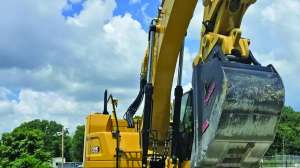
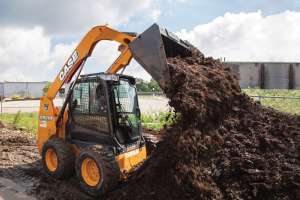
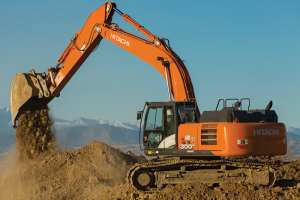
To serve that market, the company relies on seven auger boring machines made by American Augers and Barbco, two small-boring-unit cutting heads made by The Robbins Company for cutting through hard rock, and a large inventory of augers made by American Augers and Barbco, ranging in diameters from 8 to 72 inches. In terms of larger equipment, the company also owns three Caterpillar excavators, three Case backhoes and four Bobcat skid-steers.
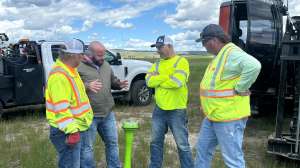
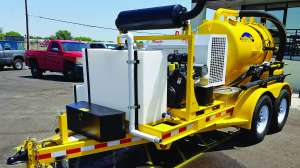
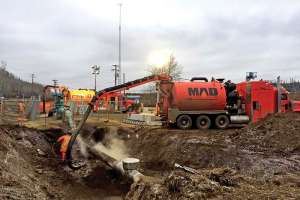
In the air-excavation division, the customer base primarily consists of land developers, engineering firms, municipalities, public-transit agencies and pipeline companies. “We find existing horizontal and vertical utility lines and compile reports so the landowners know where existing utilities are prior to designing a new project,” Arvid says. To service those customers, the company owns eight vacuum trucks made by VACMASTERS (one 1000 model, two 3000 models and five 4000 models).
Over the years, the company also accumulated something less tangible but equally as important as equipment: experience. That was particularly important in the horizontal-boring market because it’s such a specialized service that relies on highly technical machines. Compared to potholing, horizontal boring is a complex endeavor that’s made even more complicated by wildly varying terrain and soil conditions, not to mention hidden and unmarked underground obstacles, Arvid says.
“When you run into a problem with opencut work, you typically can just get a bigger and more powerful excavator,” he explains. “But in trenchless excavation, after you’ve gone through 12 or 24 months of permitting, design review, land acquisitions and so forth, you’d better make sure you have every single base covered. Because once you start a tunnel and you run into a problem, you can’t just start over.”
Problems pop up frequently enough, but that’s where experience becomes a valuable commodity. As an example, Arvid cites a recent job in which SSC was hired to bore a 90-foot-long 72-inch-diameter steel casing for a 48-inch-diameter, gravity-fed sanitary sewer line for Pima County in Arizona. Just 12 feet into the bore, however, the tunneling crew ran into a large chunk of concrete. It turned out to be one of five large footers supporting a box culvert built in 1903 under a railroad track.
County officials considered slightly altering the course of the bore and using a lift station to accommodate the resulting change in elevation. But SSC found a more cost-effective alternative: Use jackhammers to break through the 5-foot-thick footers.
In one particularly challenging job in the U.S. Virgin Islands, SSC engineers figured out how to replace four 120-foot-long corroded pipes running under a large earthen dike at a major oil refinery. “For a variety of reasons, opencut excavation wasn’t an option,” Arvid says. But SSC offered the refinery three different options and even figured out a way to do the project more efficiently and at a lower cost than expected.
“One thing that truly sets us apart is almost five decades of experience,” Marcia says. “Our business acumen has grown tremendously over the years.
FURTHER GROWTH EXPECTED
Looking ahead, Marcia expects the company to continue growing, possibly through both adding more services and expanding geographically. A reasonable expectation going forward is owning 10 air-excavation vacuum trucks and boosting employment to around 45 employees, Marcia says.
“We’ve never been interested in being a small company,” she says. “We’ve always wanted to be a good-sized company that offers professional opportunities for employees and provides them with great benefits and a career.”
Management signaled its intentions three years ago when the company changed its name to SSC Global. While the company isn’t yet a truly international firm, the name change clearly indicates management’s ambitions.
“Our customers had been asking us to join them in other locations and often didn’t know we could and would travel anywhere with them as their trenchless contractor,” Marcia says of the name change. “Putting ‘global’ in our name allows us to promote this message in the upcoming five to 10 years as we expand.”
Moreover, management feels secure about the company’s long-term prospects because of aging utility infrastructure. “There’s a lot of security in our industry,” she explains. “We all need underground utilities. They either need to be replaced as they age or new construction requires installation of new utility lines.” Furthermore, trenchless excavating equipment is expensive, which poses a barrier to market entry by newcomers.
The company’s strong relationships with customers also bodes well for the future. Arvid says SSC has served some customers for 20 years, and those bonds helped it persevere during hard economic times. “Most companies are in business for the money,” Arvid concludes. “We’re in it for the relationships.”
Boring machines deliver exciting revenue results
For sheer return on investment, it’s tough to top the American Auger horizontal-boring machines Specialized Services Company (SSC Global) has purchased over the years. The first American Auger unit the company purchased back in 1989 for nearly $38,000 is still going strong today — and generating revenue, says Arvid Veidmark III, a co-owner and executive vice president at the company, founded in 1969.
Yes, the machines are expensive. A new auger-boring machine these days costs well over $100,000. On the other hand, Veidmark estimates the model 36/200 unit the company bought in 1989 — one of four American Auger bore machines now owned by the company — has bored tunnels for tens of thousands of feet of steel casing and produced millions of dollars in revenue during the last 27 years.
Moreover, the machines pose a high barrier to market entry, says Veidmark’s mother, Marcia, president and co-owner. “People don’t competitively enter the horizontal-boring field because of the large capital investments it requires,” she points out.
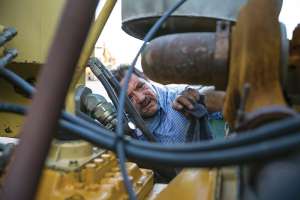
Dependability is another reason why the machines are such great revenue producers. Minimal downtime not only boosts productivity and increases customer satisfaction, it also helps maintain profit margins on projects. “As long as you take care of them, they’re very reliable machines,” he says. “We have great mechanics and we really respect the equipment — keep it well-maintained and serviced.”
One key to that dependability factor: DEUTZ air-cooled diesel engines, which he says are more reliable than liquid-cooled engines, which include seals and gaskets that are eventually prone to failure. “The air-cooled engines are designed to run hotter and they better endure the Arizona heat,” he says.
Moreover, the auger-bore machines are basic, well-engineered units. The main components consist of an engine that turns a gearbox that, in turn, spins the auger, plus a hydraulic pump that drives the rams, producing up to 1.2 million ft-lbs of thrust. The machines can turn augers up to 72 inches in diameter, he says.