
In the High Desert of Southern California, the ground rarely tells the same story twice. One foot can feel like concrete, the next like sugar poured through your fingers. Heat locks it tight by day, cold loosens it by night and wind erases yesterday’s assumptions before the sun comes up again.
That’s the reality Advantage Directional Drilling operates in every day. A landscape where precision isn’t optional and confidence has to be earned inch by inch, rod by rod. It’s a place where the best plans are the ones backed by experience, reliable equipment and people you trust enough to call when things go awry.
Those factors came together during a gas line relocation beneath Deep Creek, a crossing that required threading an 8-inch steel pipe under a bridge reinforced with hidden steel and surrounded by shifting soil. What appeared manageable on paper quickly became a test of preparation, patience and partnership when conditions underground refused to cooperate and the locator signal disappeared.
“This wasn’t a job you could just drill and hope,” says Johnny Torres, superintendent and driller for Advantage Directional Drilling. “We had to be dead-on.”
A FAMILY OPERATION ROOTED IN RELIABILITY
Advantage Directional Drilling, based in Victorville, California, was built as a family business from day one. Ralph Torres started the company in 2004 with a Ditch Witch JT520, a strong work ethic and a reputation for taking on difficult jobs. Early success came from long hours, disciplined planning and a trusted relationship with Ditch Witch West, a partnership that would continue to influence how the company approached every project that followed.
Today, Advantage Directional Drilling operates primarily across California’s High Desert and into Arizona, focusing on gas and fiber work where bore data is demanded and documented. In California utility work, bore paths are logged, GPS coordinates are verified and contractors are trusted to deliver exactly what they record.
Advantage intentionally operators with small crews. A typical job includes three team members including an operator, a locator and a third contractor training to do both.
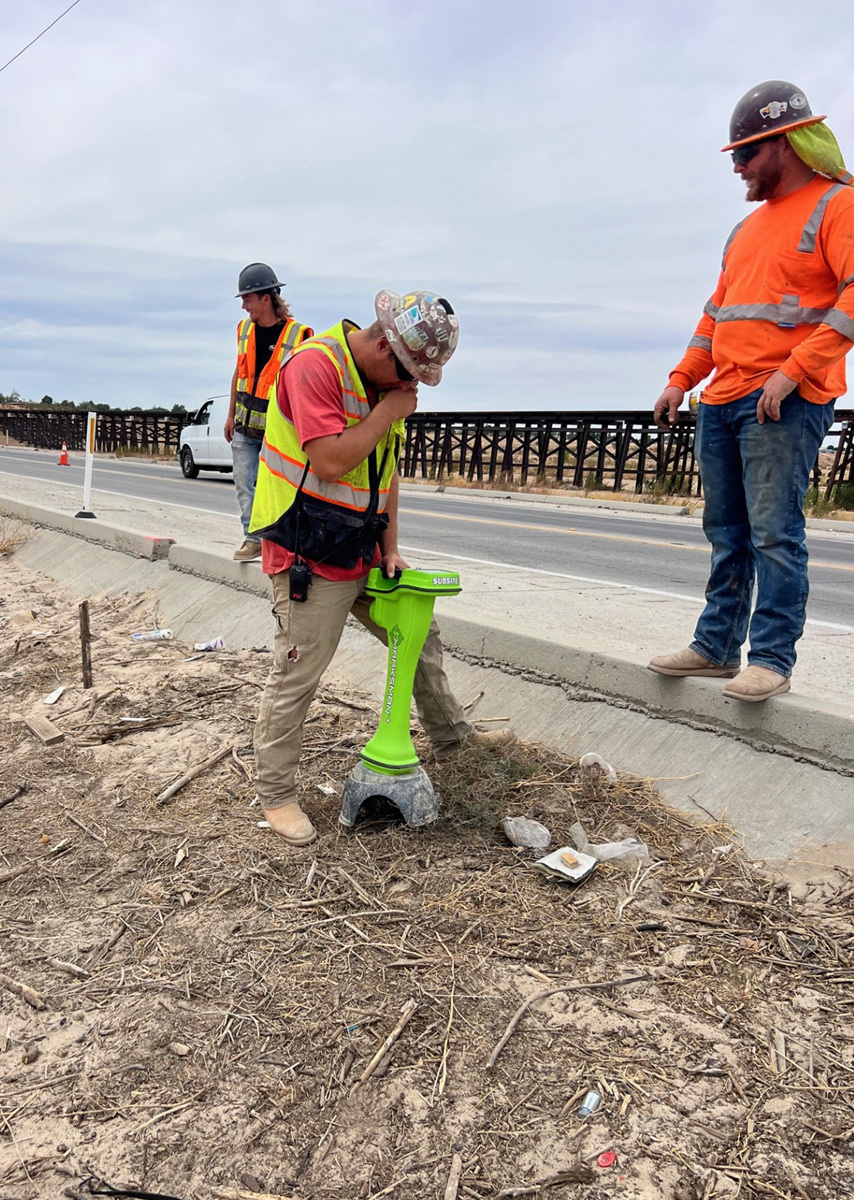
“The point is flexibility and accountability,” Torres says. “Everyone learns the whole job, not just one piece of it. That’s how you stay sharp.”
That same discipline carries into how Advantage Directional Drilling approaches its equipment. The company operates exclusively with Ditch Witch drills and Subsite locating systems, a lineup it has relied on since its earliest days. What began with a JT520 has grown over time into larger machines, including a JT30 that has accumulated extensive hours in some of the most demanding ground conditions across California’s High Desert.
“We bleed orange,” Torres adds.
That loyalty extends beyond brand preference. For Advantage Directional Drilling, reliability and accuracy are foundational to every job. Subsite locating systems, including the 750 and 752 models and the more recent Marksman+ locator, play a critical role in maintaining that standard.
Confidence in the equipment allows the crew to focus on execution rather than uncertainty. Every rod and every bore rely on tools designed to perform consistently under pressure, matching the expectations of the people operating them.
“When the signal drops or the job hinges on a split-second call, uptime and quick support can mean the difference between moving forward and losing a day,” Torres says.
UNDER DEEP CREEK: COMPLEXITY BELOW THE SURFACE
That trust and support were soon tested beneath Deep Creek, one of only two creeks in the United States that flows south to north. On paper, the job appeared straightforward: moving an existing gas line 25 feet to make room for a new bridge. However, shifting soils and buried reinforcement beneath the bridge made it clear the job was more than a routine crossing.
The original plan called for two 400-foot shots meeting in the middle. After running the numbers, it became clear that the depth required to clear the bridge structure would make a tie-in unsafe. The soil was sugar sand and the hole could collapse. Digging deep to connect would have introduced risk the crew could not justify.

Rather than risk it, Advantage committed to a continuous drill-and-pull operation. No potholing. No shortcuts.
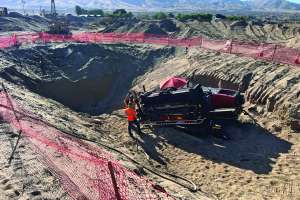
The entry pit was dug 10 feet deep and shored, roughly 10 feet by 10 feet, while Torres inspected the setup before finalizing the bore plan. From there, he planned a 2% grade down, targeting nearly 20 feet of depth under the bridge while keeping the line level enough to pull 8-inch steel.
“Once drilling started, there was very little room to adjust,” Torres says.
MANAGING INTERFERENCE THROUGH PREPARATION
Before the first rod went into the ground, Torres brought Andy Taminich from Ditch Witch West to the site to walk the planned bore. Together, they traced the alignment, reviewed locator frequencies and focused on the final 100 feet beneath the bridge approach where the road dropped sharply and where rock and heavy reinforcement were expected.
The first 700 feet went smoothly. Asphalt, sand and familiar soil offered no surprises. The drill stayed on grade and the Subsite locator delivered steady, reliable reading.
However, conditions changed as the bore approached the bridge. At nearly 20 feet deep, with roughly 100 feet remaining, the locator signal dropped out.
Interference from rebar and unknown reinforcement within the bridge structure disrupted the signal, making pitch, angle and depth increasingly difficult to trust. In that moment, the challenge extended beyond equipment. A single miscalculation could trigger a cascade of consequences. Coming up too shallow risked damaging the pipe. Surfacing in the wrong location would have ended the project altogether.
“In California, accuracy is nonnegotiable,” Torres says. “Bore data is trusted, and mistakes carry consequences far beyond a single project. This was the critical part of the bore, and we had to do it right.”
SIGNAL LOST. TRUST FOUND
Under normal circumstances, the next step would have been wireline locating. It is a reliable solution, but one that would have introduced delays at a point when time was critical. Additional crews would have needed to be scheduled, specialized equipment brought in and progress put on hold, an interruption the project could not withstand.
“Wireline would’ve solved it, sure,” Torres says. “But time kills margins. What we needed was the kind of support where you can make a call, have someone show up, walk the job with you and help you find a better way.”
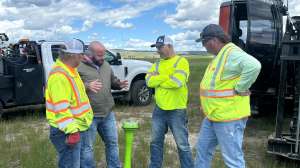
Instead, Torres contacted Ditch Witch West. Taminich returned to the site and worked alongside Torres while coordinating directly with Subsite support. Together, they worked methodically through available locator frequencies, aware that interference behaves differently depending on depth and surrounding material.
They started with 46, then moved to 21, followed by 15. Initially, the readings offered nothing usable. Then the signal began to return, first faint, then increasingly defined, like a pulse reappearing after a long pause. When the locator was set to 3.5, the signal stabilized and the job sputtered back to life.
“As soon as we changed, we had pitch and angle again,” Torres says. “That’s when we knew we could keep moving.”
Depth was still imperfect but usable. Torres relied on grade calculations and the discipline he comes back to time after time. Hold the bore steady, go slow, confirm what you can confirm and keep the work honest. When the drill head finally emerged, it was where it needed to be.
“It was one of those good days,” Torres added.
ANSWERS BENEATH THE BRIDGE
It was only after the bore was finished that the cause of the interference became clear. The disruption had not come from standard rebar alone, but from extensive bridge reinforcement. Beneath the crossing sat a tightly packed grid of 1/4-inch steel reinforced with glass fiber, forming a dense barrier beneath the structure. Together, it created an underground shield that sent every frequency skimming away like light across water.
“The signal was ricocheting in every direction and scattered every frequency we tried,” Torres says. “Once we saw what was beneath, it all made sense.”
With the cause identified, the outcome spoke for itself. The gas main was successfully relocated beyond the footprint of the future bridge. The customer was satisfied. The bore data remained accurate and intact.

WHEN PARTNERSHIP DRIVES THE PLAN
The Deep Creek crossing stretched nearly two weeks from the initial punch hole to final pullback. Progress during pre-reaming was slow, as sugar sand made it difficult to hold the hole open and required constant attention to maintain stability. By the time the pipe was installed, the crew had gone through 12 pallets of drilling fluid, each one contributing to protecting the line and completing the work correctly.
That level of preparedness extends beyond any single job. It is embedded in how Advantage Directional Drilling operates and in the relationships the company relies on every day. Midway through the Deep Creek bore, Torres recognized that the 600 feet of drill pipe on site would fall short of completing the 800-foot crossing. One call to the Ditch Witch dealership triggered a rapid response, and an additional 300 feet of drill pipe was delivered the same day, keeping the project on track.
The same support proved critical on another project when an 8-inch downhole tool raised concerns after contacting rock. Once again, Torres reached out to Taminich, the dealership contact who had previously walked the Deep Creek bore with him.
“Andy tracked down the correct tooling in Texas and had it delivered on a Saturday,” Torres says. “No questions asked.”
For Torres, that kind of support changes how decisions are made in the field. It removes hesitation at critical moments and allows the crew to focus on execution rather than contingency planning, knowing help is already on the way.
DELIVERING CERTAINTY UNDERGROUND
In directional drilling, the most critical moments do not always arrive with obvious warning. Sometimes they emerge quietly, when interference builds, signals fade and the next decision carries more weight than the last several hundred feet combined.
For Advantage Directional Drilling, the Deep Creek bore was more than a completed crossing. It reinforced the value of disciplined preparation, consistent processes and long-standing partnerships. The company’s approach of running lean crews, verifying data and relying on trusted equipment and dealer support allowed the team to move forward when uncertainty threatened progress.
Since adding the Subsite Marksman+ to its equipment lineup, losing signal no longer forces Advantage Directional Drilling to rely on guesswork. Instead, crews can adjust frequencies, verify available data and continue forward with confidence, supported by their experience and the responsiveness of their Ditch Witch dealer when it matters most.
Continue reading for free