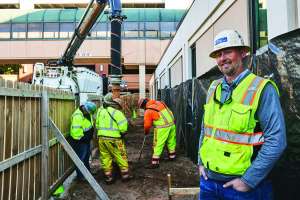
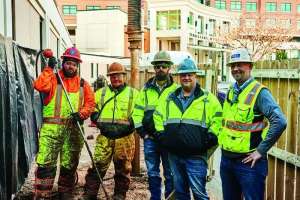
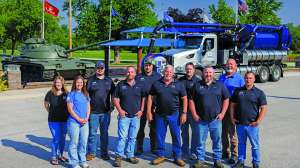
In 2015, five people in the Atlanta, Georgia, area looked around and saw an area underserved by hydrovac companies. The group was involved in several facets of the construction industry — from erosion control to site development to demolition — and encountered few vacuuming trucks in their workdays. Just two firms in the metro area had trucks slicing through Mother Earth, sucking up material and carting it away.
Seeing opportunity, the group bought a second-hand Vactor HXX (TRUVAC), a venerable model on a Kenworth four-axle chassis with a 1,200-gallon water tank and 12-cubic yard debris body, and launched Atlanta Hydrovac. They hired someone to manage the new business. However, after only one year, the arrangement wasn’t working out to the point that owners considered axing the enterprise.
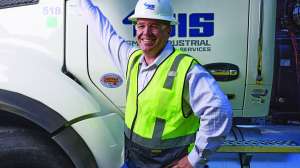
Then Greg Dubin (pronounced doobin) entered the picture. “I heard through a friend that the group was looking for someone to run the company and I looked into it,” Dubin says. He had worked in the industry for a dozen years at that point, most recently in the natural gas pipeline industry. Six years later, the 40-year-old is still general manager of fast-growing Atlanta Hydrovac — and a very busy man.
At the start of the workday, he typically is at the company shop in the Atlanta suburb of Powder Springs to see crews roll out on their assignments before rolling out on his own. On the day he was interviewed, Dubin met a client for breakfast, then sat for the interview before working up two bids, calling some other clients, checking in with a crew, and driving five miles to a work site and another 40 miles to meet with a vendor.
Asked if such a schedule doesn’t make him sometimes wish he were relaxing at the working end of a vacuuming hose somewhere, Dubin responded that he gets in his hose time, too. “I’ve been on the hose multiple times,” he says. “I’ll show up with a pizza sometimes and do some digging while the crew takes a pizza break.”
The general manager knows his limits. One of his first hires when he started managing the company was Brandon Jones, an experienced hydrovac operator who oversees scheduling and field operations. Another key assistant is Blake Daniel, who came aboard as a crew foreman but has been promoted to safety officer and operations coordinator.
BUILDING A FLEET
The fleet of trucks at Atlanta Hydrovac now numbers 13, with the company adding one or two trucks a year. The workload justifies even more rolling stock, Dubin says, but he doesn’t have qualified operators to run them. “Atlanta is one of the hottest markets right now. We could have 20 trucks, but I would have to put warm bodies (inexperienced operators) in the seats. The last thing I want to do is provide clients with a bad experience and bad value.”
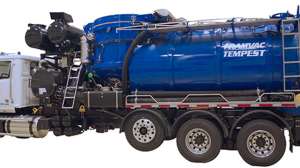
Eight of the company’s owned vac trucks are the Vactor HXX, the model with which the company began. Yet another HXX is a long-term rental. The company also owns two combo vac trucks — a Vactor 2100 and a 2100i. Why did the company go with Vactor instead of another brand?
“At the time, they were the closest supplier with a shop, about 60 miles away in Greenville,” Dubin says. The company didn’t have a mechanic or maintenance facility or an equipment yard then. It was parking its trucks overnight at a dump. Consequently, the proximity of Vactor’s shop was a calling card. “We needed someone nearby.”
That’s not to say the trucks themselves weren’t otherwise appealing to Atlanta Hydrovac. “Every brand has its strengths and flaws,” the general manager says. “Overall, we are happy with Vactor products.”
The situation changed four years ago when the company built a 100-foot-by-60-foot facility, large enough to handle simultaneous maintenance on five trucks. Mechanics and a full-time shop manager staff it. With the exceptions of major engine overhauls and transmission work, the company’s vac trucks and field support vehicles no longer have to make the run to Greenville.
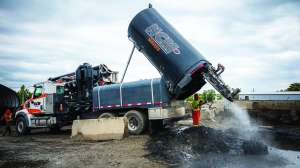
The company has also added two GapVax hydroexcavators to its fleet. In the equipment yard are two GapVax HX56 multipurpose wet/dry vacuum rigs with 15-cubic-yard debris bodies. A 2022 version of the unit is on order.
AN ARRAY OF WORK
Dubin has a flexible description of his customer base. “Anyone who puts a bucket in the ground is on my possible client list,” he says.
A majority of customers are utility, site and general contractors. A few are residential developers. Natural gas utility companies have long-term arrangements with Atlanta Hydrovac for periodic work. Even one-off contracts sometimes lead to company trucks working at a job site for six or seven months.
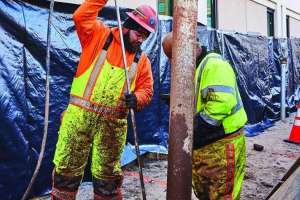
Company crews are busy, daylighting and potholing and trenching. They also regularly are found at water detention ponds, which they clean according to federal mandates for such bodies of water. In addition, a dozen times a year, when the size of a contract warrants it, the company will send a crew out of state.
Is there a bread-and-butter call from a customer, a frequent task that is the backbone of business? “Our bread and butter is any excavation, from potholing to water lines to whatever” says the ever-practical general manager. “Anything you need, we can handle it.”
The trucks also clean up construction sites. Rather than dig into undisturbed soil, cleanup crews vacuum existing material into debris tanks and haul it away. Example: A concrete pour for one contractor didn’t work out — the pavement cracked and needed repouring. So, the concrete was broken up and Atlanta Hydrovac was called to remove underlying soil to create a firmer base for a new slab.
The GapVax trucks have a different calling: sewer cleaning. “The two trucks are running nonstop doing sewers every day. We do the camera work and the cleaning and the testing. We offer pretty much a turnkey package for sewer customers,” says Dubin. Yet the service is barely mentioned on the company website, on purpose. “We try not to put out too much that we do that kind of work. Customers already have a two-week wait for us to get there.”
Crew members are each assigned to a truck, with one floater to cover absences. About half of the men work exclusively with hydrovac rigs performing traditional excavations. Six are authorized to operate the GapVax jetter units. “We have some phenomenal operators,” says the general manager.
When COVID bore down a year ago, the owners group huddled and put policies in place that were workable and reasonable. Everyone in the company experienced a learning curve as they dealt with the virus in a safe way. “We had a couple of spikes during the period,” Dubin says. “About this time last year, we had eight guys go down at the same time. Our operations manager and shop manager each spent a week on trucks.”
Workplace safety of a more ordinary kind is on Dubin’s mind these days. Company crews recently received a new safety handbook. A client-friend of Dubin’s is safety director for a large contractor in the Southeast and helped the company put together the manual.
“Safety training has been our push this year,” Dubin says. “How to train people to be safe, what programs you need to have in place and so on. We have been very fortunate to have people willing to help us with our program.”
While the company hasn’t experienced any major injuries, there have been minor scrapes. For instance, an operator on a hydrovac truck grazed the grille of his truck and a sharp edge gouged his arm.
“So, now we have a plastic sheet on each grille so that doesn’t happen again,” Dubin says. “We have a safety meeting each week, analyze jobs each morning for safety concerns, and have monthly meetings. Going forward, we’re going to continue to promote being safe.”
MAINTAINING RELATIONSHIPS
Good working relationships rather than lowest bids are what keep Atlanta Hydrovac working, according to Dubin. He says he sometimes gets calls along the lines of, ‘Hey, we’re told we ought to use you and we need you for this job.’ Such word-of-mouth payoffs are a product of the general manager investing time each day with clients. He calls them to be assured that everything is going well or, if a job is complete, just to say hello.
“I am big on face-to-face communication, and I spend a lot of time on the phone. I call 50% of my clients every day,” he says. Think about that: Half of his clients hear from him every day! That kind of regular dialogue spills over to create goodwill toward Atlanta Hydrovac crews. “So many clients are on a first-name basis with my guys. The best kind of call I get is when a client phones to say he wants this particular operator or that operator back on his job site the next day.”
Cultivating and maintaining personal connections dovetails with Dubin’s desire for the company to have “organic” growth — that is, to respond to customer demand so competently and agreeably that customers keep calling back for more. He believes confidence in his crews and in the company’s product ultimately is what separates Atlanta Hydrovac from its rivals.
He quotes a mentor who taught him the core value of working relationships. “He would tell me, if you keep doing what you’re doing, you’re going to be fine. What you tell the client is the truth. You show up on time. And you communicate on a daily basis. That’s how you build relationships in this industry.”