When Champion Cleaning Specialists was first established in 1982, the company focused exactly on what their name indicated — a sewer cleaning company.
But in the years since, the company’s specialties have significantly expanded. The Cincinnati, Ohio-based company’s branding these days — CCSI — aims to drop that “cleaning” phrasing to show that it is much more diversified in its service capabilities: cross-bore work, sewer maintenance and inspections, hydroexcavation and pipe lining.
“A couple years ago, we abbreviated it down to the CCSI,” say Jon Parnell, operations manager. “It’s shorter and stands out a little more. It’s on our website. When you see our trucks go down the road, it’s CCSI. We once did a large cross-bore project for an energy company. When our contact brought the bill to his boss, he saw Champion Cleaning and thought they were paying $1.5 million to an agency for dry cleaning. So there you go. If we’re going to do things like line pipe, we need to get away from saying ‘cleaning.’”
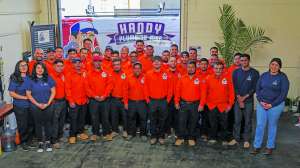
When the company first started, Parnell said it was mainly a van and maybe four or five guys doing just general sewer-cleaning work in the Cincinnati area. CCSI now has over 100 employees working in areas across the country.
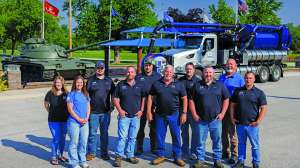
“We’ve grown into a big company, but we still try to maintain that small family feel to it,” Parnell says.
TAKING ON MORE
Today, brothers Pat and Chris Kurtz own CCSI. They purchased it from the company’s founder, their father Kevin, in 2009.
That ownership transfer also coincides with how CCSI has transitioned away from being just an industrial cleaning company. The company purchased its first vacuum and CCTV inspection trucks in the early 2000s and began doing some sewer projects around Cincinnati. By about 2007, CCSI started teaming up with local Duke Energy gas line installers to do pre- and post-job inspections as cross-bore awareness became more prevalent.
“We really kicked off with Duke Energy in 2009 and started to work directly with them,” Parnell says. “Then we just continued to grow from there.”
Hydroexcavation work increasingly came into the picture starting in 2010.
“We had combo units, but we didn’t do a lot of hydroexcavation at the time. It really wasn’t a big thing,” Parnell says. “But then there was an incident that required a safe way to dig, and we were contracted for the work.”
There was concern about an underground nitrogen gas line leaking into a manhole after a worker who entered the manhole died. CCSI had to expose a roughly mile-long stretch of the line in search of the leak.
“We ended up finding the leak,” Parnell recalls. “At the time, we had three Vactor 2100s. Then we brought in one rental, and another company we had assist us brought in two. We purchased another Vactor after that, and the hydroexcavation work kicked off from there. We saw the profit that could be made. We weren’t doing much hydroexcavation at all before that.”
The hydroexcavation mixed in well with the other work CCSI had been doing for energy companies.
It was around 2010 that CCSI also started branching out more beyond the Cincinnati area, first in other areas of Ohio and gradually across the country. In 2012, CCSI began doing cross-bore contracts for Pacific Gas and Electric and eventually opened a California office. Energy company contracts have also caused CCSI to establish offices in St. Louis, Missouri, and Charlotte, North Carolina.
“Signing multiyear contracts with energy companies forced us to open these various offices,” Parnell says. “In the beginning we used to have everyone from Cincinnati travel wherever to work, but as we have grown in these other areas, we’ve hired people from those areas.”
When Parnell first joined the company in 2006 as a general laborer, he was one of about 20 employees. Now across all the markets CCSI works, the company employs more than 100.
MANAGING THE TEAM
Managing a large team spread out across the country has its challenges. Employee hiring and retention can be a struggle, Parnell says.
“It’s harder now than it was,” he says. “We go through maybe three people to find one good person. It’s the work ethic more than anything. The work we do is hard. It’s in the elements, and it can be hard to find a person willing to do that work.”
CCSI does many of the typical employee satisfaction standards from annual holiday parties to bonuses.
“We just try to be fair,” Parnell says. “If we get an emergency call, and guys have to come in the middle of the night and work till the afternoon the next day, we’ll give them a bonus on their paycheck. Whatever we need to do to keep them happy.”
The growth necessitated hiring a human resources manager a few years ago.
“That has been very beneficial,” Parnell says.
One initiative the human resources manager set up is a company culture committee.
“We try to meet twice a month or at least once a month,” Parnell says. “It’s all the area managers from across the country and myself coming together to discuss what we can do to make employment better here. We do it on Zoom. That’s been a lifesaver.”
The culture committee recently put out a survey to solicit feedback from employees on things CCSI could be doing better. Anything related to employee satisfaction can come up in a meeting, Parnell says, like a recent discussion about options for company-wide outings or events.
EQUIPPED TO WORK
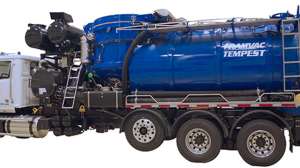
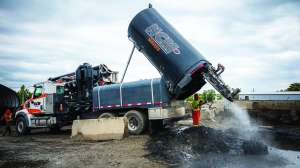
CCSI’s equipment roster includes 42 lateral-launch CCTV inspection trucks — 24 from Rausch USA and 18 from Aries Industries. The vacuum truck fleet includes 12 Vactor 2100s, four Guzzlers, KAISER PREMIER trucks and an Aquatech (Hi-Vac).
“Some jobs, we’ve had to go 200 to 300 feet off the road. So we’ve been able to utilize a hydrovac with the water, and then we take a Guzzler truck that we can run the flex hose off the 200 to 300 feet, be in the middle of the woods and still hydroexcavate down,” Parnell says. “We’ve noticed that some of these dedicated hydroexcavation trucks can’t pull the distance.”
SEEKING SERVICE BALANCE
“I don’t think they foresaw it getting this big,” Parnell says of CCSI owners Pat and Chris.
But through the growth, CCSI has still maintained a certain ethos that was in place when the company was much smaller. Although semiretired now, Pat and Chris have been active owners who for many years were very hands-on and putting in five-day work weeks regularly, Parnell says.
“Through networking, I know owners from other companies, and you’re meeting them on the golf course. That type,” Parnell says. “But Pat and Chris were here every day, five days a week. One would come in 7 a.m. to 5 p.m. and the other would be here 10 a.m. to 7 p.m., every day. They were involved in every aspect of the company.”
The brothers remain involved in some decisions but have passed on a lot of company oversight and leadership to people like Parnell and CCSI President Lincoln Stephenson.
“He’s very involved too like Pat and Chris were,” Parnell says. “Pat and Chris provided a good example of dedication. We’re appreciative of all the people working for us, and they’ve been a big part of the growth. It seems like when people come to CCSI, if they fit, they stay.”
Going forward, Parnell says the short-term plan is to focus on getting the pipe-lining division well established because the long-term goal is to have a healthy balance among all of CCSI’s service offerings.
“We’d like to get it to where the lining and all the industrial vac services make up 50% and the cross-bore work makes up 50%,” Parnell says.
Continue reading for free