

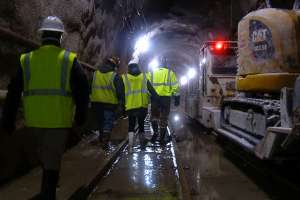
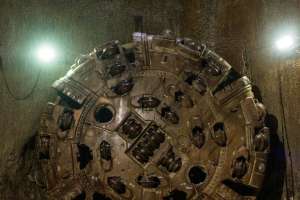

Deep under Indianapolis, a massive machine is slowly chewing its way through the bedrock the city stands on. In its wake, a new tunnel system will provide relief from combined sewer overflows (CSOs) that have plagued the city.
“DigIndy is a very large project that is going to include taking offline a number of CSOs that are currently located within the central part of Indianapolis,” says Tim Shutters, construction supervisor for Citizens Energy Group.
Citizens, a utility service company providing natural gas, thermal energy, water and wastewater services to about 800,000 in central Indiana, began the project in 2012 and expects to complete it by 2025.
“In 2011, Citizens acquired all of the water and wastewater infrastructure from Indianapolis,” says Mike Miller, manager of construction. “That included the city’s commitment to build the tunnel system to conform to the consent decree established with the U.S. EPA.”
NEED FOR THE PROJECT
When Indianapolis was built, the most sophisticated way to handle removal of stormwater was to use the sewer pipes.
“Under dry, slow conditions the sanitary flows run to the wastewater treatment plant and everything is fine and works as it should,” says Shutters. “When rain events come along, however, the system becomes overwhelmed. Overflows were created that exit into the local bodies of water.”
Indianapolis knew something had to be done to prevent the pollution. In 2006, the EPA and the U.S. Department of Justice reached a consent agreement with the city to eliminate 95 percent of CSOs by 2025. “We have about 138 CSO outfalls on the whole system and this project is going to catch about 100 to 110 of those,” Miller says.
THE PROJECT
The $1.9 billion project includes using boring machines to create 28 miles of 18-foot-diameter tunnels 250 feet below the city. The first two legs of the dig — mining of the 7.5-mile Deep Rock Tunnel Connector and the offshoot 1.9-mile Eagle Creek Deep Tunnel — were completed in March. The joint venture of Shea-Kiewit was the lead on the project.
“We are currently lining that portion right now with a 1-foot-thick liner to keep groundwater out,” Miller says. “It should be finished around the end of 2017.”
“Originally, the Eagle Creek section was going to be open-cut, but it was going to be very cumbersome and it was going to be deep and near a levee system. We were able to come to an agreement with our contractor and went ahead with tunneling that portion.”
Tunneling also added more storage capacity on the Eagle Creek line; with the open-cut route they would have used a smaller-diameter pipe.
The completion of the Deep Rock and Eagle Creek tunnels leaves just four segments to go. The next two segments — the White River Tunnel and the Lower Pogues Run Tunnel — are in the procurement process.
“We have asked a few contractors for pricing,” says Shutters. “Shea-Kiewit has done a great job, but we felt it was necessary to allow some other people to come in and competitively provide pricing so we could get the best value.”
The project is designed so that when each segment is completed, it can go online immediately while work continues on the next. “There will be a big bulkhead that we put between the Deep Rock Tunnel Connector and the next tunnel so everything south can go online,” Miller says.
THE NEXT PHASE
The White River and Lower Pogues segments are to begin early this year. The Lower Pogues is expected to affect downtown the most; it will go past Lucas Oil Stadium.
“Most people won’t even notice the deep underground work,” Miller says. “However, there are up to three drop shafts that we have to construct from the ground surface down in that portion of the project. That is going to be pretty impactful on certain parts of downtown for the better part of a year.”
Overall there are 33 drop shaft sites currently planned along the project route. While larger contractors will handle the tunneling portion of DigIndy, local contractors will handle the other parts of the project — installing drop shafts and other shallow consolidation sewer work.
“We’re on the backs of ratepayers and they want to see the money staying local,” Miller says. “The big tunneling contractors are employing local laborers and subcontractors and the shallow-work will be sent out to local contractors.”
SETTING RECORDS
The project earned national recognition in 2013 when Shea-Kiewit bored 410 feet in 24 hours, setting a world record for tunnel boring machines of similar size. “We’ve also broken records for the most production in a week and a month,” Miller says. “Because of that, we’re pretty far ahead of schedule.”
The tunnel boring machine was manufactured by The Robbins Company in the late 1970s and spent most of its life in New York working on water and subway tunnels.
“It most recently came to us via the Second Avenue Subway Project in New York,” Miller says. “Shea-Kiewit rehabilitated the machine themselves with input from Robbins and then Robbins manufactured a new cutter head specifically for this project.”
MINOR HICCUPS
No project is without its little hiccups and DigIndy isn’t an exception. There have been little pauses along the way, including finding unanticipated groundwater during the Deep Rock Tunnel Connector mining segment.
“The contractor was very good about working with us on a solution on how to mitigate the impact of the water during construction,” Miller says. “It wasn’t detrimental to the project. It was just a little more than anticipated in a certain area.”
Crews also had to deal with the alignment of Deep Rock, which includes many turns. Contractors use a conveyor belt system to remove debris from the tunnel.
“A conveyor belt only really likes being in a straight line,” Shutters says. “Every time we put a curve into the tunnel alignment, our contractor had to overcome some obstacles to make that rubber band want to turn.”
Having to deal with those alignment issues led Citizens Energy to look at the rest of the project and modify alignments in the next phase to minimize changes in direction.
“For the most part we have been very lucky with the project,” Miller says. “We’re fortunate to have great geology, a great engineering team and a great contractor.”
=====
PROJECT: Dig Indy
UTILITY: Citizens Energy Group
LOCATION: Indianapolis, Indiana
START: 2012
PROJECTED END: 2025
WHAT IS IT: A series of 18-foot-diameter tunnels 250 feet under ground in Indianapolis to minimize combined sewer overflows (CSOs)
Continue reading for free