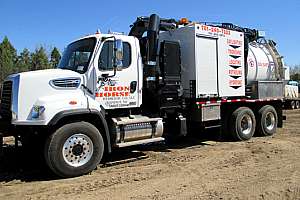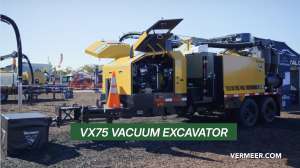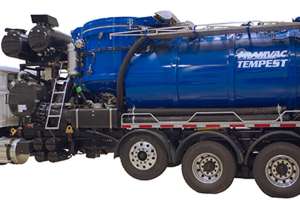

When Dwaine Ruckman, the owner of DR Hydrovac in Strathmore, Alberta, got into the hydroexcavating business in 2003, he wanted a truck that would be as safe it was durable and productive. He found just what he was looking for in the Tornado F4 Slope, built by Petrofield Industries (a division of Empire Iron Works).
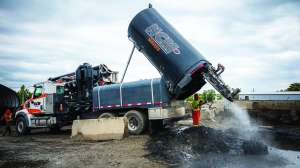
The truck includes an unconventional debris-tank design; it sits at a slight angle atop part of the water tank, which creates a floor that slopes toward the truck’s rear. This enables efficient debris dumping with a hydraulic sweep. Moreover, overhead obstructions don’t come into play because an operator doesn’t raise the tank to empty it, Ruckman says. “There’s less hydraulics on board and no subframe for a hoist, so the truck is lighter, too,” he points out.
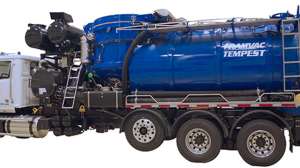
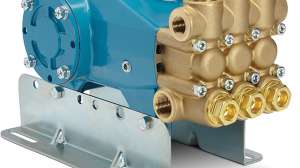
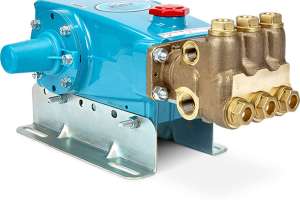
DR Hydrovac owns four Tornados built on chassis made by Peterbilt Motors (model years 2013 through 2015). Each truck features a 5,400 cfm blower, made by either Roots Systems or Hibon; a triplex water pump (25 gpm/3,000 psi) made by Cat Pumps; a 10-yard debris tank; a 2,000-gallon water tank; a 26-foot-long extendable boom with a 342-degree coverage radius; a 740,000 Btu boiler (to heat water used to excavate frozen soil); a Fuller transmission; and a 23-foot-deep digging capacity.
The large debris and water tanks increase productivity by minimizing trips for water refills and dumping debris. Moreover, the four trucks also include three drive axles in the rear, rather than two, which allows the units to legally carry more weight without violating highway weight regulations. “They also give us more traction on soft ground and less compaction,” Ruckman adds. “In our line of work, you can end up working on some pretty soft ground. We sometimes work on pipelines that cross private farmland right-of-ways, so they’re looking for less disturbance.
Ruckman says he specs blowers that will generate enough power to get jobs done; anything more is just overkill. “Bigger blowers equal more weight, and engines have to work harder to operate them, so you use more fuel,” he explains. “At the end of the day, is that better? You can’t charge customers any more money just because you have a bigger blower (than what’s generally needed), so we’d rather spend less on fuel. However, if I come across something that requires a bigger blower, we’re not afraid to mount one on. If I see a market for something, we’ll build it and make it go.”
The company aims to sell its hydrovac trucks after four to five years, while they still hold good resale value. Because the company sometimes sells used trucks to companies in the United States, the value of the American dollar versus the Canadian dollar can factor into the timing, too. “Sometimes we sell a truck just because it helps us buy the next one,” Ruckman notes.
But no matter when the company decides to sell a truck, it always get top dollar. Why? A comprehensive maintenance program. “When we’re not running the trucks, we’re checking them over front to back to make sure they’re running right,” Ruckman says.
Read more about DR Hydrovac in the March/April issue and learn how they handle industry slowdowns.
Continue reading for free