
Water for drilling operations can be tough to come by, and disposal costs for mud used in drilling can be expensive for companies to haul away.
For contractors trying to control their costs on job sites, reducing the costs of trucking in water and hauling away thousands of pounds of waste has a big impact in the long run.
Mud recyclers are one way to reduce waste and cut expenses, and they can be used with drilling operations of all sizes. These machines pull in dirty mud — slurry — used in directional drilling, and separate the solids from the liquids in order for the liquids to be used several times over.
THE RIGHT UNIT
Finding the mud recycling system that works best for your company can be tricky, but there are certain things you can look for to make your decision easier, according to Mud Technology International.
Factors that contractors should consider when looking for a mud recycling system include:
- Type of drill being used
- Drill rate
- Type of solids
- Length of the bore
- Gpm of the pump
- Tank volume you will need
- Number of cones
- Screen size
Contractors should be concerned about the environment as well when selecting a mud recycling system. The right unit will protect the environment and leave the job site as clean as possible.
“The industry is very stringent on keeping clean job sites,” says Seth Matthesen, senior product manager for Ditch Witch. “They’re really concerned about having it kept clean.”
Typically with a mud recycling system, the amount of waste hauled off a work site is considerably lower. Matthesen recalls a customer in Chicago who was pumping 20,000 to 40,000 gallons of fluid a day, and he only had to haul off 1,000 gallons thanks to the recycling system that was used.
ADVANTAGE OF MOBILE
There are several mud recyclers on the market from Mud Technology, KEMTRON Technologies and several others. Most of the systems are too large to move without the use of semis, but there are several on the market that are mobile and can be moved with pickup trucks.
“Without these systems, you’re going to take that mud from the drilling process and haul it off to your disposal area, which may be 5 to 100 miles down the road,” says Matthesen.
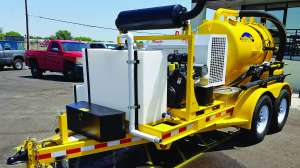
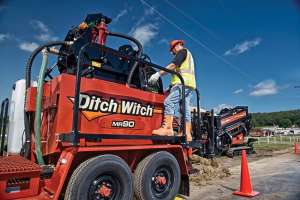
The MR90 from Ditch Witch is unique in that it is the only unit available that can be towed full of fluids. Matthesen says other units on the market don’t have trailers that are certified to haul that much material, so water must still be hauled to the system and then away following the job.
Ditch Witch says its MR90 can be set up on a job site within 10 to 15 minutes.
“In the mid-sized market, which our unit fits best, it’s fair to say that those drills are probably only going to be on and off a job in less than two to three days,” Matthesen says. “So to go through the process of taking a unit out and spending an hour to two hours to set it up just costs you money.”
THE MR90
The MR90 — Ditch Witch’s first mud recycling system — operates with a 25 hp Kubota Tier 4 engine that provides the power for recycling, drilling and all hydraulic functions, including the shaker action.
The unit sports a 450-gallon mud tank — a 110-gallon clean tank and 340-gallon first-pass mud tank. It also carries a 300-gallon freshwater tank for extra drilling fluid capacity and can be used for equipment cleanup.
Slurry — dirty mud — is first delivered to the MR90’s first-pass shaker screen where it is shaken to separate mud returns from larger particles. Those returns are collected in the rear hopper and later disposed of, or returned to the ground after being mixed with a drying agent.
Mud is then pulled from the 340-gallon first-pass mud tank where it is filtered again through six 2 1/2-inch hydrocyclones and final shaker screen. The clean mud is then stored in the 110-gallon clean tank for future use in drilling operations.
The unit has a shut-off on the tank, so when the tank gets full it will automatically shut off to prevent spills. It also allows for the operator to move away from the unit if needed.
“We got into this industry because we make our own drill pipes that go onto our own drills, our own electronics and our own beacons,” Matthesen says. “We can design and manufacture the units here, and we have quality control. We know it’s going to work well with our units.”
KEEPING THEM RUNNING
With any mud recycling system, it’s important for contractors to pay attention to the screens and hydrocyclones on the units, according to John Miller with Mud Technology.
Miller says routine maintenance on the machines will extend the life of the complete mud system and the unit’s individual components.
“When it is time to move the equipment from one location to another, take a few minutes and thoroughly wash the machine to remove all mud and debris,” Miller says.
Miller says it’s hard to determine the general life span of a mud system when purchased new. Ground composition and the volume of use play big roles in how long the system will operate effectively.
“What I normally tell contractors is we have units that were built in 1996 that are still in use today and still going strong,” Miller says. “We also have had units that had a life of less than five years of hard service that have required refurbishing and upgrading.”
Continue reading for free