John Panetta knew the time would come to add directional drilling to his company’s many services, but it didn’t happen overnight, as several other companies in the area already provided that service.
“In those first years of business we saw that the market was flooded with drilling companies,” says Panetta, owner of Panetta Excavating of Blanchester, Ohio. “There was too much competition.”
That changed with the economic woes of 2008 when Panetta started to see some of that competition shut down. Panetta decided then that it was time to add directional drilling to his company’s offerings. Directional drilling now accounts for 30 percent of the workload.
“It has been very good for us,” Panetta says. “The weather here in the Buckeye State is a big factor on jobs and directional drilling is an answer to dealing with the weather conditions we experience.”
BUILDING THE COMPANY
John and his wife, Sandie, launched Panetta Excavating in 1994, offering general excavation services to contractors, municipalities and agriculture customers. The company — with its five other employees — performs about 50 percent of its work with municipalities, 30 percent with commercial clients and the rest with mainly agricultural customers.
Sandie performs many of the office duties, while John and the five other employees are in the field most of the time. “It’s pretty gratifying to see what you have done at the end of the day,” Panetta says.
Panetta’s biggest goal from the beginning has been service diversification. “When one slows down, there is another that can sustain the business,” Panetta says, explaining why directional drilling was eventually added.
ADDING DIRECTIONAL DRILLING
After about 14 years in business, Panetta decided it was time to buy a directional drill. He purchased a Vermeer D7x11. “Before we had directional drilling and that capability, we would have to shut down a street or cause disruption for a business on a job,” Panetta says. “Now we have other options and more flexibility.”
With the D7x11, the company can handle 400 feet of drilling and up to 6-inch-diameter pipe. Panetta says he prefers not to get into larger-size pipe and have to add more equipment and technicians.
An additional benefit of the drill is it allows the company to work in Ohio’s varied weather and soil conditions. “There’s a saying here in the Buckeye State that if you don’t like Ohio weather, wait five minutes because it will change.”
The soil in the company’s service area is heavy clay and gets saturated in a rainstorm, making open dig unlikely for a day or two after a rain event. With the drill, however, the company can continue to work right after the rain ends. Panetta says his more experienced technicians operate the drill.
“There are hazards involved with directional drilling,” Panetta says. “If you drill right into a charged electrical line or gas main, it can be a very bad day. That is where having an experienced crew and other equipment comes in handy.”
Panetta says adding directional drilling gave the company the opportunity to add to its customer base. “We got into a more extensive list of clients including the smaller municipalities and water districts in our area of Ohio,” he says.
SUPPORT EQUIPMENT
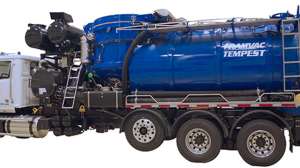
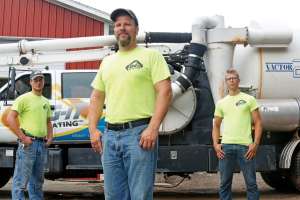
Two important pieces of equipment that go hand in hand with directional drilling are the company’s Digitrak Mark III locator (Digital Control) and a rebuilt 1985 Vactor vacuum truck on a Mack chassis.
The Vactor has allowed Panetta Excavating to expand services to customers. “With the water districts we do all the maintenance, including manhole maintenance, putting in any new taps and line repair,” Panetta says. “We can unclog sewer lines too with our Vactor.”
In one situation, crews were installing a sewer lateral that would be going under a gas main on one side of the street and above a water main on the other side. “We felt directional drilling was too risky to try,” Panetta says. “In that situation we opened up the road and did the installation. We could then verify with the Vactor where the water main was and the gas main.”
The rest of the company’s fleet includes:
- Four Chevrolet service vans
- 1985 Mack DM dump truck for debris hauling
- 1993 Mack CH tractor for equipment hauling
- 1998 Mack RD dump truck for stone and sand hauling
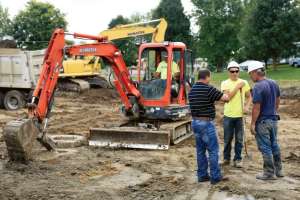
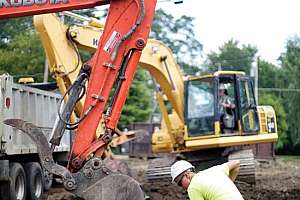
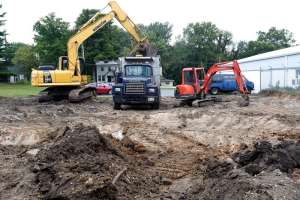
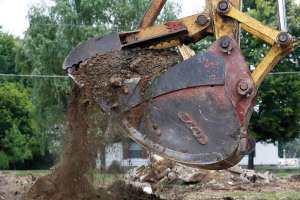
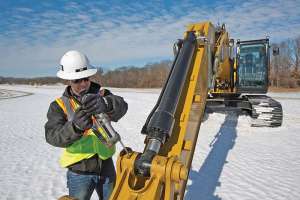
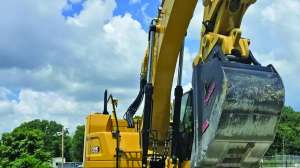
- Two Komatsu excavators
- Caterpillar backhoe
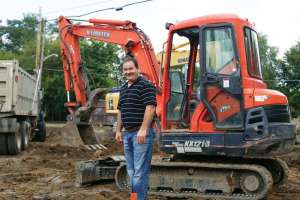
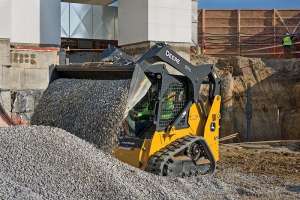
- Two bulldozers, two skid-steers and a mini-excavator
All of the equipment comes in handy when the directional drill isn’t available because of job site conditions. “If we are dealing with sewer or storm sewer lines and the area is too flat, we would stay away from directional drilling because we need a little grade in order to move the fluids,” Panetta says.
BRING ON MORE IN THE FUTURE
Panetta says although he is not eager to grow the company, he is always interested in new technology as it comes along. The company is looking at possibly moving into pipe bursting services or more hydroexcavation work.
“We have a very good crew and we enjoy the advantages of a small company where employees are much like a family,” Panetta says. “If we got much bigger, I would be behind the desk, and that’s not me.”