Mitch Louis has worked in and around Texas and Oklahoma oil fields for three decades. When the industry “took a pretty good hit” 10 years ago, he temporarily ran a small Colorado manufacturing company. Its product? Hydroexcavation trucks.
“The company owner was my friend and was in the process of buying a patent to help his business,” Louis recalls. “He wanted me to come out and sort of be CEO for nine months while he was off chasing the patent. It allowed me to see how the trucks were built and the logic behind them.”
Louis liked what he saw, and it set off a chain of events that would eventually lead him to starting Texas-based 4 Warriors Hydro Excavating with his family.
A HYDROVAC START
Louis and another friend started a hydrovac company in 2010 called PLJ Enterprises. It was dedicated to oil field cleanup tasks like flushing mud pits. To keep busy, the company’s hydroexcavators ranged across a 200-mile radius of the Texas Panhandle and adjacent Oklahoma territory. After three years, Louis sold the company to a Canadian firm, Lonestar West Hydro-Excavation Services, and stayed on with the new organization for a year to assist with the transition.
Then it was on to something else for Louis — specifically, starting up another company. Louis admits to being “an entrepreneur at heart,” which means he likes to start and grow companies, not necessarily grow old with them. “My ultimate goal in starting PLJ was to build the business and sell it,” he says, a sure indicator of entrepreneurial genetics.
His second company, ML Services, was an oil field work-for-hire firm that cleaned drilling rigs, pressure-washed equipment, broke down and moved rigs, and performed general roustabout tasks. Entrepreneurial restlessness led him to close ML Services in 2015 and launch yet another firm, 4 Warriors Hydro Excavating. This time, his son Blaine Louis and other family members became part of the entrepreneurial team. Consequently, 4 Warriors feels more permanent.
A FAMILY VENTURE
The Louis family calls North Texas home, though Mitch and his wife, Sherrye Louis, live today in Elk City, Oklahoma. He is a native of Shamrock, Texas, situated between Amarillo, Texas, and Oklahoma City. In the early 1980s, he attended ag classes at West Texas A&M in Canyon to broaden his career horizons. But with a family to support, he shortly returned to work, signing on as a Shamrock-area pipeline construction worker. It was the Eagle Ford shale formation that finally drew Mitch deeper south into Texas.
Eagle Ford oil and gas development is centered on a swath of 15-30 counties (depending upon who’s counting). Investors poured $30 billion into the development in 2013. In March of this year, nearly 90 rigs were drilling horizontal wells there, 77 of them looking for oil.
After Mitch sold out to Lonestar West, his son was hired on with Lonestar and moved to San Antonio to join the Eagle Ford scrum. Blaine, who had worked part time with his father since high school, had built relationships with drilling companies in South Texas and Lonestar West took advantage of his connections. Blaine started a Lonestar West branch in the area with a fleet of three trucks, which he built up to six.
“It was a first big opportunity for me,” Blaine says, calling it a life-changing experience. That’s saying something for a guy who at age 18 began a seven-year stretch of riding bulls in professional rodeos. He admits to breaking plenty of bones in the rodeo ring but also says it taught him to hold nothing back when competing, in business or anything else. Blaine stepped up to shoulder increased responsibility with Lonestar West, and when he and his father launched 4 Warriors two years later, he was ready to be a full partner in the work.
DEPENDABLE TRUCKS
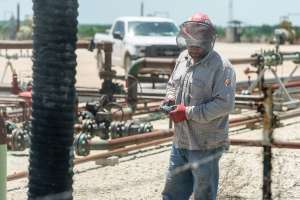
The men decided the new company would target oil fields in south and west Texas. They have found plenty of work there.
“We have a variety of clients today,” Mitch says. “Ninety-nine percent are pipeline contractors. I’m proud to say we have 30 to 40 companies we work for on a regular basis.”
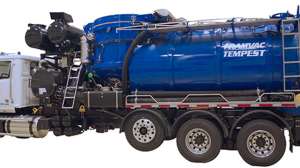
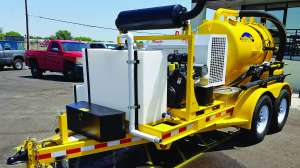
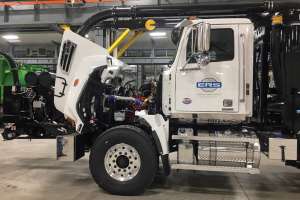
To serve all those customers, 4 Warriors operates 10 hydroexcavators, up from three in 2015. They are all Foremost vacuum units manufactured in Calgary, Alberta, and introduced to Mitch by Lonestar West. Most of the units are Foremost 1600 models fitted to a chassis with triple rear axles and a 425 hp engine. The trucks feature a 1,600-gallon water tank and a 13-
cubic yard debris containment body. Rear-mounted 8-inch booms are wireless-controlled.
The rest of the fleet are 1200 models with 1,200-gallon water capacity and 10 1/2-cubic-yard debris capacity. Asked why he went with the Canadian manufacturer, Mitch says it was a consequence of both technology and relationships.
“The Foremost trucks are a little bit more expensive than some, but they’re a better-made truck, more durable than a lot of hydrovac trucks out there,” Mitch says. He adds that the trucks are not necessarily superior “but they are the only units I’ve ever really run, so I understand them. I can work on them myself. The thing we like most is the design. A chassis is just a chassis, but the working end of the Foremost truck works really well.”
The relationship with Foremost began with a good friend who was involved in the trucks’ manufacture. Mitch has since built other friendships in the company. “What sets Foremost apart in my mind is the relationships I have with the guys who build the trucks. Those guys are personal friends.”
POISED FOR GROWTH
4 Warriors is exclusively an excavation company — no power-washing. Blaine insisted on it. “I made my dad swear we would just use the trucks for what they were designed to do: dig,” Blaine says. “There is just a lot of hours in cleaning, and it’s hard to keep hired hands.”
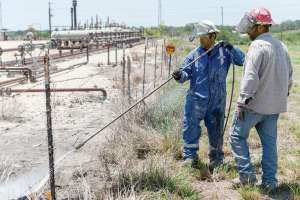
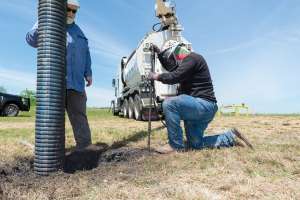
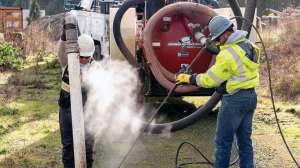
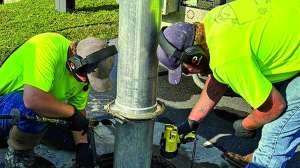
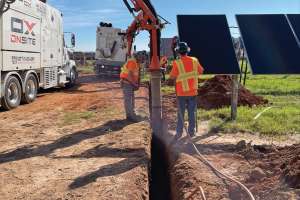
The company exclusively potholes, trenches, and daylights; and any given job might include one or more of these services, and most jobs do.
The $5 million-a-year company has 23 employees, with Mitch as president and operations manager and his son as vice president and sales manager. Because Blaine has built up relationships across the region, he can cultivate sales and market the company mostly over the phone. “It hasn’t meant a lot of travel for me, so I can stay close to home and be with family,” Blaine says.
Rocky Johnson, an ex-bull-riding rodeo buddy of Blaine’s, was hired a year ago as the company’s first salesman and covers West Texas oil and gas operations. Samantha Louis, Blaine’s wife, is the company’s office manager at the headquarters in Marion, Texas, taking care of payroll and other paperwork. “Really, she takes care of the headaches,” Blaine says.
With key positions filled, the company is poised for expansion.
“I honestly think the oil industry will be pretty good for another five years anyway,” Mitch says. “I look forward to the growth of the company. I think a good round number for the truck fleet is 12. When we get to a dozen trucks, we’ll sit back and contemplate what’s next.”
The expansion of the truck fleet has been more customer-driven than planned, according to Mitch. “If our customers have to wait for us to show up — if we have to tell them ‘No, we can’t get to you right now’ — we feel like it’s time to look at adding another truck. If you tell a customer no too many times, you begin to hurt the relationship.”
At this point, 4 Warriors has enough trucks and manpower to answer all calls. “That’s so important,” Mitch says. “Utilization is huge in our business. We’re not making any money when we’re sitting around.”
4 Warriors is a lean operation, with company executives taking turns operating the hydrovac trucks as needed. In the course of the interview, Mitch notes that he had just gotten off one of the trucks. “I ran it for a week,” Mitch says. “We’re not blessed with paying a lot of extra people to sit around. Last week was spring break and a couple of operators took a week off, so we filled in.”
ABOVE AND BEYOND
The 52-year-old company president clearly is a people person. His personal driving force might be entrepreneurial in character, but it is predicated on doing right by people. Blaine says relationships indeed are central to how his father conducts business, but so is doing things the right way.
“He does it the honest way, not under the table,” Blaine says. “He learned early on that the honest way of doing business is the better way.”
The people-focus is unmistakable. The choice of hydrovac trucks was keyed to good relationships with the people building them. People are behind the Louises’ service mantra.
“If you tell a customer you are going to do something, you produce and those relationships become stronger and stronger,” Mitch says. “As long as you are a service company, and that’s all we are, I believe you have got to provide service that goes above and beyond everybody else.”
Still another set of people is considered the key to 4 Warriors’ success: employees. “We basically all do the same thing in the industry,” Mitch says. “Everybody has trucks. It’s the people you employ to run those trucks who are the difference. We recognize that the people who run our trucks are the ones who sell our work.”
FOR THE FAMILY
But the most important people to Mitch clearly are his family members. He wouldn’t have started 4 Warriors if his son hadn’t wanted to be his business partner, he says, partly because his son is of a younger generation.
“The oil and gas industry as a whole is under new management, and new management brings new technology,” Mitch says. “It takes someone like Blaine and his generation to relate to those changes. Let’s face it, most of the time the younger generation doesn’t really appreciate what us old-timers think anyway.”
He believes the hydroexcavation business is somewhat handicapped by being so young. He cites the difficulty he has in finding qualified truck operators.
“We are still a new industry. We don’t have 15-year veterans we can hire,” Mitch says. “I’m afraid if the industry doesn’t pay attention, some of us old guys will retire without passing along the business knowledge we should have.”
Mitch says he won’t be selling 4 Warriors. He equates starting a company to birthing a child, and he didn’t enjoy watching how one of his “children” was treated after being sold to Lonestar West.
“I want to continue to help build it, and someday it will be Blaine’s and maybe his son’s — they have a 2-year-old boy and a girl on the way,” Mitch says. “I hope it is a family-run operation for years and years.”
As for him retiring after his son takes over, Mitch isn’t sure he can. “I say I am going to retire, but I don’t know. There’s no telling what I’ll get into next.”
Surviving during the recession
4 Warriors Hydro Excavating became a company in early 2015, starting with the purchase of two big Foremost hydroexcavators. A third truck was added in July of that year. And then the national slowdown in shale oil field work caught up with the company.
Fracking and horizontal drilling in the U.S. had challenged the ascendant position of OPEC oil countries, which responded by pushing a low-pricing strategy. The North Dakota shale range was perhaps hardest hit in 2015 when oil prices slipped, but Texas was hurt, too. Only fracking companies in the Permian Basin of West Texas continued to produce in volume, and that area could not by itself support all the state’s auxiliary companies.
“Everything went south in a hurry,” says Mitch Louis, company president. “We had just picked up our third truck a month before, and we felt like if we were going to survive, we needed to diversify.”
The company looked for work with utility companies. In November of that year, 4 Warriors landed a contract with a major telecom company in the state capital, Austin.
The potholing and trenching work for the company proved difficult, however, partly because the big rigs that were intended for use in wide-open oil field situations were far less suitable for Austin’s congested primary and residential streets.
“It was very challenging operating our big trucks around the city’s oak trees,” Louis says.
The money wasn’t really there either, Louis says, and sometimes wasn’t quickly forthcoming.
“But the Austin work did keep us above water during a time when there really wasn’t anything else going on,” Louis says. “We maintained our employee numbers for eight months and kept all our equipment. When the oil field work finally came around again, we went back to it. Any hydroexcavation company that made it through that slump had a head start when the work returned.”
Today, 4 Warriors is once again busily supporting the fracking industry. When the oil field economy recovered, the Louises left utility work behind. Blaine Louis, Mitch’s son, says the diversion into utilities was a worthwhile experience because it taught the company something about working the trucks in different situations. Yet he agrees with his father, who says, “Utilities wasn’t our niche.”
Nevertheless, utility hydroexcavation work will remain an option during tough economic times. The Louises say the company will return to the urban work or to some other commercial activity if the oil business slumps again. “If the industry slows down, we will diversify again,” Mitch says, reluctantly.