
There are a hundred little things on a construction site that can potentially endanger the public; that’s why having a foolproof plan for every single job, big or small, is more than good practice.
“It doesn’t matter how much money we make, or how big the project is. If somebody gets hurt, that job is a complete failure,” says Richard Crow, regional manager with Murphy Pipelines Contractors in Florida.
Possibly the most vulnerable members of the public around job sites are pedestrians.
THE BASICS
Dealing with safety means dealing with hoses and cables, walking routes, and potholes, among other challenges and obstacles. It is the contractor’s job to find solutions to those challenges.
“If an access pit is left overnight, the site has to be secured with construction fencing and a temporary cover,” Crow says.
There are many options for temporarily covering pits to reduce risk and liability. Contractors should consider a specialized device — a piece of plywood doesn’t do the trick — such as raised plastic pothole covers available on the market.
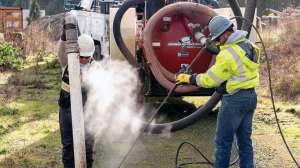
When working with hose or cable, sometimes access is an issue, and often contractors must cross lanes of pedestrian traffic. “We use ramps for our lines, made for pedestrian and traffic bearing,” Crow says.
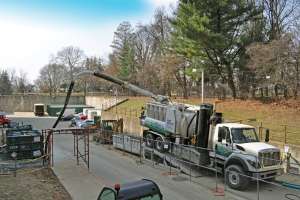
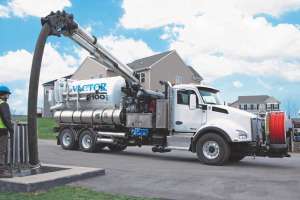
Other jobs may require more elaborate solutions. When Ecotech Hydro Excavation in Quarryville, Pennsylvania, was excavating debris from a hospital basement, the company’s GapVax unit was parked across the street with the boom stretched over the road. Scaffolding carried the hose over a sidewalk to protect pedestrians walking beneath.
Depending on the service, having the appropriate number of people on site is also important. Using spotters to ensure bystanders aren’t getting too close is always a smart decision.
“A lot of times you’ll get the wanderers that come up and they just want to know what you guys are doing,” says Anthony Chavez, safety compliance officer for Minnesota’s Davids Hydro Vac. “If you don’t have that extra guy, they may go into an area that you’ve already excavated or they may not pay attention to the caution tape or the cones that you have set up.”
The last essential any company should have is insurance. If the worst would happen and someone is injured, it’s important to be covered. “We have coverage in case something happens — lightning does strike,” Crow says.
MAKING THE PLAN
Companies that are generally working in areas where there could be pedestrian traffic are advised to develop a plan for the job site before work begins.
“We are out here providing a service, and generally there are some specs or guidelines in providing pedestrian safety or vehicle safety,” Crow says. “I think it’s crucial for all parties to have a review process when you’re submitting something for pedestrian or community safety.”
For Crow and his team, the first step when approaching a job plan is to survey the site. Murphy Pipelines Contractors supervisors start with a drive-through, followed by an aerial survey via Google Earth. They then use that aerial map to analyze routes and traffic, then sketch out necessities for that particular job.
“You need to understand what the construction crews are going to do during the day: what access they need, to and from the site,” Crow says. “A lot of times people are worried about the site itself, but you have dump trucks and other large deliveries coming through the site every day. And how are they going to off-load. How are they going to pick up?”
After agreeing on a plan, it is formalized and industry-standard traffic and pedestrian control is applied. “It could be not just vehicle traffic, it could be sidewalk traffic,” Crow says. “How are you going to detour people around sidewalks? How are they going to access it?”
The plan is also submitted to necessary authorities — municipality, county, or state Department of Transportation — and reviewed by the client. After those approvals, the plan is distributed to site superintendents and foremen to be implemented.
GETTING THE WORD OUT
While signage is needed at job sites to warn of dangers and traffic changes, contractors should also communicate with the general public prior to work starting. “Messaging is really important,” Crow says. “It’s easy to put up a few cones and some detours around, but if you don’t notify the public in advance, it just causes confusion.”
Crow suggests notifying them in advance of any obstructions or detours or obstacles that they might come upon. He knows firsthand the danger of this topic. Before working at Murphy Pipelines Contractors, he was the client on a job where the contractor picked up some signage before the site was clear. As a result, a woman rear-ended a dump truck and was killed in the accident.
“That contractor made an error by picking up his traffic control plan too early,” Crow says.
REVIEWING THE PLAN
Often, in construction, all you can do is roll with the punches. But having a solid safety plan and understanding of the site before work begins allows contractors to make those on-the-fly changes with confidence.
“Generally when the job starts, things change. It’s just construction; it’s the nature of the beast,” Crow says. “We consider the safety plan a working document, so we continually review throughout the progress meetings.
“This gets lost amongst a lot of contractors, engineers, and even clients: No job is too small, or too big. It should be the same thorough process. I think once a party assumes that a job is too small, that’s when issues are going to come up,” he says. “You just don’t want to miss anything when it comes to safety.”
Continue reading for free