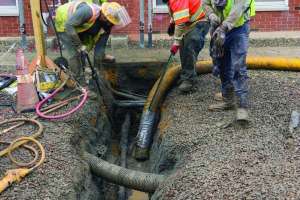
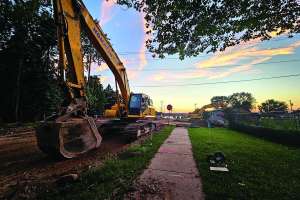
A subcontractor crew working for McVac Environmental Services uses the hose from one of the company’s custom vacuum excavators to expose utilities at a job site in Morristown, New Jersey.
Operating Engineer Mike Evans (left) and technician
Ryder Ruzzano prepare a custom vacuum excavator
with an Industrial Vacuum 6,400 cfm pump and onboard air compressor.
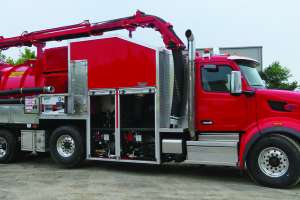
Charles Demers and his team at McVac Environmental Services relentlessly evaluate how to increase the efficiency of their heavy equipment to best serve clients and keep the company growing. Consequently, the New Haven, Connecticut, firm mostly operates custom-built machinery that generally exceeds industry standards.
“After 35 years of being in the business, we believe we know what clients are looking for,” says the company president and owner. He adds that the functionality of a piece of heavy equipment is all important, that it can actually do what it was built to do or, in some cases, be versatile enough to, say, vacuum-excavate test pits and trenches one day, then vacuum, truck and dispose of anhydrous liquid the next. “If something changes in a project or throughout the day, you want to be able to pivot.”
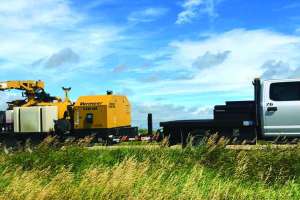
The company doesn’t build the machinery inhouse. Rather, it specs out the chassis it wants for each rig and works closely with an engineer and custom fabricator to turn out vehicles that will meet its expectations. The machines then are custom-built from the ground up, nearly a dozen a year on average the past few years. “We always seem to change one or two things as we design these trucks because we’re constantly learning and wanting safer, more efficient performance,” says Demers.
Bottom line: Some 95% of McVac Environmental Services’ fleet of 150 trucks is custom-built. The handful of others, such as roll-off and dump trailers, are commercial brands. It is a prime example of how McVac has, in Demers’ words, methodically worked to “couple best-in-class operators with custom-built machines to separate ourselves from the crowd.”
Its competitors range across the eastern United States, with McVac’s service area covering more than 20 states from Maine to Indiana to Florida. With the corporate office in New Haven, the company has for decades maintained a 24/7 facility in central New Jersey, and since 2020, has added operations facilities in Virginia, Pennsylvania and Long Island, two in New England and one in northern New Jersey.
However, work projects extend well away from the company offices. Wherever their clients are working, McVac will be there to support them. Year to date, McVac has performed services at energy facility and pipeline job sites in North and South Carolina, Mississippi, Louisiana, Oklahoma, Illinois and Michigan. In mid-June, there were 10 McVac trucks on Kinder Morgan projects in central Tennessee.
And who are these excavation clients? “I would say we have a fair mix of clients,” says Demers. “We do a lot with energy infrastructure and utility general contractors including electric transmission, oil and gas pipeline, and specialty rail and heavy civil contractors.”
Daylighting, potholing, trenching — the work is the same wherever it is happening, but the type of excavation equipment can vary by region. “It will depend on the territory. In the Northeast, mud disposal is much more challenging, so a lot of contractors prefer pneumatic. While down south, there is much more clay soil and disposal is easier, so hydro is preferred.”
Sometimes soil on the same project will vary and, without warning, a different type of vacuum equipment is needed. No problem. “Beginning in 2024, the majority of our trucks are capable of doing both,” Demers says. “If we are excavating with air and the client wants hydro for some reason, we just flip a switch.”
McVac also is known for its specialty vac equipment, the most striking example being its Vac Traxx unit. The massive machine was engineered in-house and then custom-fabricated. It serves two sets of clients. The wide-track off-road vehicle weighs 100,000 pounds and yet exerts only 3-4 psi, so it can operate in wetlands or swampy areas and safely cross over existing pipelines without first laying timber matting. Its debris tank can hold 10 cubic yards of debris. Vac Traxx is often potholing and pitting on vast soft parcels being developed as solar or wind farms, as well as along tree-lined transmission right-of-ways.
The other usage of the Vac Traxx is in places like hilly areas of Pennsylvania and West Virginia. Its low center of gravity and wide stance allow the vehicle to directly climb slopes of 50 degrees and move along side-slopes of 30 degrees. A stream at the bottom of the hill? The one-of-a-kind mobile excavation unit can cross water up to 50 inches deep.
McVac also offers clients its Hy-Rail vacuum trucks that are driven onto railroad tracks and hydraulically converted to ride the rails. The trucks can roll to a designated stretch of track to daylight utilities, remove fouled ballast, remediate fuel spills, excavate foundations and perform other tasks. A custom-built jet vac combo unit with a 2,000-gallon water recycling system can finish a cleaning job without having to replenish its water supply. “These units are being used every day,” Demers says, “mostly along the Northeast Corridor.”
The company also operates high-dump vac trucks that can directly unload into roll-off containers.
“If we are working in a contaminated site that capability becomes important,” Demers says. “The collected material never has to touch the ground.” The company has a dozen of the high-dump vac trucks.
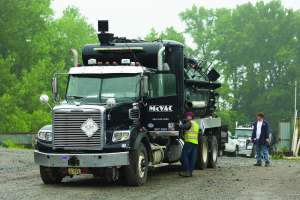
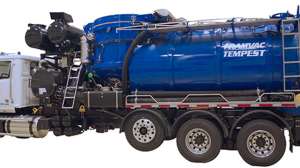
The company’s custom vac trucks often are more powerful than mass-manufactured ones — typically, the McVac trucks are powered by 550 hp diesel engines — and feature 17-cubic-yard debris tanks that are built to standards that qualify for containing ordinary or contaminated debris, adding to a unit’s versatility. But they are not what Demers calls “monster trucks” — that is, way-oversized vehicles.
“Such trucks have a ‘wow’ factor, but getting a truck to a site is important,” Demers says. “It can be tricky to navigate trucks in and out, and our clients want us in and out as fast as possible. All of our trucks have huge power, so if job settings prevent the machine from being positioned alongside the work, that’s not a problem. A McVac truck can move material upward of a few hundred feet horizontally and upward of a hundred feet vertically. But we pay attention to their physical size too.”
The president was asked how this concentration on sizing and configuration of the vac trucks measurably benefits McVac. “It allows us to be more productive on a daily basis,” Demers says. “We are paying more for the equipment but we are more productive as a result.” He added that some pencil-pushers might see getting a vacuum job done quickly as a downside because it can diminish the final payout.
“Our clients keep coming back,” he says. “That’s what matters. If we can go in and knock it out of the park and are called again because we did, that’s what matters.” He said the company has accumulated many examples of the faster-than-expected completion of an excavation job.
Has he noticed if vac truck manufacturers and contractors are responding by upping the capability of their vacuum units? “I have seen a lot of manufacturers change their specs a little bit, but they don’t look at the details like we do. We look at every detail of a piece of equipment — the electrical, the hydraulics, baffles, how the pipes are run — and change things to whatever works best for us. Others have changed their trucks but have not changed enough to really compete side by side.”
Another McVac service is employing high-pressure sewer jetting trucks to clean pipes and culverts at industrial plants, in municipalities and on highways. Some 60-70% of such work by McVac is in support of contractors working on department of transportation projects. While it will clean pipe as small as 6-inch, the company primarily works on culverts and larger diameter lines, such as 48- and 72-inch lines. Its trucks typically have 4,000-gallon water tanks, 300 gpm pumps and recycle 99.9% of water used in the cleaning. It sends RapidView IBAK cameras into the lines for inspection. Demers says the company especially shines on sites where access to the work is challenging. “We like the challenge to figure out the way to proceed safely and efficiently, and we’re fortunate to have employees who have deep industrial, facility and complex site experience.”
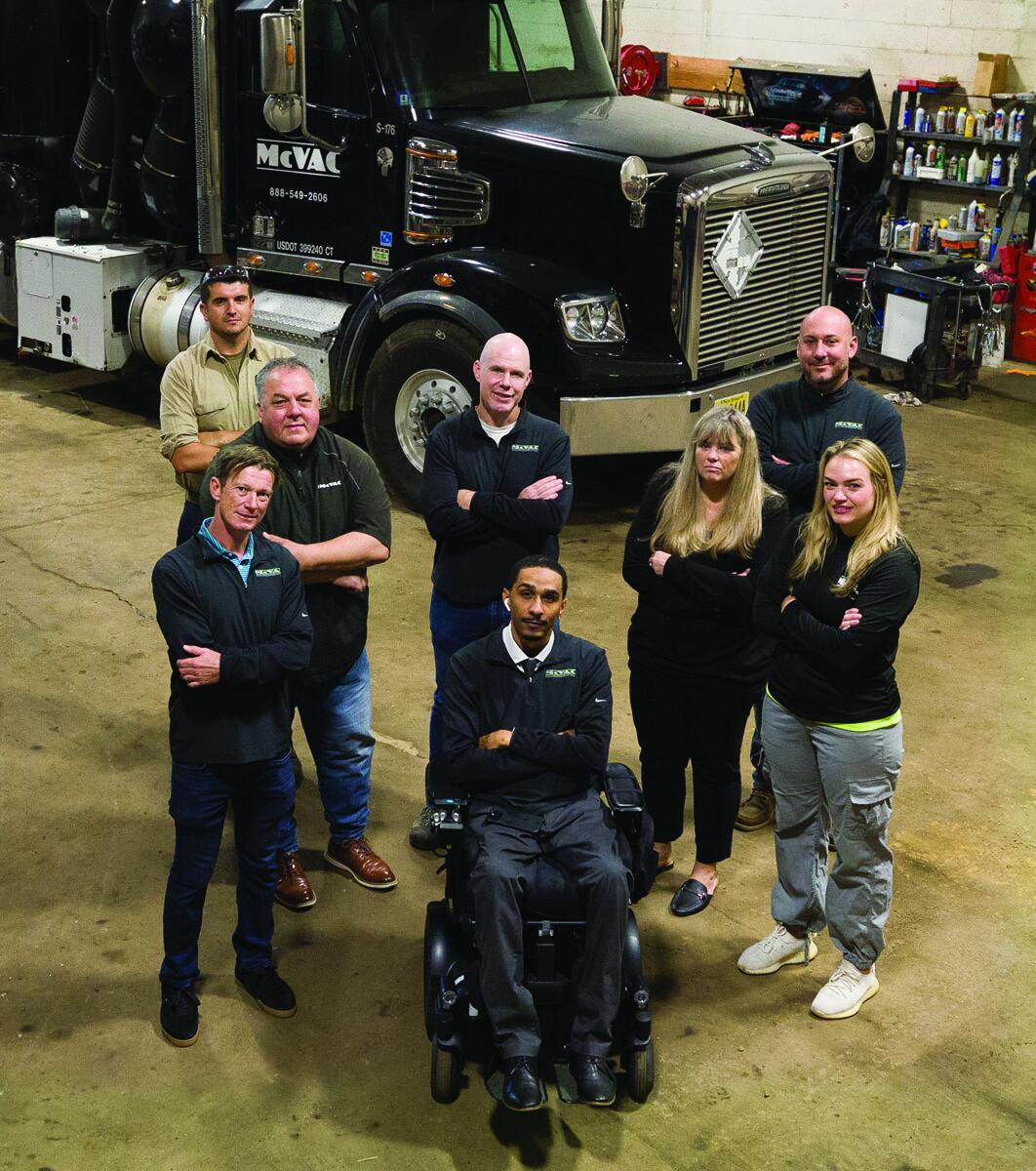
McVac Environmental Services is a union shop, so benefits are attractive and Demers says he is working to keep the family-owned company a family business.
“We want to help our co-workers, whether on a personal or work level. If anyone needs anything, my phone and my manager’s are on,” he says. “We stand behind our people because while you can provide the best equipment, you need to take care of the people who make it all happen.” A number of employees have been with the company for 15-20 years, an indication that its culture is working.
Asked to describe the company in a word or phrase, Demers responds, “One McVac. Even though we are in different locations and offices, we are all part of the same team. We problem-solve together and support each other. That’s very crucial to the company’s success.”
As for the future, Demers says the company is sort of feeling its way. It might venture into the Midwest, but he hasn’t considered the western seaboard states. For now, he says, “We will keep strengthening our current service, while migrating south and a little bit west. We feel comfortable with that.” Managing travel time and other logistical considerations is a factor in expansion planning. “We don’t want to burn any business by not showing up when expected.”
What the president does want to see is for the company to “get a lot more involved in turnkey work.” That is, he wants McVac to handle by itself whatever combination of tasks is involved at a site — for example, vacuum excavation, water and waste management, decontamination and groundwater remediation.
McVac is currently a turnkey service provider at several high-profile energy and infrastructure projects in the Northeast. With the suite of environmental services the company offers — powered by some special machines — the president envisions McVac becoming more and more a “one-stop shop.”