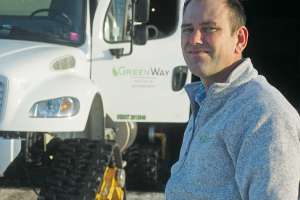
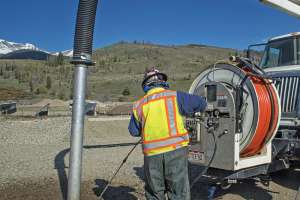
Troy Peterson doesn’t like to sit around doing nothing for very long. When he sold his interest in a steel recycling operation, he knew he needed to find something new to fill his time.
After talking to his brother, who works for an oil company, he found it: owning a hydroexcavation company.
“I was just going to go simple with no employees and stay small and just have fun,” Peterson says. “I started with one truck, and that didn’t last long.”
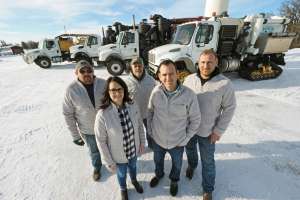
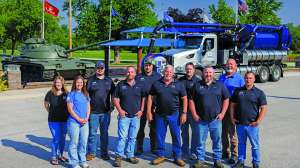
Six years after starting GreenWay Environmental in Karlstad, Minnesota, with just one truck and himself, Peterson has grown his company to five trucks and five employees. There are plans to add two more employees and more trucks this spring.
“We’re just a small company, but we’re making a big impact out here,” Peterson says.
VARIOUS WORK
That “out here” is in a little corner of northwest Minnesota, near the border of North Dakota and Canada. However, Peterson says he will work in any of the 50 states.
Most of his work, though, keeps him in his immediate service area, working along pipelines for oil and gas companies, and potholing of utilities.
“We do the city work, waterlines and sewer lines,” Peterson says. “That’s the normal day-to-day stuff. Then we do all the pipeline work, the station work, the big digs and then all the potholing of stuff out of the stations.”
Most of his current customers have used his services since he first started GreenWay Environmental. It didn’t take long for his business to grow.
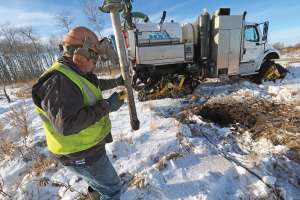
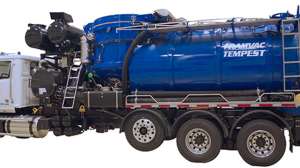
After starting with one Vactor HXX 2112, he now has two of those machines with 12-cubic-yard debris tanks, one Vactor ParaDIGm unit (3-cubic-yard debris capacity), a Vermeer VSK 800 vacuum excavator, and a Westech Vac Systems unit that he took possession of in late February.
Peterson says he’ll also be buying an oil-vac truck in the near future as well to bring his total to six trucks.
“I knew the company was going to grow fast; that’s just the way things go with me,” Peterson says. “There’s really no half-throttle. We just do it, but we do it really well. I have very, very good relations with my customers, and we take care of them.”
Peterson believes that is one of the reasons why his customers like working with his company — his and his crew’s willingness to get out and work with the foremen and lend a hand if needed.
Beyond the hydrovac work, the company does reclamation work, as well as building and structural moving. It also just recently acquired a crane and will rent that out to customers.
UNIQUE EQUIPMENT FOR UNIQUE WORK
Working for oil and gas companies provides some challenging environments, many of which include swamps, where gaining access for big hydrovac units can be difficult.
“I was in my second year of running the company when a gas company gave me a pile of work and I was going to do all the hydrovacing on these digs, but it started raining,” Peterson says. “They didn’t have it in the budget to bring in big mats to get my big truck in.”
Peterson says it made him think about ways to get that work he was missing out on because of the size of his current trucks.
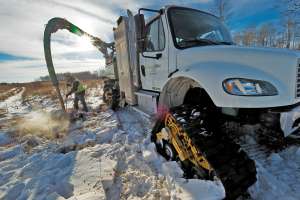
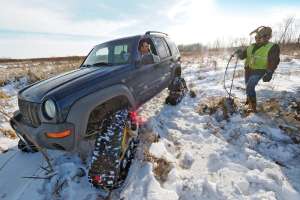
“That’s when I teamed up with Mattracks and we started talking about putting tracks on a hydrovac unit,” Peterson says. “They had never built a track that big for that type of application for something that heavy. I told them that I thought it was something we need to do.”
Mattracks and GreenWay Environmental came up with what Peterson now has on his ParaDIGm unit — 400 Series rubber track conversion system treads.
“It was strictly because I was tired of losing work because I couldn’t get my big truck into these fields,” Peterson says. “The first job I used them on was for an oil company. They were rerouting this pipe, and they had me come in there. They had budgeted for a month and a half with the big truck to do all this hydrovac work.”
Peterson, however, came out with one of his tracked units and knocked off the job in two days, without putting a mat down. Thanks to that job, GreenWay Environmental now does more work for the oil company.
“Now we go to these jobs in Nebraska with the tracked truck and we do all the off-station work that leads into work for the big trucks,” Peterson says. “They just hire me for everything.”
ADDING THE FIFTH TRUCK
It’s no secret that Peterson is excited about his newest hydrovac unit from Westech. It was a must-have truck with more work coming from the oil and gas companies. The small ParaDIGm is nice, but having a larger truck still capable of getting in those tough areas was important, he says.
That’s why Peterson worked with Westech in the last year to design the hydrovac unit for his company. The new truck is a 9-cubic-yard tandem that stays under the legal road limit when full.
The truck, which can be fitted with tracks, has a hydraulically driven Roots (Howden) 624 blower (3,200 cfm, 16-inch vacuum). Ben Schmitt, Westech general manager, says the truck looks like a baby brother to a Westech Wolf, with side-mounted aluminium water tanks (with 1,000-gallon total capacity).
GreenWay Environmental is the first company to have the new truck, allowing Peterson to get the truck into the field and prove it’s performance before Westech goes to market with it, according to Schmitt.
“I’m a Vactor and Westech guy,” Peterson says. “They’re the companies that will, at all costs, get you up and running. I’ve been hollering and hollering for years that we need a legal tandem. I’m glad they reacted.”
Peterson says from this point forward, he will only be getting the 9-cubic-yard trucks for his company because of the weight issue.
FINDING THE HELP
Peterson knows he could grow his company even more, but one of the challenges he faces — much like the rest of the industry — is finding the employees, especially in northwestern Minnesota.
“I have a tough time getting guys,” Peterson says. “We’re all union here, and the available employees are used to working a job, getting laid off and going.”
Peterson, however, says he has never laid off any of his employees and likes to hire full-time, local people.
“I try to get them younger and bring them into the company and train them, and hopefully they stick around for a while,” Peterson says. “The toughest part with us is their job and being away from home. It gets tough. Sometimes they’re on the road away from family for a month at a time. You just have to work with them and try to take care of them.”
As far as keeping those good employees, that’s the easy part: “I pay them very, very well, and I take care of them,” he says. “I have a three-unit condo that I moved in for them in our small community of 800. I own a lot of houses and I provide them with housing if they need it. They get company pickups. I just take care of them. I’m nothing without my employees. I just take very, very good care of them; pay them very well.”
SLOW AND STEADY
Peterson is careful not to grow too fast. He’s seen what happens when companies have.
His plan is to add a couple more trucks in the future, with a goal of up to eight trucks. One of his first additions will be a liquid-vac truck to test that market this year.
No advertising needed
Troy Peterson has never advertised for GreenWay Environmental. He’s never needed to.
“I’d be scared to advertise,” says Peterson, owner of the hydroexcavation company based in Karlstad, Minnesota. “I don’t like saying no, and if you advertise, you have everyone calling.”
Even without advertising, GreenWay Environmental crews are staying busy. In fact, last summer proved to be a challenge.
“We were so busy we were having a real tough time keeping up,” Peterson says. “There were only three jobs that I couldn’t cover, and I felt so bad that I couldn’t cover those three jobs.”
Peterson doesn’t like to be in those situations, saying normally he can just move things around on his schedule thanks to understanding and flexible customers, but it just couldn’t happen with those three jobs.
“That’s why I’m scared of advertising,” Peterson says. “I can’t forget about my core customers that have been with me since I started and fed me work.”
Peterson has seen changes, though, in the industry in the last six years from when he first started. One big change is he is charging cheaper rates to keep up with the competition.
“You have to keep your rates in line with everybody else,” Peterson says. “I’m all union and we’ll go to some nonunion jobs and compete with companies that are paying nonunion, and it’s really, really hard. Sometimes it’s a little tough to compete.”