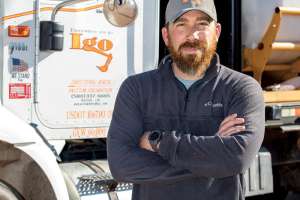
Trevor Igo mostly digs ditches for a living. For variety, he also bores holes. For this, he gave up a career in law enforcement. Igo Inc. is a success story about a young man following his head and heart into the utility construction industry.
Igo (pronounced eye-go) actually is a second-generation company owner in a family business started by his father Terry Igo in 1979. The senior Igo had a rural property with a small cattle operation in Besse, Oklahoma, some three miles south of Weatherford and about 70 miles west of Oklahoma City. He needed some utility line excavation done for a house being moved onto the property, but he couldn’t find anyone to dig the trenches.
“It seemed like a good business to get into when you couldn’t find anyone to do the work,” Trevor says of the pivotal moment. In response to the dearth of excavator contractors, his father launched his utility construction firm and found plenty of opportunities. “I grew up around the whole process. From sixth grade, I would ride along. Where he went, I went. I worked with Dad all the way through high school.”
His father had a Ditch Witch unit to open trenches for pipe and for boring pathways for underground utility lines. The younger Igo eventually operated locating instruments and his father did the operating. Because the pair comprised the entire work crew for most jobs, the son was given ample opportunities to become familiar with the tools of his father’s trade.
Yet when he went to college in 2001, the younger Igo had no plan to follow his father into the business. His future seemed to lie in law enforcement. Upon his graduation from Southwestern Oklahoma University in Weatherford with a degree in criminal justice and a minor in Spanish, Trevor appeared headed for a career in uniform.
The Oklahoma City Police Department and the Oklahoma Highway Patrol each offered him a job and he opted for the latter. While he waited for the paperwork to clear the bureaucracy, Trevor returned home to Weatherford and that’s when fate intervened in the form of heavy rains that flooded the region. One of his father’s customers, a water district, had 13 crossings washed out or damaged. An abundance of work lay ahead for the company.
“I had met my wife about the same time and we sat down and made a decision,” he recalls. The young couple decided to go all into the construction utility business with Trevor’s father and forego the higher profile work of a highway patrolman. So, in 2005, the second generation teamed up with the first. “We swapped our roles, though. I operated the boring machine and Dad did the locating.”
FINDING A NICHE
The post-flooding work temporarily swamped the young company. Its next big opportunity came when a local developer — and friend of the family — decided to build an 80-acre housing subdivision near Weatherford. Igo was given the contract to excavate basements and put in water and septic tank systems. Before long, a second homebuilder started a development, and the resulting housing boom presented the Igos with so much work they had to temporarily hire additional employees.
More significantly, the horizontal directional drilling side of the business began to heat up. Igo Inc. had subcontracted a large HDD project in 1999, rehabbing a municipal facility in Clinton. Realizing directional drilling was the more profitable segment, the senior Igo sought other bores. By 2005, the company was undertaking what Trevor characterizes as “deep and big stuff, more complicated bores where we have to thread the needle. It has become a niche for us around here.”
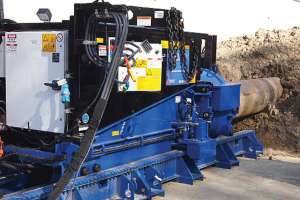
To do such exacting work, the company upgraded to a larger Vermeer unit. Today, Igo depends on a Vermeer D24x40 Series 3 drill. The machine delivers 28,000 pounds of thrust and pullback and 4,200 ft-lbs of torque. Powered by a 125 hp John Deere diesel engine, it can bore holes up to 4 inches in diameter.
With the 24X40, the company’s longest boring job to date is 1,200 feet for a 4-inch plastic gas pipe. “We do so much HDD,” says Trevor. “At certain times, probably half our work is directional drilling.”
That’s saying something because the company offers a host of other services: among them, excavation of basements or foundations, laying of water, sewer, gas, power and telecommunication lines, right-of-way clearing and HDPE fusion.
Equipment for all the foregoing is parked on three acres, with a 100-by-50-foot shop that has four service bays. When the company was jammed with work at the new Weatherford subdivision in 2008, it would park its equipment overnight on the edge of the property. The developer told the father-and-son team that he would build them a facility at that location if the company would lease it from him. So, they did.
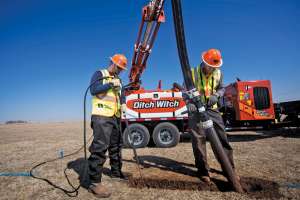
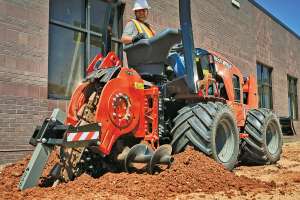
In the equipment yard these days besides the Vermeer HDD unit are two trenchers, a Ditch Witch 5110 and Vermeer V120. The smaller Ditch Witch is a four-wheel-drive 50 hp unit. The V120 tractor unit has a 115-hp engine. The larger trencher was used on a memorable laying of 27 miles of waterline on a 17-section ranch.
Waterlines are the usual undertaking for the trenchers, including for several rural water district systems. The trenching and installation process moves quickly once everything is lined up. “I remember we put in a 4-inch waterline, four and a half feet deep, and were moving about 500 feet every 30 minutes,” Trevor recalls.
MORE BIG EQUIPMENT
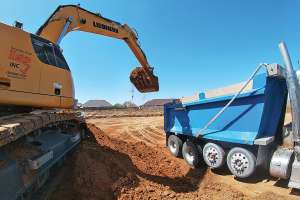
While the trenchers are efficient pieces of equipment, they are single-function machines. Trevor says they can sit idle for a month or more between trenching jobs. He more regularly cranks up an excavator to create a wider trench or power through a gypsum rock outcropping. For such work, Trevor uses a Liebherr R 920 Compact.
“It has technology I appreciate,” Trevor says of the 23-ton excavator powered by a 150 hp Cummins diesel. He particularly is impressed by what Liebherr calls “ergonomic proportional joysticks,” which produce sensitive but smooth operation of boom and bucket. “I like the precision of the joysticks, and it was the largest excavator I could find with a blade and rubberized tracks.”
When Trevor joined his father in the company, most of their open cut excavation work was done with a CASE backhoe. But for several reasons, they soon transitioned to a small excavator, Trevor says. “For about the same money, you could buy a larger excavator with about the same fuel rating. The excavator worked circles around the backhoe and gave me the precision cuts I wanted.”
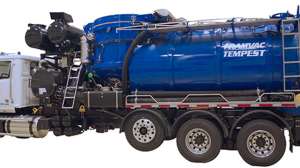
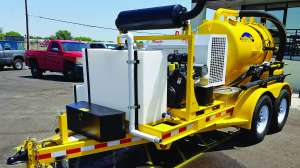
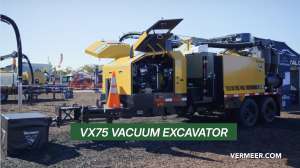
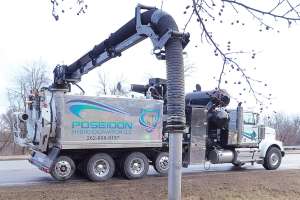
Trevor is constantly using a Vermeer V800HD vacuum excavator. It rides on an 18-foot, dual-axle trailer and is present at about every job. “It pretty much goes with us daily and always accompanies the HDD. The vac practically lives behind a one-ton truck.” He says he tried out several brands before settling on Vermeer as the best unit for the cost. “A hydrovac is one of the best investments a contractor in the underground construction business can make. If you don’t have a vac, you’re going to have to pay someone to do the work for you.”
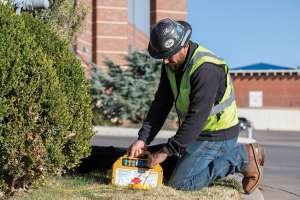
Trevor wants eyes on any utility line that intersects either an open cut or an HDD bore. He uses a Vermeer McLaughlin G3 Verifier to locate and determine the depth of a buried line and, if necessary, vacuums a hole to expose it. “Our reputation is that we don’t accidentally cut anything. The biggest risk of doing so is on the boring side.”
Other equipment in the company yard includes a Deere 333G skid-steer. It’s called upon for numerous tasks including stringing out pipe and conditioning soil, compacting filled-in open cuts and sweeping debris from adjacent pavement. “We try to clean up our ditch lines and make them look as good as they can and the skid-steer really helps with that. We have so many attachments for that thing.”
TAKING PRIDE IN THE WORK
How satisfied is Trevor in his decision to become a utility contractor instead of a highway patrolman? So satisfied that he’s hoping a son will follow him into the family business. “I’m hoping there’s a third generation, if that’s what a child chooses to do. It’s a pretty good deal once you get in and do it.”
He adds, with low-key Oklahoma casualness, “Things worked out. I have a lot better lifestyle than I would have in another profession. I get to play with all the cool toys. I like sitting on a drill for a couple of hours and then climbing in the Liebherr to lay some pipe.”
More than pleasure drives him, though. “I think it comes down to pride,” he says. “There’s nothing like doing a bore that someone else can’t do. It’s so rewarding to accomplish something that you had to kind of make up as you went along to get it done. I suppose that’s true no matter what kind of work you’re in. There are other professions, but this one is a skilled trade and there is a lot of pride in the industry.”