During the course of nearly five decades, Donny Schlomka successfully grew Schlomka’s Vac Truck Service into a thriving company, built on an unusual, all-eggs-in-one-basket business strategy that centered on catering primarily to one client — a local oil refinery.
Based in Inver Grove Heights, just south of St. Paul, Minnesota, the business eventually owned 30 vacuum trucks and employed about 25 people, with most of the workers and equipment devoted to servicing the refinery.
The symbiotic relationship between the two companies appeared to be rock solid — until it wasn’t.
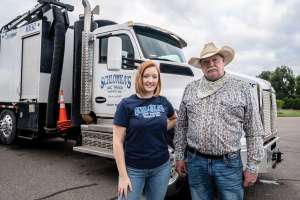
The successful run ended unexpectedly in late 2016 when refinery officials told Schlomka, who at the time co-owned the business with his wife, Susan, they wouldn’t renew the company’s service contract. The reason? It didn’t offer enough services, says Amber Worthington, who co-owns the company with her brother, Danny Schlomka, and their parents, Donny and Susan Schlomka.
“It was risky to have all our eggs in one basket,” Worthington says. “And that basket tipped over on Dec. 1, 2016, the day our contract with the refinery ended.”
The client loss was devastating to members of the Schlomka family, several of whom operate other businesses in the Minneapolis-St. Paul metro area, as well as the company’s employees, she says.
“We basically lost 90% of our work in one day,” says Worthington. “We didn’t know if we should keep going or close down.”
Eventually the family opted to do the former. And the ensuing experience offers a valuable lesson for other contractors about the benefits of developing a diverse customer base — and the value of the grit and determination required to rebuild and keep a fourth-generation, family-owned company in business.
NEVER SAW IT COMING
Losing the client was even more crushing because the Schlomkas had no inkling anything was wrong.
“The refinery used our services for 48 years, which made us feel very secure,” Worthington notes. “If they called my dad at 2 a.m. because they needed something, he’d be there in 20 minutes. He literally gave everything to that customer.
“We didn’t see it coming,” she adds. “But at the end of the day, it’s a business and there’s always risks.”
Job one was deciding whether to liquidate the company or rebuild it virtually from scratch. The family decided to keep going, she says.
“Dad would’ve been pretty devastated to see things end this way,” Worthington explains. “And since we (Worthington and Danny Schlomka) are the fourth generation, we decided we had to keep going.”
Donny Schlomka wholeheartedly agreed, but with one caveat: It was the children’s turn to run the company.
“He told us he was willing to help out when and where needed, but he wanted to take a back-row seat,” she says.
HEART-BREAKING PROCESS
Rebuilding required some gut-wrenching moves. For starters, the company had to cut ties with about 15 employees, while four more left on their own because of the uncertainty surrounding the company’s future. Some employees had to relocate to get new jobs, she says, but others were rehired when business stabilized.
Furthermore, the business sold about half of its fleet of trucks, many of which were specialized vehicles aimed at serving the refinery’s specific needs.
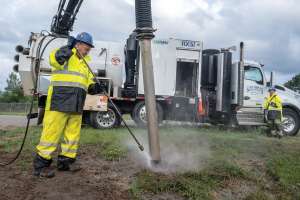
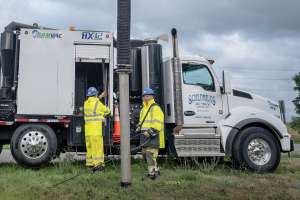
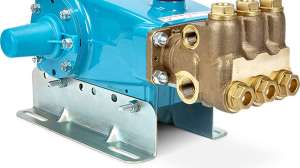
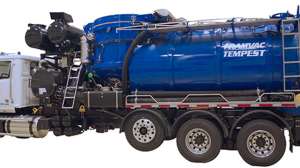
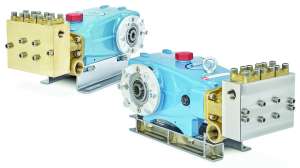
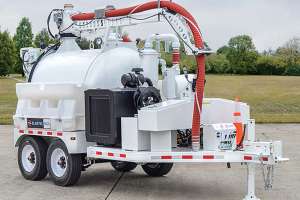
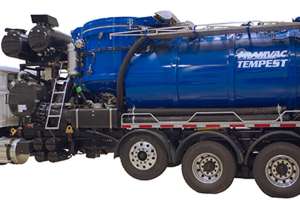
Today, the company owns four hydroexcavation trucks: two Vactor HXX built on Peterbilt and Kenworth chassis and featuring 12-cubic-yard debris tanks, 1,200-gallon water tanks, water pumps from CAT Pumps and blowers manufactured by Ingersoll Rand; and two RAMVAC units from Sewer Equipment, built on Kenworth chassis with 12-cubic-yard debris tanks and 1,300-gallon water tanks.
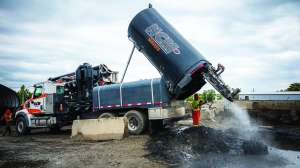
The trucks are used to do excavating for construction and pipeline companies, clean municipal sewers/catch basins/lift stations and handle chemical spills and other work related to environmental cleanup.
The company also owns two Guzzler Classic wet-dry vacuum trucks made by Guzzler Mfg. (a subsidiary of Federal Signal Corp.) and primarily used to serve industrial, wastewater and agricultural customers. Built on Kenworth chassis, the units feature 12-cubic-yard debris tanks and Hibon blowers built.
In addition, the business has invested in seven 3,000-gallon liquid vacuum trucks, built on Peterbilt chassis and equipped with vacuum pumps built by Fruitland Mfg. They’re used mostly for maintaining stations and tanks owned by pipeline companies.
The company also owns two 5,000-gallon vacuum trucks that feature 5,000-gallon tanks and vacuum pumps from National Vacuum Equipment. They’re primarily used to collect and carry leachate wastewater from landfills, haul dairy byproducts and handle work at wastewater treatment plants.
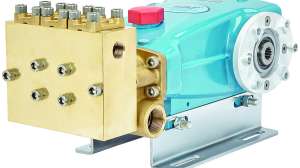
Schlomka’s uses two water-jetting trucks, one from Sewer Equipment Co. on a 2022 Kenworth T370 and another a 2003 International chassis. Each truck features a 1,300-gallon water tank and a Giant triplex water pump (80 gpm at 2,500 psi). The company uses nozzles from Hydra-Flex.
An Aries crawler camera system and a 9,500-gallon tanker trailer made by Polar Tank Trailer round out the equipment fleet.
AIDED BY REPUTATION
The company makeover was challenging. One of the first tasks was getting the word out about the company’s revival, mostly by knocking on doors of prospective customers and talking to contractors they’d worked with at the refinery.
“It was important to reach out to companies because when we lost the refinery contract, a lot of people assumed we had closed up shop,” she says. “Word spread pretty quickly among the contractors we used to work with at the refinery.”
In addition, the company leveraged another asset: the good business reputation her father built, as well as the reputation of other family members that run well-known and long-standing businesses under the Schlomka name in sectors like portable sanitation, septic tank pumping and industrial cleaning. (The company’s roots stem from a cesspool-cleaning business started in 1939 by Worthington’s great-grandfather, Carl “Henry” Schlomka, and his brother, Ray.)
“I didn’t realize how relevant our name was in the industry until we got outside of the refinery,” Worthington says. “I was concerned that nobody knew about us.
“But once we started knocking on doors, and with no advertising except though Facebook, calls just started coming in,” she continues. “People seemed to appreciate our knowledge of the industry.
Word-of-mouth referrals has the company’s best form of advertising, Worthington adds.
“The best way to advertise and market yourself is to do a good job. We never had to hire a salesperson — our employees are our best salespeople.”
Worthington also notes it helped that the company never took an aggressive approach to attracting customers.
“We never went to a customer and said, ‘We want all your work,’” she explains. “Instead, we just asked for a piece of the work so we could prove our capabilities. And if it grew organically from there, that’s awesome.”
MORE COMPLEX LOGISTICS
Running the “new” company proved to be much more complex than the old business model.
Instead of catering primarily to just one customer, with most employees and equipment operating at that customer’s facility, the company’s workers and vehicles were spread out and servicing many customers at different times, creating much more challenging logistics.
“The first three years or so was quite a learning experience,” Worthington says. “We were a little unorganized and figured things out on the fly.
“It required a lot more work than when everyone worked at one facility,” she adds. “It was a whole different ballgame.”
Eventually the company invested in a Verizon Connect Reveal fleet-management platform, a cloud-based system which includes GPS and makes routing and dispatching more efficient.
MISSION ACCOMPLISHED
Slowly but surely, the business grew. And after about three years, Worthington says the business was back on solid footing, with hundreds of customers instead of one.
“Mainly, we just diversified,” she says. “Instead of providing a high level of customer service for one customer, we do it for many customers.
“It’s definitely a different way of doing business after so many years with essentially one customer,” she adds. “But we’ve truly grown from the experience.”
Hydroexcavation work generates about 50% of the company’s revenue, with other services kicking in the balance.
Diverse services and customers also provide another benefit: offsetting business cycles that keep cash flow consistent and helps avoid seasonal layoffs.
“Our hydrovac work generally runs from May through November or December, depending on when the ground freezes,” she explains. “After that, our other work picks up, so we stay busy during the off-months for hydroexcavating.”
Would Worthington go so far as saying the loss of the refinery contract was a blessing in disguise?
“Absolutely,” Worthington says without hesitation. “My dad will tell you that all day.”
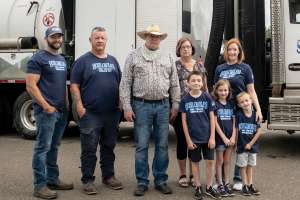
The entrepreneur also says she and her brother are motivated about building on the legacy built by her great-grandfather, grandfather and father. And she says she’s fully aware that third- and fourth-generation owners of family businesses generally don’t fare well and wants to avoid that scenario.
“I’m excited about what’s to come,” she says. “But we’ve learned you always need a backup plan and must be prepared for the worst.”
SLIMMED-DOWN OPERATIONS
In its new reincarnation, Schlomka Vac Truck generates about half the sales revenue, employs about half as many employees and owns about half as much equipment compared to before December 2016. On the other hand, expenses such as fuel — which the refinery paid for — and insurance, equipment repairs and safety training all have increased because the scope of operations is so much bigger, Worthington notes.
“We’re driving our trucks all over the place, which increases risk exposure,” she notes.
But the company remains on healthy footing and Worthington says she’s optimistic about the future of the revamped business, provided growth is controlled and manageable and doesn’t impact customer service or job quality.
“Slow and steady growth definitely is my philosophy,” she says. “The thought of growing too big makes me nervous. I’m not sure we ever want to be as big as we were before.
“Sometimes people ask me what we’d do if we ever got a large contract like the one with the refinery,” she continues. “But I’d never give up what we’ve developed in the last six years. This is a much safer and much more comfortable place to be compared to having all our eggs in one basket.”