Trinity Subsurface LLC is a risk-taking and problem-solving company that is proving as adroit in finding new markets as it is in locating underground anomalies. The Delaware-based firm is four years old and already operating in nine states, and the District of Columbia.
The company is accurately described as opportunistic, says Jami Roblejo, the company’s MBA-holding executive who oversees marketing and sales. “Absolutely we are opportunistic. We always are looking for opportunities. As fast as we have grown in four years, I definitely would say we’re willing to take risks.”
The firm was founded in 2018 by Greg Finkle, a professional engineer who at that point was a 10-year veteran in the private utility locating industry. From its Wilmington, Delaware, headquarters, Trinity first reached out to contractors and municipalities in Delaware, Maryland and Pennsylvania. The reception was good enough for Finkle to expand two years later into New Jersey, New York, Virginia and Washington, D.C.
Those contiguous entities were a natural expansion path for the young company, which at that point mostly was offering locating and subterranean mapping services using electromagnetic and ground penetrating radar technologies.
“When we started with just locating we realized our clients had more and more needs, so we added services,” says Roblejo, who joined the company two and a half years ago.
VARIETY IN CUSTOMER BASE
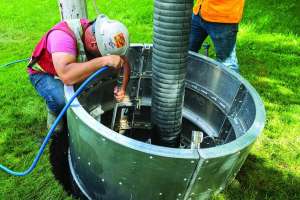
Today, Trinity Subsurface also offers concrete scanning, hydro- and air-excavation services, jetting, camera inspection of pipelines, pipeline spot repairs, and inflow and infiltration analysis. According to Jeff Finkle, the founder’s brother and operations director, “All of our services are growing very rapidly, but the largest division of services — location and scanning — is our bread and butter. It’s our fastest-growing division.”
He says the customer base breaks down approximately into 50% locating work, 20% vacuum excavation jobs and 30% remedying pipeline problems (inspecting, jetting, repairing). In each category, projects can run from half a day to several months.
Who is calling for these services? Most clients are on the private side — as opposed to government agencies or municipalities — but the mix of services produces intersecting clients. Locating and mapping utilities for one client can lead to air excavating a trench for another one, for example.
“There are so many different segments of the market,” Roblejo says. “Because we are a full-service company, we are very, very busy.”
The busyness was ramped up a little over a year ago when the company leapfrogged from the Northeast all the way to Dallas, where it set up a branch location to service Texas and Oklahoma clients. A few months later, it dropped down to Florida to open a branch office. “We saw opportunities and decided to take advantage of them,” says Roblejo.
NOT SHYING AWAY
The company’s aggressive approach to finding customers seems matched by its willingness to take on tasks other companies might decline. Founder Greg Finkle is described on the company website as having a “passion for solving complex problems.”
Last summer, Trinity had one such problem dropped in its lap. A Wilmington company was required by county officials to repair or replace a 30-foot sewer line lateral. While that sounds like a simple undertaking, the line had limited access (one manhole and a four-inch cleanout) and ran under a water main, a primary natural gas line and other utility infrastructure. Furthermore, the eight-inch pipe transitioned to 10 inches in mid-run and was located 20 feet underground.
Daunting, to say the least. Two other trenchless pipe repair companies told the property owner that repairing the pipe was impossible. Replacing it was an option — an expensive option: To do so would cost in the neighborhood of half a million dollars. A second opinion seemed like a good idea and Trinity was called.
“My brother and I and our pipe crew team leader, Tyler Smith, came back to the office and considered different ideas to come up with something we thought would work,” says Jeff Finkle. The team decided to perform six different patches on the line, overlapping them a foot. “The tricky part was how we were going to perform the repair where the pipe transitioned to eight-inch. We couldn’t get our repair packer through that area.”
The solution: Building a moldable plastic sled to transport the packer and epoxy repair material through the reduction joint, pulling back the sled when the repair system was in place and completing the repair. “When we proposed this to the company and to the county, we were asked, ‘Have you ever done this before?’ We had to say, ‘No, but we’re confident it’ll work,’” says Finkle.
It did work. A team headed by Smith pulled it off and completed the project within two weeks. Finkle looks back on the job with pride. “This was a stressful project, but also very rewarding,” he says.
The company tries to form meaningful relationships with clients that go beyond a particular contracted job. In this sewer repair project, Finkle says the working relationship that Trinity established with the client was instrumental. The client trusted the underground company despite its misgivings about the unorthodox approach.
Is the company’s can-do reputation in any way burdensome? After all, being handed difficult tasks all the time could be wearying. “We do get stuck with some pretty tough jobs,” Finkle says. “But we feel if we can’t do something, no one can, and we get satisfaction from succeeding where others couldn’t.”
It seems to be a winning formula. The company keeps growing: It has 61 employees to date, which is expected to increase to 70-75 by the end of the year. Most are in the Northeast, naturally, where business activity is concentrated, with a handful in Texas and Florida.
TRAINING FOR ALL
Sean Warner joined Trinity at the company’s inception. A veteran of the utility locating industry, he is focused on training and developing the company’s growing workforce. He oversees a three-week-long classroom program for new hires, followed by several months of training in the field. Interspersed are morning and weekly safety and product training sessions.
“Safety is a key for us,” Finkle says. “We want to make sure our employees are safe and that the work is accomplished for our clients.”
While company crews generally are divided into specialty teams — pipe inspection, excavation, locating and so on — familiarity with each of the provided services is part of the program. “It’s important for all of our team members to be educated about all the services,” Finkle says. “We encourage everyone to be cross-trained. An example is a lot of our guys can run a jetter truck, but also can operate a pipeline inspection camera.”
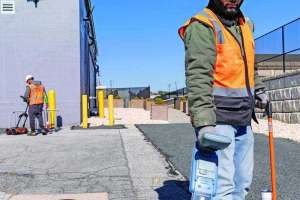
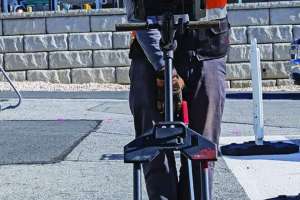
The variety of offered services requires a variety of specialized equipment. The equipment is up to date because Trinity values technology. Its technical work — that is, locating and documenting the presence of underground objects — is accomplished using a wheeled GSSI UtilityScan ground penetrating radar unit that can detect metallic and non-metallic objects 35 feet underground and map a scanned area.
Crew members pull out Radiodetection handheld scanners for locating utility lines and a Proceq (Screening Eagle USA) concrete scanner unit to find rebar, conduit, voids and anything else hiding within a cured concrete slab, wall or ceiling.
The locating and scanning work is all about finding the hidden. Sometimes underground objects are located precisely, sometimes more generally.
“A lot of factors go into location accuracy,” Finkle says. “We utilize three different pieces of technology to search and we bring lots of experience to a job. Generally, our clients are happy.”
Roblejo adds this perspective: “There are limitations on locating something we can’t see. If we can’t locate something, we are honest and tell the customer we can’t.” Trinity offers a final solution in such cases, which is to vacuum excavate a site and visually expose what’s down there.
Trinity relies on Envirosight camera systems for its pipeline inspection work. Crawler and push cameras navigate sewer, water and storm pipes and operators print out inspection reports produced by the system. When cracked or failing sections of pipe are found, Trinity can repair them using its Perma-Liner point repair equipment. The Perma-Liner patch solution is growing in popularity with Trinity Subsurface customers, according to Finkle.
Still to come is a cured-in-place curing system the company will introduce to its customers in 2023. The SpeedyLight+ system manufactured by Pipe Renewal Technologies uses LED light to cure CIPP lining, doing so several times faster than other methods. The system can cure liner more than 300 feet from the point of entry in a pipe up to 12 inches in diameter. “It’s a new technology and we are really excited to offer it,” says Finkle.
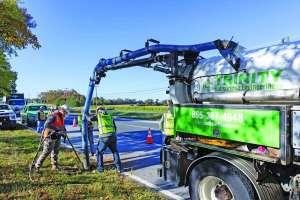
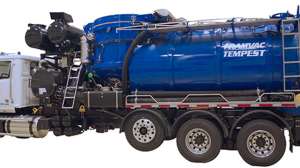
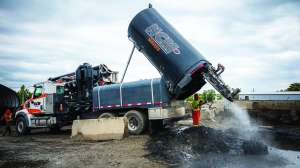
Larger machines in the Trinity equipment yard include a Vactor 2100 hydrojetter and a Vactor Paradigm air vacuum excavator. These larger pieces of equipment increasingly are maintained by the company itself.
“We are doing more and more work on our vac trucks,” Finkle says. A 6,000-square-foot maintenance shop is part of the Delaware headquarters complex and two smaller shops are being added at Pennsylvania and New Jersey locations.
FUTURE PLANNING
Four-year-old Trinity Subsurface is a young company in more ways than one: The average age of its employees is 35, according to Roblejo. While the company is immersed in the market in the Northeast, it still is establishing itself in Florida and Texas. Growing the business in those two southern states is management’s immediate focus.
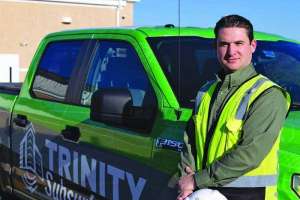
Company executives are not expanding pell-mell. They are open to growing the company footprint, but at a sustainable pace. The firm has survived the always-perilous startup for years and worked through the parts and materials disruptions of the last year or so. Currently being managed are inflated fuel prices — the company has a fleet of 35 Ford F-150 pickups.
In short, Trinity Subsurface seems in control of its future.