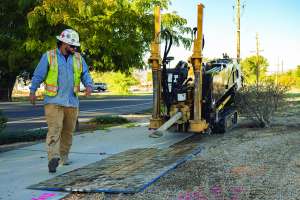
Mark Construction isn’t just drilling holes — it’s leading the way as the biggest name in horizontal directional drilling on Colorado’s Western Slope. The company has become a go-to provider for projects from Denver to Salt Lake City.
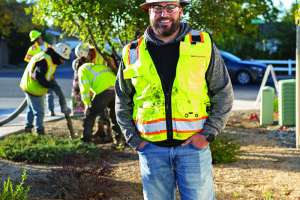
“There are a couple other drilling companies in the area, but we are the biggest on the Western Slope,” says Mike Seriani, general manager of the company, headquartered in Grand Junction, a hub of western Colorado.
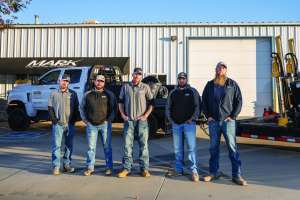
Seriani knows the industry inside and out. Born and raised in Grand Junction, he grew up working in his father’s concrete company before jumping into drilling in 2012. By 2014, he was running crews, catching the attention of local partners who saw his potential. Together with Tad Hatter, Robert Hawk and his father Mike P. Seriani, Mark Construction was born.
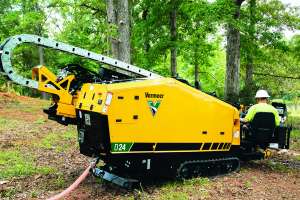
What started with five employees, a single Vermeer HDD rig and a hydroexcavator has grown into a powerhouse operation with 38 employees, eight Vermeer rigs and a fleet of hydrovacs, trucks and loaders. “Our growth has been steady,” Seriani says. “We’ve taken on every challenge, from economic disruptions to tough drilling conditions, and come out stronger.”
BUILDING A REPUTATION
The company’s reputation is built on tackling the toughest jobs others shy away from. Whether it’s installing a gas line under Interstate 70 in record time or completing a 3,200-foot waterline project others couldn’t handle, Mark Construction consistently delivers. “We are not afraid to take on projects that others will not,” Seriani says. “We have a great team that always finds a way to do it and to do it safely.”
The Interstate 70 job was undertaken three years ago. A four-inch gas line was to be installed under Interstate 70 as well as under an adjacent creek. The job was thoroughly planned out and a four-person crew began boring. “Given the conditions, we figured it would take a couple of weeks,” Seriani says. “We completed it in three days.”
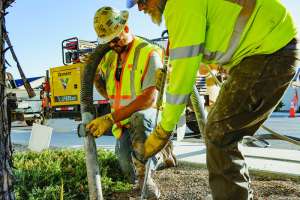
The four-person crew, by the way, was a typical Mark Construction contingent. The company runs eight crews of either three or four people. Crew members are cross-trained. “That way anyone can step in so that people can take vacations and we can still run the business,” says the general manager.
Mark Construction undertakes a variety of drilling projects, according to Seriani. Some are day-long jobs where a line needs to duck under a roadway or driveway. Others involve replacement of existing lines and can take months to complete. All of the boring is for installation of cable or pipe ranging in diameter from 3/4 inch up to 24 inches. The contractor does four or five of the larger projects a year.
An ongoing drilling contract for the company is for installation in Mesa County of fiber infrastructure for high-speed internet to serve homes and businesses in Grand Junction and surrounding areas. “We actually have two fiber projects going right now. We are about three years into it, and I suspect the project will continue for another two or three years.”
Seriani says that in the valley the crews encounter pretty good soil and good drilling conditions. In the mountains, well, they are called the Rocky Mountains for a reason. “We run into a lot of hard drilling situations there,” he says.
Most of the drilling in the range is for gas lines from 2 to 8 inches in diameter.
What he least likes to encounter on a project is river rock, which he characterizes as cobblestone 6 to 8 inches in diameter. It is unstable and therefore unpredictable. He does encounter it, of course, in and around a valley where two rivers come together. It tests the skills of his crews, he says, to establish and maintain a hole, to seal it off. It requires them to utilize a perfect combination of drill bits and mix to get the pipe in the ground.
He was asked which kind of project he most likes to bid on — that is, the quick-and-easy or the long and taxing ones. “Both have ups and downs,” he says. “The ones needing bigger machines can take longer but in the end you feel a bigger sense of accomplishment. With the smaller ones, you can see the results a lot faster.”
USING THE EQUIPMENT
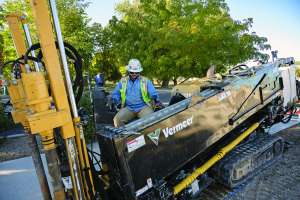
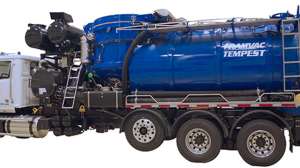
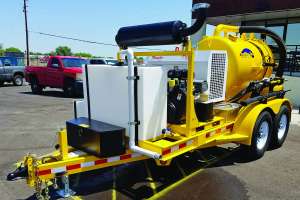
When the company was first founded, the employees numbered five — the four owners and one hired hand. The principal pieces of machinery were one Vermeer HDD unit and a McLaughlin hydroexcavator. Nine years later, Mark Construction has 38 employees and a fleet of eight Vermeer directional drilling rigs. Also in the equipment yard are Bobcat skid-steer loaders and mini-excavators, eight hydrovacs of different brands, five dual-axle trucks for pulling trailers and 22 one-ton trucks to support crews.
The first Vermeer machine the company owned was a D20X22, a relatively small drill with about 10 tons of thrust and pullback. It still is working on projects for the company alongside smaller and bigger units. The smallest drill in the fleet is a D10X15, which delivers five tons of drilling and pulling force, the largest a D60X90, the largest product in the Vermeer lineup with 30 tons of force behind it.
The choice of Vermeer as a brand is simple: The manufacturer has a dealer in Grand Junction, though the machines hold up well, according to Seriani.
“We have an in-house mechanic, but sometimes you have to take it to the dealer,” Seriani says. “If you stay on top of what you’re doing with the drills, they run great. It all depends on the operators — anyone can hop on a drill and force it to do something. Our original 20X22 is still operating every day and it has 10,000 hours on it.”
The smaller and middle-sized drills are more frequently called upon for fiber cables and gas lines. The heavier drills are most often used on specialty projects, such as sewer mains and, in one case, an 18-inch waterline. The waterline extended 3,200 feet and was accomplished in two shots.
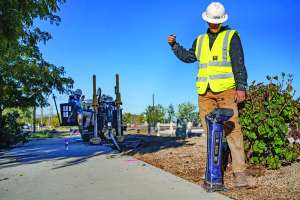
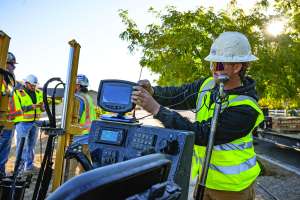
When drilling, crews will use HDD systems like the Mag X PRO System from Underground Magnetics to track the drill head along the route. “Underground Magnetics have played a big part in some of our high-priority jobs,” Seriani says.
SAFETY MINDED
Mark Construction declares on its website, “Directional Drilling Done Right.” Seriani says that it starts with communication with customers and a focus on safety.
Besides the obvious implications of safety for workers, Seriani is referring to the safety of other infrastructure in the path of the swirling bit on one of his powerful Vermeer directional drills. The company allows an extra margin of clearance in a bid to steer away from bumping into another utility.
“We never cross utilities without verifying their location, of course,” Seriani says. “But also, while the legally required minimum distance to clear another utility is 18 inches, our minimum is 24 inches.”
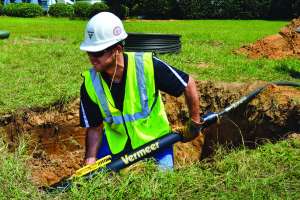
There are a lot of humanmade hazards in the ground to avoid. According to the industry’s Common Ground Alliance, some 20 million miles of buried infrastructure clutter America’s soils — including pipelines, cable and wires. Seriani’s crews always contact 811 for a report on what’s in the ground but also probe the soil on their own to verify all utility crossings.
Even with the precautions, however, hidden infrastructure sometimes still manages to elude detection. Seriani recalls a gas line intercept one time that might have resulted in an explosion but didn’t.
“We do all we can to mitigate disruptions in service,” Seriani says. “We strive to eliminate any such encounters and if one ever does occur, we try to learn from it, creating a plan on how not to let it happen again.”
A PLAN FOR THE FUTURE
Mark Construction is a company that doesn’t advertise, save for social media outreach through Facebook. Consequently, most job referrals come from either return customers or through word-of-mouth recommendations.
“They come because of our attitude and our willingness to do things the right way,” Seriani says. “I think we have found the easiest way to sell the next job is to maintain quality on the job we already are doing. We do it right. We leave the job site clean. We don’t want to have to come back.”
The company is willing to try new things. When it started out, it used its HDD equipment to clean culverts, drilling out plugged ones and pulling out the debris. It wasn’t an original idea, but no one had heard of it in the valley. “But after the drilling took off, we haven’t done it since.”
Are there other new things that Mark Construction wants to try? No. “We just want to continue to build our client base and grow our network,” Seriani says. “We want to stay true to ourselves and not overextend and thereby reduce the quality of our work.”
The owners currently are working on three-, five- and 10-year plans. One of the key tenets of their planning is continuing to partner with key customers, and to build on the relationships locally and wherever the work might take them.
“If you had asked me 10 years ago to look ahead a decade, I would not have thought we would be where we are,” Seriani says. “We are a growing company that takes pride in its work. That’s a testament to the people we have working for us. We couldn’t ask for a better group of managers and guys.”