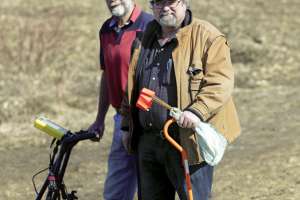
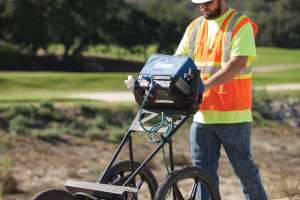
Steve Watson sold ground-penetrating radar units for four years before he recognized that many customers needed companies to do the subsurface imaging more than they needed the equipment itself. In 2007, Global GPR Services was born. Today, Watson’s company is kept busy searching high and low (mostly low) for utility lines, bedrock formations and, yes, bodies.
Global GPR Services’ office is in Brampton, a suburb of Toronto, Ontario. England-born Watson moved as a child with his family to Canada and lives now in nearby Waterdown, north of Hamilton on the far west end of Lake Ontario. He entered the industry as a salesman for Sensors & Software, a 30-year-old GPR technology company headquartered in yet another Toronto suburb.
Because his background is in geological engineering, Watson’s transition from equipment sales to service provider was seamless. “To be good at this work, you need to have a good technical background,” he says, noting that GPR equipment companies sometimes forget that in their eagerness to sell their devices. “A tech background definitely is best. Geophysics knowledge is an asset.”
Possessing all of the above, Watson plunged into owning a business. With Sensors & Software’s permission, he approached people who had contacted the equipment company about needing work done. He rented equipment from his former employer and quickly won a contract to scan the concrete floor of a retail unit facing excavation after a flood. Watson located the site’s hidden utility lines and earned his first paycheck as a service provider.
“I knew there was a market out there for someone who understood the equipment and technology,” he says. He still mostly employs Sensors & Software imaging equipment, and job and equipment referrals still flow back and forth between his company and his old employer.
THE CUSTOMERS
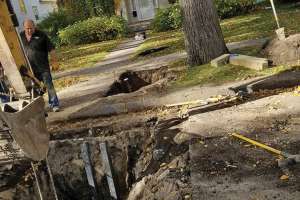
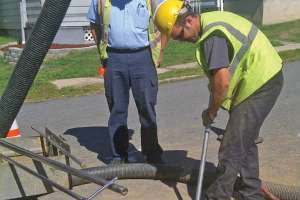
Locating subsurface utility lines constitutes just a third of Global GPR Services’ business, which is a bit surprising given the hazardous profusion of underground lines in urban areas. The utility calls most often are from commercial clients. Even calls from homeowners usually originate with a contractor who has been hired by a property owner. Watson shies from purely residential clients.
“A challenge we have from homeowners is One Call,” Watson says. He refers to the governmental requirement that property owners contact a location company before digging on their property. The idea is to avoid burying tree balls on top of electric lines and such. “The first thing I tell the homeowner who calls is that we are a private company and we charge for our location services. The phone usually goes quiet at that point.”
While fees charged by Global GPR Services are not overly expensive, according to Watson, “In the eyes of homeowners, the fees are very expensive.” He basically charges an hourly rate that grows more favorable to a customer as a project lengthens, even when a work site is some distance from the home office. His business partner, Tom Maruya, is the company’s finance and accounting specialist.
What about underground treasure hunts? Watson was jokingly asked. Does he ever settle for a percentage of found treasure? “I never work for a percentage,” he says seriously, suggesting that the question has come up. Watson is tight-lipped about such searches, though he admits to having one on his radar that involves a long-lost artifact from the last century.
THE SCIENCE OF GPR
Beaming radio waves beneath surfaces to reveal what is hidden there is not a one-size-fits-all proposition. GPR scanning units basically emit signals and receive bounced-back signals that paint pictures. These reflected radio waves are analyzed in real time on a machine operator’s screen and are stored for further data analysis. The effective depth of radar penetration varies greatly, from a few feet (seawater) to a few thousand feet (ice).
Watson’s GPR machines produce signals ranging from 50 MHz up to 1,000 MHz. Essentially, the lower frequencies penetrate farther into a targeted mass. However, choosing the proper frequency is not that simple. “The higher the frequency, the shallower the depth of penetration. The lower the frequency, the deeper the penetration,” Watson says. “But the other trade-off is that high frequency brings high resolution and low frequency is low resolution.” Balancing and weighing these radio frequency characteristics are where training and expertise enter the picture.
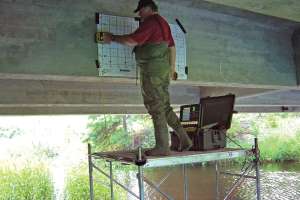
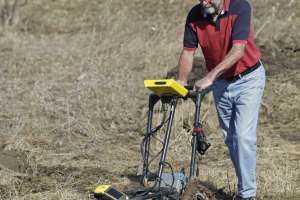
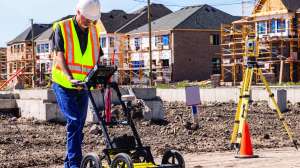
The company’s equipment includes a Noggin 250 (Sensors & Software) for utility locating and much of the company’s other applications, Conquest (Sensors & Software) for concrete imaging, pulseEKKO PRO (Sensors & Software) for geophysical mapping, and EM Subsite locator (Ditch Witch).
The characteristics of the surface being scanned — earth, water, concrete, asphalt — must be factored in, as well as the depth and size of a targeted object. Sometimes these elements combine to frustrate a search. Failure happens, albeit uncommonly. “Absolutely, sometimes we don’t find what we’re searching for,” Watson says. “All the subsurface imaging technologies have their shortcomings. There are only two pieces of equipment that will find any utility, and that is a backhoe and an excavator. There’s no exact science in locating something other than exposing it.”
One utility survey by Watson at a power transmission plant in California consumed a week, but 80 percent of Watson’s utility searches are completed in two hours. That means his services are available for other kinds of searching, such as geophysical surveys. Those projects can involve mapping strata of bedrock in the path of a new sewer line so that a trenching contractor can pick a best route for a line and bring in appropriate equipment. Geophysical contracts are attractive to Watson because they usually are for large acreage.
However, the single largest category of search undertaken by Watson’s company is cemetery mapping. The cemeteries are what Watson calls “historical” graveyards, meaning the dedicated burial grounds have been around a long time. As a result, headstones have been knocked down or removed, and the human remains they once marked are left unmarked. To avoid opening gravesites where graves already exist, Watson is called to accurately map entire subterranean sections of cemeteries.
DETECTIVE WORK
Speaking of bodies, Global GPR Services has found three so far for law enforcement departments. This can properly be called detective work as it involves detecting criminally hidden objects. Watson can talk about discovering the remains of a woman buried in a concrete floor or finding stashed money in the backyard of a drug dealer. Oddly enough, some of his successful forensic searches have been in cemeteries. Digging holes and mounding earth in a cemetery is akin to hiding things in plain sight.
Watson has a classic opening line in recounting a favorite true crime episode. “Three men were sitting in a bar,” he says. “One guy was drunk and began to brag to the guy on the stool next to him that he had gotten away with killing a man.” The third man at the bar, sitting on the other side of the drunk’s new friend, turned out to be a retired police officer. The former officer’s ears pricked up as he listened to a drunken confession of murder and the secreting of a murder weapon in the ceiling of an apartment.
“The police did their due diligence, and on a Thanksgiving weekend, the search began,” Watson recalls. In the apartment above where the man used to live, Watson was brought in to scan the poured concrete floor. His GPR equipment soon detected a handgun encased in the concrete. It turns out the man was an accomplished mason. After shooting his victim, he had chipped a hole in the ceiling of his apartment, wedged the handgun into the hole and expertly smoothed it over with new cement. Case solved.
SATISFACTION IN FINDING UTILITIES
Such excitement is not an everyday experience at Global GPR Services, but the 61-year-old company owner said he is deeply satisfied whenever he finds a gas line or high-voltage power line before a trenching contractor or backhoe operator can dig into it with catastrophic results. The flip side is that Watson is frustrated when his subterranean discoveries are ignored.
“Unfortunately, some contractors believe they know more than we do and go ahead and dig or pull up or cut a utility. They don’t respect our findings. One contractor told me after cutting into a line that he just didn’t believe it was where we said it was. He believed his drawings instead,” Watson says. “The drawings were wrong.” When one contractor dismissed Global GPR Services’ conclusions and augered down into a 3-foot-diameter, high-pressure waterline, the ensuing eruption of water washed out a street intersection in about 15 minutes.
Then there are the excavation companies that only call for a GPR scan after disaster strikes. “Sometimes we are the last ones they call,” Watson says. “A couple of weeks ago, a contractor cut through a 600-volt supply line for a mall, shutting down the mall. We’re going out there tomorrow. He has more digging to do and doesn’t want to cut anything else.”
After a decade of exploring the unseen with penetrating radar, Watson has developed a tip or two for anyone wanting to get into the work. The first is to become educated about geology before taking a course on GPR and locating utilities. Being grounded in science and technology is essential. His other professional recommendation is to accurately source utility lines before searching for them. “Go and locate where a utility line originates and start there. Even if it is outside the scope of your work, start from a known position when you can.” Reducing guesswork increases the chance of finding a hidden line.
For 11 years, his GPR carts have been rolled across the ground — or floated across water surfaces in his rubber dinghy — but Watson says the equipment is holding up well and reliably finding what it seeks. “I have about a third-generation of the GPR system, but it does the same good job as the day I bought it,” he says, noting that he has periodically updated the machines’ technology. “Are there better features in newer equipment? Absolutely. Would they help me do my job better? Probably not. With my education and experience, I can use the technology I have and get the job done very well.”
Searching for snakes
Steve Watson considers himself an outdoorsman and naturalist. Being out in the field is one of the attractions of his work as founder and owner of Global GPR Services. Geophysical and environmental surveys not only are a big part of the company’s business, they are personally satisfying to Watson — even at 40 degrees below zero.
That was the temperature when Watson undertook an environmental assessment on the banks of the Saskatchewan River near Burstall,
a Canadian community of 450 people. His assignment was to locate a colony of prairie rattlesnakes hibernating in the ground. The snakes are an endangered species, so noninvasive exploration by ground-penetrating radar was the perfect solution.
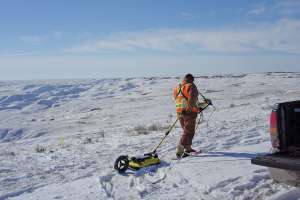
To that end, Watson put on his winter duds and pulled a Sensors & Software Noggin 500 GPR unit across the frozen ground. Ground that is solidly frozen is not an impediment to such a survey, incidentally, though snow cover can be a hassle. One might ask: Why not walk the grounds at a warmer time of the year? The answer is that hibernating poisonous reptiles are not as apt to turn up underfoot in the dead of winter. “That‘s why we did it in the winter months. We didn’t want to contend with rattlers,” Watson says.
The snakes don’t dig the holes in riverbanks. They slither into and claim the homes of badgers and other burrowing animals. The lairs had been roughly located during a survey in warmer months, so Watson was directed to a specific area of about 15,000 square feet where his GPR unit could tell the subsurface story.
In the end, the hibernating spaces of roughly 300 prairie rattlers were identified, each snake an estimated 7-8 feet in length. The pipeline company that had contracted out the survey accepted Global GPR Services’ findings, possibly with some reluctance: The pipeline had to be rerouted at a cost of $14 million.
“We understand that we cannot just bulldoze through an area without first examining the area for animal inhabitants,” Watson writes in a white paper on the project that can be found on the Global GPR Services website. “New practices and methodology must be used to maintain the balance in nature. Ground-penetrating radar is a nondestructive testing technology that is being used as a new practice and methodology in maintaining that balance.”
And the methodology works at 40 degrees below zero, too.