In 1982, Brent Moore had a hunch that boring and tunneling services just might be the keys to a lucrative and successful business venture.
During the ensuing four decades, his instincts proved to be as accurate as a laser-guidance system on a microtunneling machine.
Today, the company Moore established some 40 years ago — Horizontal Boring and Tunneling Co. in Exeter, a tiny town about 40 miles west of Lincoln in the southeastern corner of Nebraska — is a multimillion-dollar-a-year company with about 100 employees.
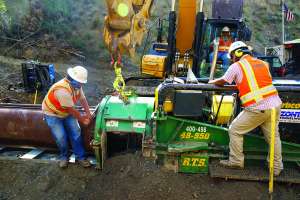
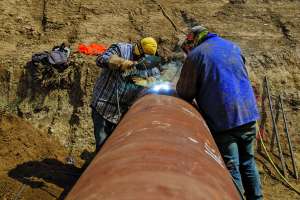
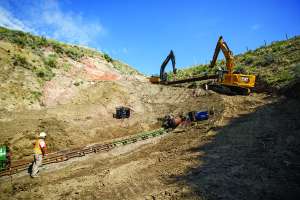
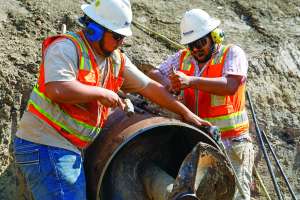
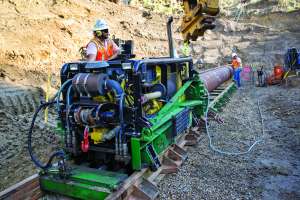
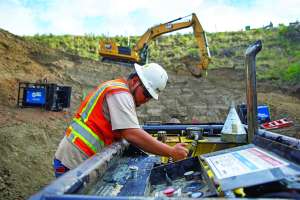
Every week, work crews fan out from Exeter, as well as the company’s two other locations in Tulsa and Des Moines, to perform services ranging from auger boring, horizontal directional drilling and pipe-jacking to pipe-ramming, tunneling and microtunneling. They primarily work throughout the Western and Midwestern United States, Moore says.
“We probably work in about 16 or so different states every year,” he explains. “A couple of weeks ago, we had crews working in 10 states at one time.”
Most of the time, HBT is hired by general, utility and highway contractors, as well as railroads and state transportation departments, to bore underground paths for everything from sewer and water pipes and pipelines to culverts and fiber-optic lines.
The keys to the company’s growth and success? Building relationships with general contractors, companies and utilities and continually expanding services to meet their ever-growing needs. A willingness to keep investing in new technologies. Providing great customer service. And never saying no, says Moore.
“Our array of services allows us to be the go-to trenchless contractor that people want to use,” says Moore. “A lot of our growth came from doing nothing more than growing along with our good customers and doing quality work in a timely manner. And never saying ‘no’ to customers.
“When people need something done, we find a way to do it.”
OPPORTUNITY KNOCKED
The seeds for Moore’s career were planted during his teenage years when he worked for a local water- and sewer-pipe installation company on Saturdays and during school breaks and summers. Then he went to college to study construction management at the University of Nebraska.
“I really enjoyed the work,” he says.
During summers in college, he worked on an auger-boring crew for the same contractor. Between semesters during his sophomore year in 1976, the owner asked Moore if he wanted to work full-time for the company and manage a crew.
“I realized that I’d make more money that year than what I would’ve earned after four years of school,” he says. “So I quit school and went to work.”
Sensing the potential to grow the trenchless work, Moore and a partner offered to purchase some equipment from the contractor and perform trenchless work separate from the owner’s operations. An opportunity became reality in 1982 when the owner agreed and Horizontal Boring & Tunneling Co. was formed. HBT purchased some auger-boring equipment, plus a couple of trucks and an excavator from the owner.
“I felt it was an important and specialized service with good growth opportunities,” he explains. “It was a service that growing numbers of contractors needed.”
In addition, there wasn’t much competition in the trenchless infrastructure installation arena at the time. It also was a specialized service that required expensive equipment, which provided barriers to market entry, he notes.
“It slowly became a more common practice, which led to even more work,” Moore points out.
GEOGRAPHIC EXPANSION
The company started out with about five employees and two auger-boring machines and worked primarily in Nebraska. Business dried up when a recession hit in the early 1980s, which proved to be a blessing in disguise because it forced the company to look further afield for work, which transformed it into more of a regional company and exposing it to new customers.
“We did a lot of projects in Texas and Oklahoma,” Moore says. “We built good business relationships with contractors and went wherever they went.”
Providing great customer service was a big driver of growth.
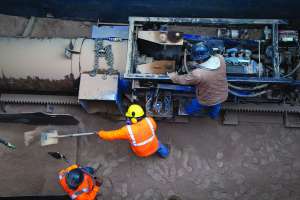
“We always act like we’re a part of the contractor’s team,” Moore explains. “They want things done efficiently and done right, so we don’t delay their work. So we constantly focus on providing great service — meeting their schedules and deadlines, which often are variable.
“Staying ahead of them and staying out of their way is critical.”
BUILDING DIVERSE SERVICES
The company originally only did auger boring. But over the years, it branched out into other trenchless technologies.
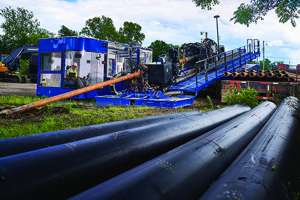
To accommodate those expansions, the company now owns Akkerman tunnel boring machines; horizontal directional drilling machines from American Augers and Vermeer; low-boy trailers made by Trail King and Load King; Peterbilt semi-tractors; excavators and front-end loaders made by John Deere and Caterpillar; and bulldozers from Caterpillar.
The large equipment fleet also aided growth because many companies don’t have enough machines to handle large projects, Moore says.
“Our capacity helps us because we can supply multiple crews equipped with multiple pieces of equipment on larger jobs, which helps us stay ahead of contractors’ operations,” he says, noting the need to quickly bore paths for pipelines and other infrastructure. “Each of our crews has a fair amount of equipment.
“The sheer size of our equipment fleet gives us an advantage,” Moore says. “We can afford to leave some equipment in Texas, for instance, and then pick up work there later that needs that equipment.
“That way we don’t always have to mobilize to move things cross-country,” he continues. “And we have employees based in different states, too.”
PROVIDING GREAT SERVICE
Was there one particular project that dramatically enhanced the company’s reputation and provided a stepping stone to more customers?
“Not really,” Moore says. “It always came from just being able to do whatever needed to be done, even if it involved doing something different that required us to buy different kinds of equipment.”
For example, as employees’ expertise and experience grew, the company expanded into longer directional drilling for pipe crossings under highways and rivers — projects that also required bigger machines, he says.
“We’re always up to a challenge and we’ve never walked off a project,” he adds. “We always find a way to be successful and take pride in taking on the difficult jobs that other companies won’t do.”
How else does HBT differentiate itself from competitors? Experience is a big factor, Moore says.
“We’ve been at this a long time,” he notes. “Our employees are what makes us go. They do it all. Our workforce is knowledgeable and skilled and works with a get-it-done attitude.
“When you combine that with all our different kinds of equipment, it provides a big advantage.”
MORE GROWTH EXPECTED
Looking back, Moore says he’s often amazed at not only how big the company has become.
“I never could’ve anticipated we’d reach this kind of size and scope, nor handle so many different kinds of projects,” Moore says.
“But that’s not because of me,” he emphasizes. “It all stems from our employees — the work they do, the problems they solve and the skills they learn and develop.
“It truly has been amazing to watch.”
As for what lies ahead, Moore envisions good things for his company — and the industry at large.
“With the way technology has advanced and the way I think it will continue to advance, the opportunities are unlimited in this industry,” he says. “Trenchless techniques continue to play a larger and larger role and everyone seems to be getting more productive and cost-effective at doing the work.
“There’s also a lot of infrastructure that needs to be upgraded,” Moore adds. “So there’s definitely a bright future ahead.”