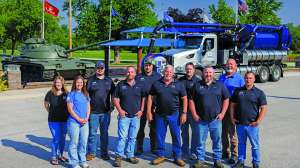
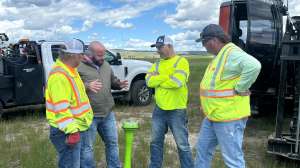
Now more than ever, the trenchless industry needs college-educated new hires with the classroom knowledge and the hands-on skills to get the job done right. Two institutions that are delivering such talent to the marketplace are Northeast Wisconsin Technical College of Green Bay, Wisconsin, and the University of Arkansas Community College at Morrilton.
Dig Different spoke with NWTC’s Gas Utility instructor Jason Nelson and UACCM’s Director of Workforce Development Caliese Cain to learn more.
Dig Different: Let’s begin by learning about your colleges.
Cain: The University of Arkansas Community College at Morrilton is a public two-year institution located in Morrilton, Arkansas. It offers a variety of associate degree programs, technical certifications and workforce training focusing on providing accessible, affordable education.
UACCM serves a diverse student population with programs in fields such as health sciences, technology, and general education, preparing students for both immediate employment and transfer to four-year institutions. The school boasts a large workforce training center that houses the only American Welding Society Accredited Test Facility in the state and provides custom training and testing to industry partners.
Nelson: Founded in 1912, Northeast Wisconsin Technical College is a nationally recognized two-year public college serving nearly 23,000 individuals annually. NWTC offers over 200 associate degrees, technical diplomas, certificates and apprenticeship programs. This includes our Gas Utility Construction and Service program.
Dig Different: What courses are you offering in trenchless technology?
Cain: UACCM currently offers a course in Underground Directional Drilling. This course covers OSHA 10, CPR, location and drilling. This is a four-week program. Week 1 is a core course that covers safety and an introduction into basic concepts related to the Fiber Academy broadband concepts. The next three weeks are horizontal directional drilling classes. There is some classroom training with the mass majority hands-on with equipment.
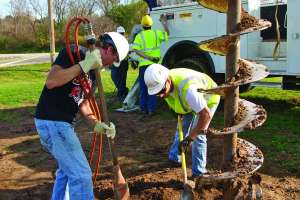
Nelson: NWTC has a program called Gas Utility Construction and Service. It’s a nine-month program, hands-on learning underground construction course, mostly natural gas installation and electrical installations. The trenchless technology part fits in with installation of the pipes and wires, and we teach the students, of course, trench safety. They also get competent person and OSHA 10 training plus real-world installation and training with equipment.
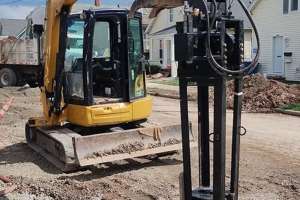
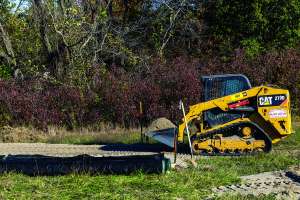
The biggest pieces of equipment we have for trenchless technology training is our directional drill and our hydrovac. Students get hands-on learning experience with the drill.
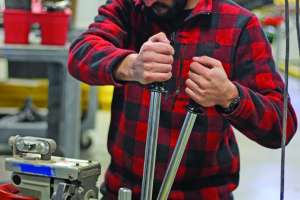
They’re learning how to load rods, how to push and pull rods, and the safety aspects associated with directional drilling. We also teach them about chemical mixing and locating.
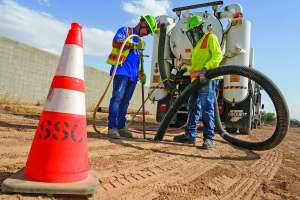
With the hydrovac, students learn how to expose underground facilities, how to maintain mostly empty space and where to dispose of the reclaimed ground that they take into the hydrovac.
Dig Different: How long have you been offering these courses, and what inspired you to do so?
Nelson: This course actually started around 1988, and it was one of the only courses in the United States as far as a nine-month hands-on program. It really evolved from the Wisconsin Public Service here in Green Bay having a shortage of skilled workers, so they decided they wanted to start a program to kind of generate some employees.
Cain: This course has been offered a little over a year. It was begun as part of a partnership between several community colleges and the state to bring more trained workers to the area in order to meet the needs of the state’s fiber initiative.
Discussions were had with industry back in 2019, prior to the pandemic. We were initially inspired to offer the course to meet demand at the request of industry partners. The pandemic slowed the progression down for adding this to our calendar. However, the state’s current initiative led us to pick up where we left off in the development of the program and allowed us to offer a more extensive program with the state’s support.
Dig Different: What are the key skills that you are trying to teach your students?
Cain: In point form, our Underground Directional Drilling course covers:
- Understanding Drilling Equipment: Knowledge of drilling rigs, mud pumps, downhole tools and other equipment used in directional drilling.
- Operation of equipment related to horizontal directional drilling.
- Drilling Fluids Management: Knowledge of drilling mud properties, fluid dynamics and how to adjust drilling fluids to optimize performance and prevent borehole collapse.
- Bore Tracking and Steering: Competence in the ability to track the drill bit and steer it accurately.
- Soil and Rock Analysis: Ability to assess ground conditions, including the type of soil, rock formations and underground obstacles.
- Locating: Skills in interpreting geological data to avoid underground risks like fault lines, water tables or unknown utility lines.
- Troubleshooting Equipment Issues: Ability to diagnose and fix common mechanical and operational problems with drilling equipment.
- Handling Obstacles: Flexibility in adjusting plans when encountering unforeseen conditions like boulders or hard rock.
Nelson: Absolutely No. 1 is safety. Once you get past the safety aspect, we’re a procedural-driven program. Everything that we have when we’re installing gas or electricity has a procedure. The students learn how to read a procedure and follow the procedure while incorporating all the safety rules and aspects of the job.
Dig Different: What are the trends in trenchless technology that are guiding your curriculum?
Cain: There is a trend of fiber being expanded into rural areas; while you can do this through tower and aerial in addition to underground, many contractors are laying fiber underground due to its longevity and ability to survive intense weather. This will only continue due to the government funding available for fiber infrastructure. Additionally, power and other utilities may be run underground for the same purposes, creating more jobs in the field.
Nelson: With directional drilling, the trend is to build more and more kinds of facilities; not just natural gas pipelines, but electric communications. Waterlines and sewers are also being installed with directional drilling, which doesn’t disturb the surface as much as open trench installations. And if it’s done properly, the safety level is raised because of the way it’s put in. There aren’t a lot of open trenches and things that can be damaged to deal with.
Dig Different: What trenchless industry needs are you trying to meet with your courses?
Cain: The state of Arkansas is in the midst of the fiber initiative and this program is assisting in bringing trained individuals into the state to assist with this. As the underground utility industry is growing, so is the need for trained operators and locators. We are working to bring the needed skilled workforce to the state.
We have had graduates go to a variety of companies that are working with fiber. However, we have seen some employed by companies that deal with utilities.
Nelson: This is an industry in dire need of skilled labor. Here in Wisconsin, there’s four GA utility construction schools. But if you go out to the east coast or the west coast where people are retiring or deciding not to get into skilled labor, it’s an emergency. They’re running out of people to fill these positions. So we really push hard to get our programs full and every nine months we’re putting students out in jobs that are high paying, offer a lot of security so their job isn’t going anywhere, and have great potential as far as having a good career going up on the ladder.
Dig Different: Finally, what new skills do you anticipate teaching in the future, such as implementing AI in this field?
Cain: We are continuously working with our industry partners to ensure technological advances are being added into our program as they are upcoming. There is research out on autonomous aspects of drilling and as that advances, we will ensure we incorporate it into our curriculum if industry tells us it is needed. We rely on industry to guide us, as we always want to ensure that we are training on what is most utilized in the workforce.
Nelson: As we’re going towards the future, trenchless technology is going to be more and more important as a source of employment. I could see where AI may come into records management, and perhaps an automated drilling machine may come into being sometime down the road. But there still is a huge human factor that goes into underground excavation, and I don’t see that changing anytime soon.