Companies come to life and, sometimes, live busy commercial lives for decades. SSC Underground is one such company. Arvid Veidmark III is president of the successful Phoenix, Arizona, trenchless solutions company. He exemplifies the entrepreneurial spirit that sustains high-achieving firms.
“I think it is being willing to fail,” Veidmark says of the mindset behind company founders like Arvid Veidmark II and his wife Marcia, who launched Specialized Services Company in 1969. It impels him, too, as he leads a second-generation executive team at family-owned SSC.
“You have to be willing to go out there and try something, to say ‘Yes’ more than ‘No.’ We know we are not always going to be successful but we know we are going to learn from our failures. Actually, we don’t like to use the word failure much. Nothing is truly a failure.”
That positive outlook has stood the company in good stead for 55 years. Many startups don’t last 55 months, but SSC Underground is still vigorous and expanding its footprint. The firm’s executive team still is trying new things and, way more often than not, succeeding.
GETTING HOOKED
It began as an opencut trenching company when Marcia Veidmark and her husband were invited by his parents to piggyback on a contract to install underground telephone cables in Phoenix. They agreed, and invested in a Ditch Witch trencher and a trailer to haul it. A year later, they were hooked.
“We did not see how successful it would be,” Marcia Veidmark says. “We thought that if we didn’t like it, we could always go back to college.” Her husband was a veteran of Vietnam and wouldn’t lose his GI Bill benefits. On the other hand, she was expecting the couple’s first child. Big decision.
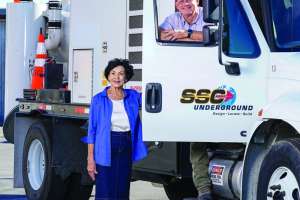
“We said, ‘Let’s try it’ and I thank God we did. After a year of being in business, we decided this was exactly what we wanted to do. We enjoyed all the challenges and the risks and the opportunities. I am a Missouri farm girl and we were hardworking people. We decided we could do this and do it well.” Today, Marcia Veidmark, who was studying business in college, is chairman of the board and CEO of the company she helped start. Her husband is retired.
From trenching to trenchless — that was the path SSC followed, but nothing about the company’s evolution or its success was preordained. If Arvid II, while out in the field one day in 1980, had not become intrigued by a working auger boring crew, the couple might have kept trenching.
Not that they were getting rich in the trenches. Marcia Veidmark recalls that they gave themselves a hundred-dollar paycheck each week and invested the rest back into the company. The early 1980s still staggered from the rampant inflation of the previous decade and SSC was eking by on the strength of entering “low, low, low-dollar bids” on trenching projects.
Seeing the auger boring crew changed that. The Veidmarks hired an auger crew for one job and decided they were capable of doing the work themselves. They invested in their conviction and purchased a Richmond Mfg. auger bore machine and went trenchless.
“We recognized that we had to learn, and had some failures, but got better and finally became very proficient,” Marcia Veidmark recalls. “The Arizona soils are so much different from most other states. It takes a while to know what you’re doing.” Establishing the new trenchless SSC as a reputable member of the emerging industry was soon accomplished and the company entered a more profitable phase of its history. “We didn’t have to keep lowballing our competitors in our bidding.”
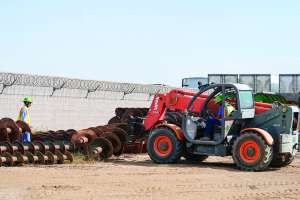
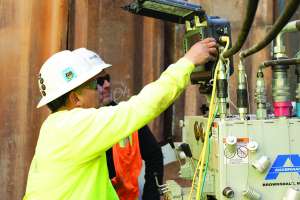
Today, the company is in a far different place. As the company expanded its trenchless repertoire, it necessarily built out its fleet of equipment, which is to say it invested hundreds of thousands of dollars on the future of SSC. The lone Richmond auger bore has grown into a stable — more than a dozen — of late-model machines including American Augers, Michael Byrne and Barbco auger bore machines, Akkerman pilot tube auger bore and tunnel-boring machines, and Robbins small boring units for rocky routes.
WIDE RANGE OF JOBS
These sophisticated, heavy-duty machines owned by SSC crews have created miles of straight passages beneath the surface of the Arizona earth for general contractors, utility companies and municipalities. Some of the jobs were simple bores beneath a roadway, others were more ambitious undertakings.
Arvid Veidmark III cites a dam modification project in 2021 as a special memory. The Cave Buttes Dam in north Phoenix was experiencing seepage at times and the county flood control district made the decision to insert a 5-foot-diameter pipe as an auxiliary outlet for the impounded water.
SSC Underground contracted to tunnel through the dam, creating a 68-inch-diameter passageway for the 60-inch pipe. The tunnel ran for 933 feet some 50 feet below the top of the dam. SSC utilized a tunneling-boring machine and an Akkerman jacking system. After installation, the pipe was grouted in place. It was a 14-month construction project.
“In that job, we had so many curveballs thrown at us,” Arvid Veidmark says, including the unexpected need to take crew safety precautions after COVID arrived. “We ran into groundwater. We ran into clay. We ran into rock.” Yet, it was a successful undertaking. The surprises were not breathtaking because the unexpected is part of the trenchless adventure.
“You go into a project with data, but you never know what is in the middle between the launch pit and receiving pit,” the president says of trenchless work. “Unlike any other technology I have dealt with, trenchless is the epitome of not being able to turn back. Once you start, the expectation is you will continue on that line. If you run into something, you have to figure out how to get past it and continue on.”
By comparison, excavation work is much less daunting. “If you are digging a ditch and it suddenly gets hard, you get a bigger excavator or something. But not trenchless. Underground, you have to figure out how to keep going.” SSC Underground has proven again and again that it knows how.
EXPANDING CAPACITIES
The investment in trenchless technology continues as the company broadens its bore and tunnel capacities. Some of its latest machines are an Akkerman 5200 tunnel boring machine that can open passages from 4 feet to 14 feet in diameter and an Akkerman pilot tube boring unit that is capable of precisely boring a 3-foot-wide passage for 400 feet.
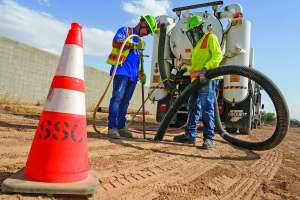
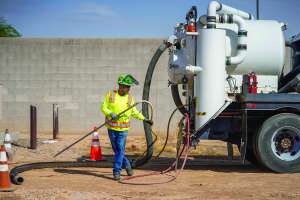
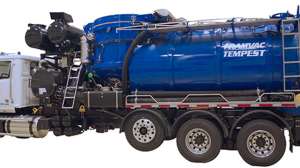
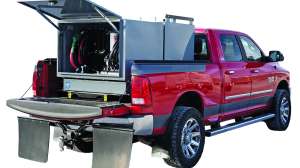
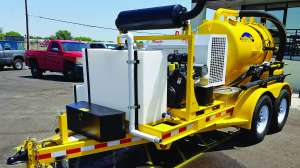
A complementary technology the company got into 20 years ago is vacuum excavation. It is another tool in working with utility companies — potholing, checking for lines in the path of a bore, and so on. SSC offers both air excavation and hydroexcavation services, with a fleet of eight air-vac VACMASTERS trucks and two TRUVAC hydro rigs. The vacuum excavation part of the business accounts for about 30% of annual revenue.
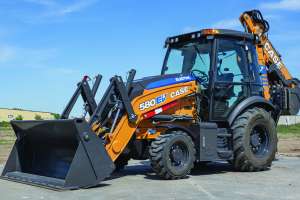
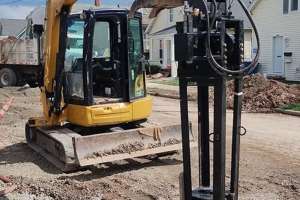
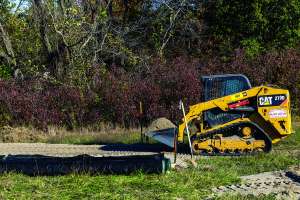
The company also has a full-sized contingent of hydraulic excavation equipment, including six Caterpillar excavators, four Cat backhoes and four Bobcat skid-steer units. Nevertheless, Arvid Veidmark III says, “We don’t take on excavation projects. The equipment is always used in conjunction with trenchless work. Every tunnel crew needs an excavator, including for lifting materials. We don’t have cranes. We use the excavators.”
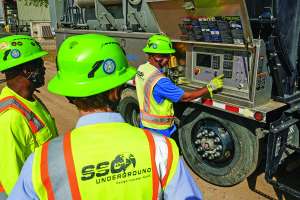
On any given day, SSC Underground has 10 crews working somewhere — four tunneling crews and six air-excavation or hydrovac crews. While the crew members generally work with one type of machine or another, all are willing to operate whatever piece of equipment needs an operator. Probably half of them regularly jump between specialties, according to the company president.
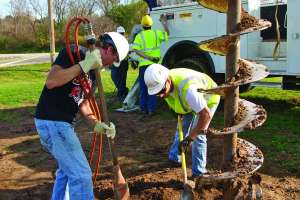
One service the company offers seems quite retro in a modern era — hand-tunneling. Some sites are difficult to access with heavy equipment or ground conditions are inimical to mechanical tunneling processes. So, SSC often uses hand-tunneling. Diggers using shovels and jackhammers work inside the casing — which is no smaller than 42 inches. It is hydraulically jacked forward as they progress, keeping the casing in contact with the face of the dirt. Loosened dirt is shoveled into an electric cart on tracks inside the casing and is carried out and away.
“We continue to expand on the service. At present, three of our crews are doing hand-digging,” Arvid Veidmark III says. “Some companies shy away from doing that kind of work. We don’t have the luxury of not doing it.”
When he joined his parents’ company after trying other career paths, the now-president handled a couple of SSC projects, one in northern Arizona, and “found that I had a knack for project management and leading a team.” Little by little, he mastered the trenchless realm of construction and felt comfortable opening the company’s Trenchless Constructability & Design consultancy.
While his consulting services aren’t heavily marketed, engineering and consulting firms working for municipalities frequently reach out to him to determine if a proposed trenchless project is feasible. He has steered more than one engineer to safer ground.
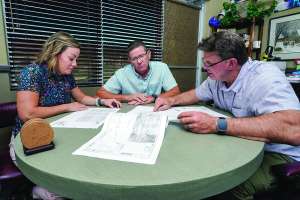
“A design firm will just write down ‘bore’ and indicate a certain route. They don’t understand the footprint of the job site, the soil conditions, that there is a power pole in the middle of the path of the bore alignment. They don’t know what they don’t know.” Bringing his expertise to the plan sometimes avoids difficulties for a contractor. “The avoidance of problems is from the get-go.”
GROWING STRONGER
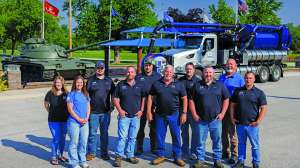
SSC Underground is a family business, which is a strength. Besides the president and CEO, other family members include a niece of Marcia Veidmark’s, Michelle Walker, who came aboard 27 years ago and is vice president of operations, and her husband, Steve Walker, who is general manager. They are key members of the executive team.
Their 23-year-old son, Ben Walker, answered an ad for a project coordinator recently and was hired. “We were thrilled to have him come aboard,” Marcia Veidmark says. “We have a growing group of employees in their 20s. It is exciting both for us and for them.”
Generally speaking, though, the family is reluctant to open the door too wide for kin to work at SSC. “It is not always easy to work with family. It can get muddy,” Arvid Veidmark says. “We have chosen to go down the path that minimizes the muddiness. Sometimes the reality is that a family member is not the best fit. We have a whole lot more nonfamily depending on the company and we are aware of that in making decisions.”
The executive team is just as mindful when it comes to adding additional services. It learned by experience not to stray from a mission path. For example, at one point it added a vertical drilling service to its horizontal lineup. The firm shortly disinvested itself of that notion. “We always look for opportunities to parallel what we already are doing,” Veidmark says. “We try to add complementary things such as utility potholing with the vac trucks, a practical next step. We have learned we need to stay tight and on the straight and narrow.”
The same practical attitude is taken toward where the company will do its work. Through the years, the Veidmarks have gravitated from concentrating on projects in Phoenix to reaching out across Arizona to its current perspective that has it working in places as far away as Virginia and the Virgin Islands.
“It is not our desire to grow outside Arizona,” Arvid Veidmark says. “That goes against one of our core values as a company — we want our people to go home every night and be with their families. Healthy homes produce healthy employees. We take distant work proposals to our employees and will turn down opportunities rather than ask employees to do what they don’t want to do.”
On the other hand, the company keeps an open mind on faraway jobs. “We don’t actively seek them. We simply answer the phone or open the email. We don’t chase such jobs, but neither do we immediately say no when they come along.”