A strong reputation in the construction world often hinges on two key factors: deep industry expertise and the ability to tackle a wide array of challenges. For BTrenchless, these qualities are not just aspirations, they’re a way of life.
As a division of BT Construction, which has been shaping Colorado’s infrastructure since 1980, BTrenchless has spent the past two decades carving its own niche in trenchless and excavation work, earning the trust of industry peers and clients alike.
Whether navigating the rugged soils of Colorado or expanding its reach into Utah through a strategic acquisition, BTrenchless, based in Henderson, Colorado, is redefining what it means to deliver innovative underground solutions.
AN ARRAY OF SERVICES
The main company’s trenchless services were set apart under the name BTrenchless about 20 years ago so the new division could more comfortably undertake trenchless and trenching work on projects of rival general contractors. Ninety-five percent of its trenchless work is for other contractors.
“As a separate division, other contractors feel a little better about having us on their job site,” says Chris Knott, the company’s director of business development and estimating. “It’s not as big a deal now as it was 20 years ago.”
The crews and managers of BTrenchless have successfully completed hundreds of earth-penetrating projects involving excavation, tunneling, drilling and more. Most of those in Colorado, but also at sites as far away as the East Coast.
The vaunted diversity of services is a bit of a two-edged sword because it requires BTrenchless crews and managers to jump from one type of underground work to another. “There is a lot of shifting gears, but our guys are used to that,” Knott says. “We have an estimating team in the office that can put together a range of drilling projects from microtunneling to HDD. Guys in the field can do a little bit of everything. They get it done whether it’s a 200-foot auger bore, a 500-foot HDD shot or a thousand-foot microtunneling job.”
Microtunneling probably is the biggest segment of its business, according to Knott, going by dollar value.
“After that, the types of projects ebb and flow. One month we will do a lot of auger bores and the next month it could be anything,” Knott says. Regardless of the mix, however, every month is busy at BTrenchless. “We have about 15 jobs running currently.”
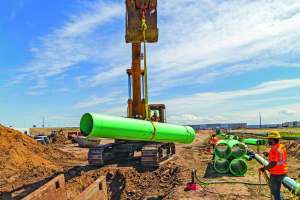
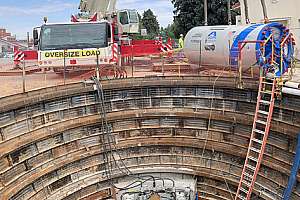
Some examples of current projects: It just completed an 18-month sanitary sewer project in Boulder, Colorado, that featured two microtunnel segments bored from a common launch shaft — a 1,500-foot tunnel for 60-inch steel casing and a second tunnel for another 500 feet of the casing. Each casing will carry 42-inch HOBAS fiberglass-reinforced polymer mortar sewer pipe. The company also installed 12,900 feet of 42-inch and 48-inch sewer pipe via opencut.
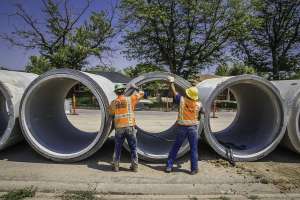
A particularly memorable work Knott cited is a portion of the First Creek project completed in June for the city of Aurora, Colorado. The trenchless portion of the project passed under sensitive ecological areas, creeks and a golf course. The methodology utilized to insert 54-inch and 60-inch casings included a guided auger bore, guided pipe ramming, microtunneling, hand-tunneling and pipe-jacking.
“It was a three-year project done in five phases,” Knott recalls. “Big traffic. Big tunnel. Big pipe. We were not working in an open field somewhere.” The completed project was acknowledged with an industry award, in which it cited the company’s advanced techniques.
“Having many tools in the toolbox allows BTrenchless to seamlessly move between the most basic of tunneling methods to the most complex,” Knott says.
Besides a completed project in Virginia, BTrenchless has recently bid on a project in Miami, and is looking at another one in North Carolina. Knott says they aren’t looking really hard at such distant jobs.
“We want to keep our people at home to work in the Denver and Colorado and Utah area,” Knott says. “But for the right job and the right customer, we will go anywhere.”
EXPANSION INTO UTAH
Three years ago, the company proved they would go anywhere and expanded into Utah by way of acquisition. It purchased HDD Wilco, a West Jordan, Utah, company.
“It was good fit for us,” says Knott. “HDD Wilco offered a range of services, but was especially big on horizontal directional drilling. It is nice to be able to feature our company in Utah, to be able to grow, and to bring on good employees with experience.”
BTrenchless essentially opened a second office in the Salt Lake City suburb and immediately increased its business volume by 10%, according to Chris Gray, BTrenchless vice president of operations. Overall annual business for BT Construction and its trenchless division is $75-90 million.
In Utah, the company currently is doing trenchless work for a contractor extending utilities under a reconstructed and widened interstate highway exchange. The project will incorporate several methods of construction including a 48-inch auger bore, three guided auger bores totaling about 800 feet, more than 500 feet of HDD installations and three Bortec on-target steering bores totaling some 400 feet.
The on-target bore work got interesting when the boring crew literally hit a wall — an abandoned concrete bridge abutment. Getting past the buried obstacle was challenging but, after some deliberation and a couple nights of excavation and backfilling, the 48-inch bore was completed on grade and on schedule.
A DIVERSE CREW
On any given day, the company has 21 crews working — 12 tunneling and nine doing opencut work. Crew members each have a work specialty, of course, but they are cross-trained in the different methods.
Most of the training is in-house, augmented by visits to industry shows like the NASTT No-Dig Show to stay current with the latest technology. The company also has an active mentoring program to encourage employee advancement so laborers can become operators and operators become foremen.
Working alongside big, heavy, dirt-eating machinery poses dangers for employees, of course, and the company works hard to keep them all safe. “Safety training is all day, every day, beginning with safety meetings every morning,” Knott says.
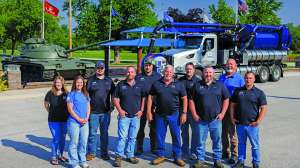
Even successful, busy companies like BTrenchless can have difficulty hanging on to employees. Knott, who has been with the company for 20 years, notes that several employees have worked at BT and BTrenchless for 40 years.
“Finding younger staff people has been a problem and I don’t foresee a change in that any time soon,” Knott says.
He adds that in two conversations at a leadership gathering recently he was told that the new generation of workers are good for about 18 months before wandering off. “Employees don’t leave for more money,” Knott says. “They just want to try something else. We do everything we can to keep the good young ones working with us.” The company employs about 200 people.
SPECIALIZED EQUIPMENT
The ponderous tunneling and drilling machines are capable of doing monumental work. Knott says the largest excavation the company’s tunnel boring machine has done is a 15-foot-in-diameter pedestrian tunnel. Its directional drilling equipment has completed 1,500-foot drills. Such successful underground work is a tribute to the operators, of course, but also to the engineered machinery.
Among the busiest pieces of equipment at BTrenchless are its microtunnel and tunnel-boring machines — all products of Akkerman. TT Technologies supplies the company’s bursting and ramming equipment. Directional drills are Vermeer and Ditch Witch. The company’s staple auger bores are American Augers and Barbco models.
“We have a good relationship with representatives of those manufacturers,” Knott says. “In building up our fleet, we want quality as well as good service and these guys provide both for us, great quality and good service.”
One service provided by BTrenchless is sort of a throwback — hand-tunneling. In the 21st century, problematic soil conditions, a certain dimension of pipe and a need for exacting control in installing it sometimes means getting the shovels out and working underground at the head of a steel casing.
“We try to do it as little as possible,” says Knott. “None of our guys like to get in there and do it. Because we have enough toys in our toy box, enough options, we usually can offer something better. But every now and then …”
Whether hand-dug or machine-bored, trenchless installation of pipe continues to be a popular solution for utilities. Knott sees steady growth in its popularity.
“Even 20 years ago, everything was 10 feet deep, with fewer roadways and fewer buried utilities. It was cheaper to opencut. That’s not the case anymore,” Knott says. “We don’t have the freedom we used to have to lay pipe in the ground that way. Boring is becoming a bigger part of the day-to-day work in the pipeline world. Boring is a bigger part of every project now.”