
Ian Eike got started in the telecom business as an in-home installation technician.
He worked for several years with a leading telecommunications contractor and then directly under the Charter Spectrum masthead while inching deeper into the industry and closer toward the beginning of an entrepreneurial odyssey.
“Townsend Technical Solutions was my first contracting company I launched for installations,” Eike says. “I ran back and forth with Spectrum for several years. I grew tired of going into people’s basements and moved into their backyards.”
In 2017, Eike founded Subterraneus Inc., headquartered in Beloit, Wisconsin. The contractor’s new business started with himself and a few friends hand burying drops for a national service provider, and he moved quickly into running a successful service drop company.
It has since expanded into horizontal directional drilling, outside plant construction, fiber splicing, design work and even back into the residential installation side of things. For Eike, a combination of fieldwork, administrative tasks and ensuring customers are happy drives him forward daily.
The shop is worker-driven, and they are driven by the work. What matters most, amid the victories and challenges associated with being the guy at the top of an efficient and productive growth-oriented organization, is managing and treating people well.

DRILLING DOWN
Today, Subterraneus has 12 full-time workers and another 11 working part time, relying additionally on subcontractors to help accomplish jobs and meet customer demands. The contractor has about 30 drop bury technicians operating in Wisconsin alone.
Eike and his team continue to learn and grow every day. The founder noted he was among the first contractors to handle fiber drops in that market — for TDS Fiber.
For Subterraneus’ part, they’ve covered quite some ground since 2017. Their recent projects include an approximately 11,000-foot fiber backbone installation that was in East Troy, Wisconsin, for Edge Broadband, near the end of the second quarter of 2025.
Most of their main contracts are in southwest Wisconsin. Now they also cover most of Missouri, where Eike branched out in 2024 with the opening of a satellite office in Columbia to service local ISPs, including Columbia-headquartered Socket Fiber and Gateway Fiber, based in Wright City.
That’s already morphed into a second mainstay location. “Mostly the West Central end [of Missouri],” Eike says. “The Beloit office fields the majority of admin work and dispatching crews on assignments. It’s a ‘well-oiled machine.’”
Now Minnesota is on the radar for Subterraneus, and a potential new office location, as Gateway has been building plants at a very fast rate, according to Eike.
“Our next office will likely be in the Minneapolis area,” he says. “Gateway moved up to Minneapolis last year and we were lucky enough to be handed the reins.”

CHASING MUD
Clay has been central to Eike for his entire life. With professional potters as parents, the contractor’s formative years were filled with pugging and mixing it in support of the family’s business and livelihood.
It could be argued the transition to working with drilling mud, the heart blood of a good HDD system, became a natural fit. “I used to make clay for my father to throw pots,” he says. “Now I make clay to keep holes open.”
Over the past eight years, Eike has embraced an outdoor underground infrastructure work mindset, laboring both in the field and leading a business, leveraging boots-on-the-ground experience and investing in reliable equipment.
His team is not unaccustomed to dealing with operational challenges and finding a way around or to the other side of tough situations. To get after it, Subterraneus owns and operates primarily Vermeer equipment, including several 10,000-pound HDD units.
When greater pullback force is required, they step up into their larger Navigator series machines, boosting drill size and rotational torque for the harder stuff.
Their crew recently took on a more challenging residential service drop on behalf of Socket Fiber. The job site in rural Missouri involved crossing a 34-foot-deep rock ravine, drilling under a road, and navigating a steep, twisting path.
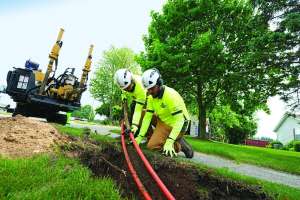
Where terrain permitted, the crew turned to their Vermeer PTX44 ride-on plow and trencher, one of several in their arsenal. Under roadways and along the cliff side, a D10 x15 S3 HDD was deployed where the plow was unable to reach.
The “mini Grand Canyon” encountered could not be drilled across, Eike says. The solution he detailed included running conduit that was attached to a bridge and then painted, matching the landscape and reflecting the contractor’s approach.
“I was pretty uncomfortable because it was the most beautiful landscape I’d ever seen,” he says. “It’s dreamland five miles down the road and a piece of orange conduit stuck to the side of a beautiful bridge.”
He continues, “It did not sit well with me. So, we ended up strapping in safely to, you know, the side of a mini-excavator (JCB 35Z) so that we could paint that conduit to match the brick. To make sure that our bringing the fiber to this customer did not affect the beautiful, obvious dreamland that they had.”
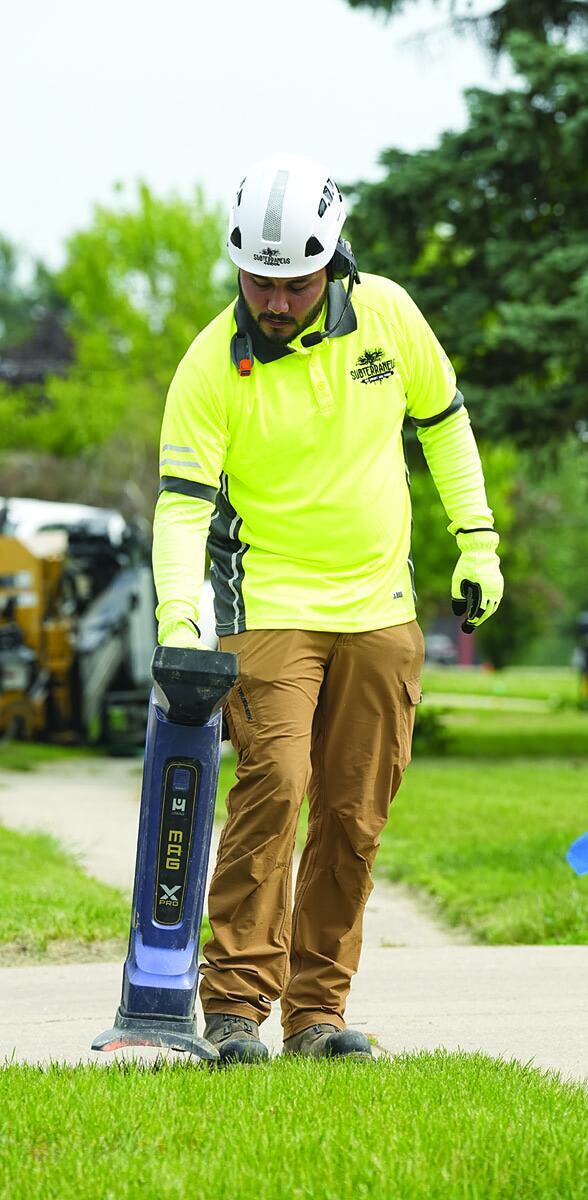
FIBER NICHE
Every project and work site presents its own geotechnical challenges, variable weather and ground conditions, and other unique circumstances. Crews hit the ground running day and night to safely deliver on timely, quality installs.
Eike, recalling the “mini Grand Canyon” case, remembers it being after 12 a.m., out working late with the crew, and accidentally tossing his phone in the woods. It just so happened that it was the mobile device being used at the time to light his way while finishing pulling the fiber in to finalize the customer’s service.
Responding in Missouri to another recent call for Gateway, Subterraneus replaced a duct and handled a minor repair for a business. They took care of a few other jobs pending while on site, maximizing the utility of an 11-hour round trip.
Eike says, “So, what does it take to run an emergency fix? Last night, we drove five-and-a-half hours one way to Marthasville to make sure customers stayed up and running.”
One of the tasks aforementioned involved installing a 200-foot bore near the site of a historical landmark, the Emmaus Asylum, billed on their website as a Missouri “destination.”
“This fiber was 100% placed to be used for paranormal studies,” Eike brought up. “The groundskeeper said it was there before the Civil War. We drilled the entire run so as to not disturb the historic property. It was one hole in and one hole out.”
‘DRILL SAVES THE DAY’
Subterraneus started as a fiber installation company, and that’s still the primary focus. Service drops are still No. 1, Eike says.
“The end goal is to do things safely and save the customer money. We want to plow where we can, but where the plow is not safe to go, the drill saves the day.”
All drilling is about terrain type, soil and ground conditions. Breaking through rocks or hard-packed clay that can slow a smaller drill down can also prevent it from or impact its capacity to finish a job.
“You can shoot out 100 feet on a drill and go from dirt to sand to clay to rock and back,” says Eike. “Up here in Wisconsin, we say the ground is anything and everything all at the same time. That’s where we started upgrading to using larger drills.
“A 10,000-pound-class drill is a little powerhouse with a very small footprint. Down in Missouri, it’s a lot of clay, and then you go from clay to worse rock than Wisconsin. It is all job-dependent. Different areas are known for different ground conditions for better or worse.”

TURNKEY INDUSTRY
Eike says ISPs like turnkey companies that can essentially take care of everything.
Subterraneus recently jumped in and started taking on subcontract work for mainline construction. As the entity has claimed market share, understood its mandate and role in the industry better, and accepted more responsibility, they’ve gained experience.
Combined with continuous learning and improvement, useful technologies and installation hours under the proverbial utility belt — time and money invested in the business — this has all turned into a conductive process for taking their HDD locating and underground drilling capabilities to a new level.
Eike is building his company on data. He sees fiber continuing as a strong bet at least over the next several years. As the owner, he works in the field, directly involved in drilling operations, sometimes five or six days a week.
“As far as the design side of things, we have done quite a bit of mainline fiber construction,” he says. “I started studying and learning GIS and even something as simple as Google Earth can be used to design and map our new outside plant for our customers. [The ISP] will task us with actually going in and designing [a project] for them.
“They give their approval, and then we’ll go and build that. We are learning the way those things are done, to get [fiber] here, and provide service to all these customers.”
A BIG PROGRESSION
Eike and company have seen a lot of tough soil, hard crossings, interesting hookups and opportunities to grow by solving problems. They are in the business of clearing obstacles, leveraging combined decades of hard-won expertise and maximizing the power of equipment like HDD machines and tooling for precise and reliable drilling performance.
He sums it up: “That’s what has been the big progression. We’ve taken years of experience and started off doing service drop work, then those drops turn into being able to use a drill so you can get under roads. That all comes together now where we can offer that and be a one-stop shop.
“We had grown to five or six drop crews; vibratory plows and stick boring under driveways to get the service in,” he says. “That is where we started hitting our stride.”

‘READY FOR THE NEW DAY’
Circling back to the recent trip to Marthasville, Eike had one more official duty wrapping up that early morning, ensuring that “yesterday’s work was closed out and the guys were ready for the new day.”
The contractor, known for maintaining a consistent flow of project information, also opts to overcommunicate, rather than undershare, with his customers. Often, his daily morning routine, starting at 4 a.m., involves working on spreadsheets and sometimes sending more than 100 emails.
The company currently has two administrators, an operations manager and nine in-house employees in the Missouri market, with the balance of their staff at the head office in Wisconsin.
“A big part of Subterraneus, what built us, I think, is that we’ve always been the ones to take the hardest possible stuff as a challenge and get it done,” Eike says. “Some of our key markets are places other people don’t want to be.
“We don’t want to be another cog in the wheel. We don’t want our customers to be that either. The ISP may shut down at 5 p.m. but Subterraneus doesn’t. That job comes to Subterraneus, and we know that we have to get fiber there.”
Continue reading for free