

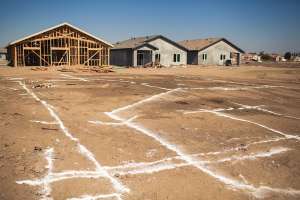
As demand for new-home construction faltered in 2008, Jim Stevenson — the owner of Accurate Trenching — knew his 40-year-old business, which relied heavily on trenching for foundation footings, had reached a critical crossroads.
So Stevenson looked at the business lay of the land, invested in new equipment and steered the company toward a completely different market: wheel trenching for agricultural and oilfield pipelines. And in the long run, the company emerged as a stronger and more diversified business, better equipped to handle future market downturns.
How Stevenson engineered this textbook turnaround underscores the value of embracing unfamiliar technology and capitalizing on underserved market niches with high barriers to market entry. It didn’t hurt that Stevenson also had established a reputation as an honest and skilled excavator, says his son, Clint, who has worked for his father ever since his high school years. He now serves as a supervisor/foreman, coordinating trenching crews.
“When the recession hit, we shrank to five or six employees, which was the smallest number since Dad bought the company in 1990,” Clint says. “A lot of competitors left the market, and we survived largely on Dad’s work ethic. His good name and integrity kept us going.”
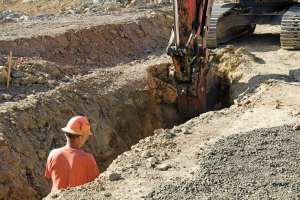
As Stevenson surveyed the recession-racked market, he saw opportunity in providing trenching service for agricultural customers. Bakersfield is located in California’s fertile Central Valley, one of the world’s most productive agricultural centers, with more than 7 million acres of irrigated farmland. “Over the years, we had turned down a lot of irrigation-trenching work because we were so busy with foundation trenching,” Clint explains. “But we figured we’re a trenching company, and if we could meticulously lay out and do excavations for complicated house footings, we also could dig straight trenches for miles of pipelines. So we started buying wheel trenching equipment.”
The move made sense for a variety of reasons. For starters, few companies do wheel trenching because the machines are expensive; a new unit costs about $260,000, which makes the market less attractive to competitors. In this case, the only wheel trenching companies around were located out of town. Moreover, the machines require constant maintenance and repair. “The machines tend to tear themselves up,” as Clint puts it. “It’s very labor intensive to keep up with repairs.”
In addition, it’s much harder to learn how to efficiently run a wheel trencher than conventional excavation equipment. “A lot of people can run a backhoe, but 99 percent of them will never run a wheel trencher,” Clint notes. “It’s a very different kind of excavation equipment, and if you’re not knowledgeable about how to run one, you can tear it up even worse than it normally tears itself up.”
In the end, the market switch proved to be highly successful. Today, Accurate Trenching employs 17 people and owns seven trenchers. One is a larger chain trencher made by Vermeer Corp.; it’s designed for excavating in hard ground and rock, and can dig a 36-inch-wide trench. The other six are smaller bucket wheel trenchers. Three of them were built by Cleveland Trencher Company (with 18-, 24- and 30-inch-wide trenching capability) and the rest were manufactured by Guntert & Zimmerman Construction Division (all with 12-inch-wide trenching capability).
The company also owns a backhoe, a mini-excavator and a skid-steer made by Caterpillar; two Bobcat mini-excavators; and four Freightliner tractor cabs that pull both low-bed trailers made by Landoll Corp. and TrailMax flatbed trailers built by Gem State Manufacturing.
The company didn’t completely jettison foundation trenching, either. While agricultural trenching for irrigation pipelines generates about 45 percent of the business, foundation and utility trenching contributes the remainder. About 75 percent of the foundation trenching arm of the business centers on commercial work, with residential work providing the balance, Clint says.
So in a sense, the recession turned out to be a good thing for the company. “It forced us to think outside the box about different markets,” Clint says. “Before we knew it, we had developed another side of the business that was better than what Dad was doing 30 years ago. We diversified to survive and that made us a much stronger company.” Clint also points out that his mother, Judie, has played an instrumental role since the company’s inception, serving as the office manager, payroll accountant and bookkeeper.
Stevenson cut his excavation teeth while working for Dave Austin, who established Austin’s Trenching in the mid-1970s, with Stevenson as his only employee for many years. When Austin decided to retire in 1990, Stevenson bought the company and renamed it Accurate Trenching.
“Dad wanted a name that was more personal to him,” Clint says. “He takes a lot of pride in his work. Digging foundation footings is a lot different than just digging a ditch — it requires a lot of skill. That’s why he named the business Accurate Trenching.”
The transition was seamless because Stevenson had worked for Austin for many years and had forged strong bonds with customers. “We’re not a huge business, so every customer knew Dad personally,” Clint points out. “His face effectively was our brand, because he was the only employee for quite some time and basically ran the company for the previous owner.”
Clint learned the trade from his father, literally from the ground up. He not only learned how to operate different kinds of equipment, but also how to calculate complex footing layouts for houses. Footings for a tract home are fairly easy to do. But laying out footings for 8,000- and 10,000-square-foot homes — which involves making sure the house is oriented legally on its lot, isn’t violating any building codes or setback provisions, and is set an appropriate distance from utility lines and such — is a much more complicated endeavor, he notes.
“It can easily take a full day for larger homes,” Clint says. “We’re taking what the architects put down on paper and translating it (onto a lot).”
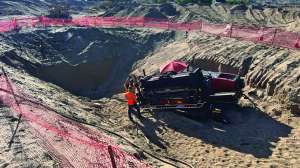
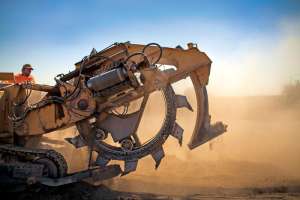
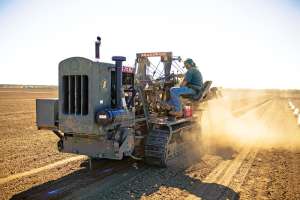
Operating a wheel trencher is also a challenge. Compared to more conventional equipment, it’s an unusual beast, equipped with a large wheel (8 to 10 feet tall) that’s lined with digging “buckets” all the way around its circumference. A high-torque engine spins the wheel around, and the buckets — which feature replaceable teeth — dig into and scoop up soil as the tracked vehicle slowly moves forward. Spoil is deposited in neat rows on either side of the machine by a conveyor belt that runs through the wheel, perpendicular to the rest of the machine, Clint explains.
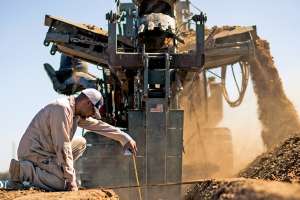
A benchmark for good production is a mile of trenching a day for, say, a 24-inch-wide 46-inch-deep trench. “Barring breakdowns, that’s a pretty solid day,” Clint says. “We’ve gone up to 1 1/2 miles a day.” To strike a straight line for trenchers, farmers will typically drop some kind of marker at the start and end points of the trench. Then they “draw” a visual line by dragging, say, a backhoe tooth behind a tractor that uses the markers’ GPS coordinates to determine a straight path from one end to the other, he says.
“Sometimes farmers don’t have GPS, so we instead measure the line off something straight, like a fence line or a line of power poles that run for miles,” he says. Other jobs are more complicated; consider an irrigation system for a 1,000-acre plot that requires 22 miles of trenching in a grid pattern, Clint notes.
Why is there so much wear and tear? The buckets — and in particular, the teeth on the buckets — take a beating as they plow through soil. “There’s also a lot of metal-on-metal wear where the wheel contacts the sprockets,” Clint adds. “They get beat to death. It’s constantly grinding against itself.”
As a result, the company’s full-time mechanic usually has more work than he can handle. The most common repair technique is something called hard-facing, where a layer of steel weld is applied atop moving parts that constantly grind into soil, such as teeth and buckets.
“It takes thousands of dollars a year to maintain them,” Clint says. “The ratio of time spent trenching versus time spent on maintenance is probably two to one, so we spend half as much time doing repairs as we do trenching.”
Moreover, to provide adequate service for customers, a wheel trenching company must have more than one trencher. This erects yet another hurdle for prospective competitors.
“If you’re going to be a professional wheel trencher, you can’t service customers with one or two machines,” Clint says. “You need multiple machines so when one breaks down — and you know it’s not if, but when — you have a backup ready to go.”
Further, to meet customers’ needs, a trenching company also needs trenchers that can dig a variety of different trench widths (12-, 24- and 36-inch widths, for example) and depths, which only compounds the capital-intensive nature of the business. In fact, sometimes a customer needs three different-size trenchers on just one job, he notes.
But it takes more than deep pockets to build a wheel trenching business. Clint says his father’s work ethic and integrity have also played a huge role in the company’s success. “I’d say that 99.9 percent of anyone who’s done business with my father has had a positive experience,” he points out. “And that’s paved a pathway to success in everything we do.
“What sets us apart is we do what we say we’re going to do, and we do it when we say we’re going to do it,” he continues. “We’re not perfect by any means, but I think we do that better than most anyone else in our trade.”
Looking ahead, Clint — who will take the reins of the company when his father retires — doesn’t anticipate a lot of changes in the company’s business model. But he says he’s open to expanding geographically and perhaps even getting into other aspects of trenching.
“I think we’re pretty good where we are right now,” he says. “I’m certainly not against growth, but we don’t want to force it. We’d much rather have it happen organically — grow through a natural increase in demand for our services. And we never want to lose our focus on the local customers that helped us get where we are today.”
Asking Clint Stevenson to pick his favorite trencher is like asking a parent to choose a favorite child. In short, all seven machines — built by Vermeer Corp., Cleveland Trencher Company and Guntert & Zimmerman Construction Division — are valuable contributors to the bottom line at Accurate Trenching in Bakersfield, California.
All of the machines feature four-cylinder diesel engines, typically in the 100 to 300 hp range. They ride on steel tracks and feature hardened-steel buckets, except for the Vermeer machine, which is a chain trencher with more than 100 carbide-tipped teeth. The buckets on the wheel trenchers feature removable teeth on the outside lip. “Those are the parts that really wear down,” Stevenson says. “If we put in a brand-new set of 5-inch-long teeth and dig for six or seven days in a row, they might wear down to four inches long.
“The dirt is like sandpaper, always grinding down the teeth,” he adds. “In fact, if the ground is really hard, we might have to change out, say, 48 teeth in just one day (each bucket has five teeth). And we use carbide-tipped teeth on our big Vermeer chain trencher (which digs a 36-inch-wide trench) when we’re trenching in really hard ground. … They’ll actually chew through rock. They won’t do it very fast, but they will trench through it.”
Most of the machines’ components operate hydraulically, such as the large rams that drive the wheel into the ground, says Clint Stevenson, a supervisor/foreman at the company.
“The most important thing for a wheel trencher is its weight, plus the torque it can generate,” he explains. The gross weight of a Vermeer T655 trencher, for example, is 53,500 pounds. “When you’re digging into the ground, you need something really heavy because you’re always working against the ground. The weight of the machine is a huge contributor to how well it performs because it creates the downward pressure that keeps the wheel in the ground.”
Continue reading for free