When Ronnie Baron Sr. decided to establish his own business in 1997, he wanted the company name to accurately reflect his ambitions. He came up with something simple and direct: Pro Serve, shorthand for professional service.
Since then, the company — based in Prairieville, Louisiana, just southeast of Baton Rouge — has evolved into a roughly $10 million-a-year company and a regional player in the industry. It primarily serves pipeline, chemical, and petrochemical customers in Louisiana, Alabama, Mississippi, and Texas, but it has worked for customers as far away as California and Utah. Along the way, the company also expanded its services from just industrial vacuuming to hydroblasting and hydroexcavating.
Many things have changed over the past 20 years, but one thing has remained constant: an emphasis on professional service that helps build customer relationships and generate word-of-mouth referrals.
PRIMARY GOALS
Professionalism takes many forms at Pro Serve. For starters, consider its fleet of technologically advanced equipment, including 14 vacuum trucks and 14 hydroblasting units. Then there’s a wide array of service offerings, aimed at fulfilling customers’ various needs. In addition, the company emphasizes employee safety, which is critical to serving the markets in which Pro Serve operates. And last but not least, a sharp focus on quality service.
“Our main goal is to provide safe, quality service — go in and get out and do a job safely,” Baron says. “We always want to prove to our customers that they were justified in hiring us.”
But for Baron, being a professional also means knowing his own limitations. As such, he says he’s always hired people whose skills shore up his deficiencies. “I know my capabilities and my limitations, so I surround myself with people whose strengths outweigh my weaknesses,” he notes. Moreover, he doesn’t hesitate to subcontract work to supplement the company’s services when needed — a philosophy that requires maintaining good relationships with competitors.
“The market has changed a lot in the last 40 years,” he points out. “It used to be that we didn’t talk to competitors, and now we talk all the time. We realize that our company can’t be all things to everybody, so subcontracting is important to us.” It’s also more cost-effective to periodically hire subcontractors for services that Pro Serve doesn’t offer, rather than investing in new machines that could very well sit idle after a project concludes.
DRIVEN TO SUCCEED
After selling hydroblasting and vacuum services for two different companies for more than 10 years, Baron was positioned for success. “I pretty much knew I could run my own company. It was just a matter of getting financing. I saw that people were making good money (serving) the chemical and petrochemical industries, so I knew that was the market I wanted to get into.”
Baron’s motivation was simple. “I knew I was never going to get wealthy working for other people,” he says.
In the early years, the company’s main market was industrial vacuuming for petrochemical customers. But around 2003, the company diversified by entering the hydroblasting industry after Baron hired Curtis Lonidier, an experienced hydroblasting operations manager who now runs that end of the company. The motivation: a much larger market.
“If you took all the air-moving (vacuum cleaning) work on the Gulf Coast versus hydroblasting, the latter offered five times more volume,” he explains. “It presented a much bigger market and more opportunities.” On the other hand, profit margins weren’t as good because of rampant lowballing on contract bids, especially on projects that used reverse auctions for bidding.
“We lost a lot of business in reverse auctions,” he recalls. “We know what we have to charge to stay in business. You’ve got to pick and choose your battles. Most guys become low bidders just to get their foot in the door, but we’d rather go in and explain why our prices are what they are.”
Low-bid companies can’t afford to invest in good equipment or pay employees enough to minimize turnover, Baron explains. “Those kinds of companies are going to do five or 10 times the business I do but at 50 percent less profit margins than I do, and I don’t understand that mentality. You just hope that customers understand it’s no bargain to go with the low bid and get low-quality work.”
ENTER HYDROEXCAVATING
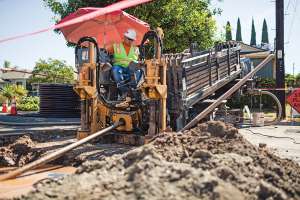
In 2007, Pro Serve continued to diversify its services by entering the market for hydroexcavating. Baron’s son, Ronnie Jr., urged him to make the move, sensing that the hydroexcavating market was about to explode — especially after the federal government said contractors could no longer use backhoes for excavating on government-funded projects.
“We were there at the beginning and really took advantage of that,” he says. “We got a lot of crossover work by leveraging our existing customer base. Our hydroexcavating work has grown and grown and grown. It probably generates about 75 percent of our total gross revenue.”
Offering an array of services has benefited the company. Baron points out that if customers like the service you provide and ask you to do something else for them, they’ll go somewhere else if you don’t provide that service. In addition, the work Pro Serve performs in the company’s two primary customer bases — pipelines and refineries — peaks at different times of the year. These offsetting cycles provide the company with steadier work and more consistent cash flow.
“Pipeline work occurs mostly in warmer months, while refineries schedule their major turnarounds (scheduled maintenance shutdowns) in winter because it’s too hot in summer to do that kind of work,” Baron explains. “So it’s lucky for us that they don’t compete with each other.”
On the flip side, Baron only expands into services that fall within the company’s realm of expertise, which affords it better quality control. “You can only go so far,” he notes. “We’ve been asked to get into other service lines, but we just can’t be everything to everybody. We’ve stuck primarily with air moving and spinoffs in that base market, like hydroexcavating and hydroblasting.”
STRENGTH IN NUMBERS
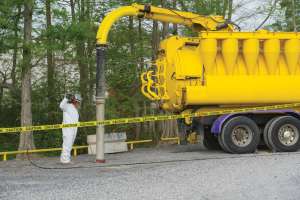
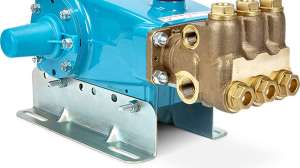
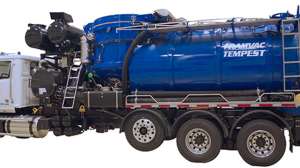
Since its inception, Pro Serve has amassed a large fleet of equipment. The company owns 14 vacuum trucks, and 13 of them are equipped with hydroexcavating packages to maximize utility. The fleet includes 10 GapVax units and four Guzzlers made by Vactor. The trucks feature 10- to 16-cubic-yard debris tanks, 800- to 1,000-gallon water tanks, water pumps manufactured by Cat Pumps and Giant Industries (1,500 to 2,500 psi at 5 to 20 gpm), and Hibon (a division of Ingersoll Rand) blowers (2,000 to 5,800 cfm). They’re used mostly at chemical plants and to do hydroexcavating (line exposure) for pipeline companies.
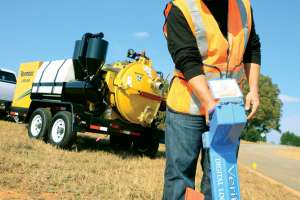
Pro Serve has also invested in 14 hydro blasters built by NLB, Jetstream of Houston and StoneAge with water pump specifications from 10,000 to 40,000 psi at 30 to 100 gpm. The units are primarily used to lance and clean tube bundles at refineries and chemical plants. The company also owns a Vermeer air excavation machine for smaller jobs. It features a 1-cubic-yard debris tank and a 1,000 cfm blower.
The company relies on a Myers trailer jetter for cleaning small-diameter sewer lines, a pipeline inspection camera system made by Sewer Equipment, four cart-mounted pressure washers made by Hydro-Quip Manufacturing & Supply, and a multitube lancer built by NLB.
Safe operation of all this equipment also played a key role in the company’s growth. “In 20 years, we’ve never had any issues with our safety record,” Baron says. “That’s probably the hardest thing to maintain for a small company like us.”
Larger companies with hundreds of employees, for example, can suffer on-the-job accidents and still maintain a sufficient experience modification ratio (or EMR, a number used by insurance companies to gauge the past cost of injuries as well as the chances for future accidents). But smaller companies are at a disadvantage because just one accident results in a dramatically larger EMR ratio because the pool of employees is significantly smaller.
“You can go in a plant and do unbelievable work, but you’re out the door if you have one or two accidents because the EMR ratio goes up faster proportionately,” Baron explains.
SHORTAGE OF SKILLED LABOR
Finding skilled, quality employees to operate the company’s expansive roster of equipment is one of the biggest business challenges Pro Serve faces. Baron says he read one study that shows it takes about five years to learn all the intricacies and nuances and become a highly qualified hydroexcavation equipment operator. That makes it critical to hire the right employees, as well as retain them for more than just a year or so, he says.
But that’s not an easy task. Baron says he’s lucky to find one qualified employee out of 100 interviews. “It’s that bad out there,” he notes. “That’s why we do everything we can to hold onto as many employees as we can. We pay them well, pay for most of their health insurance and give year-end bonuses.” Moreover, Baron says he gives $100 to any employee who refers a potential employee who gets hired and stays with the company for at least 90 days.
Lack of qualified employees is the No. 1 inhibitor to future growth, Baron says. “We’ve been 100 percent tapped out this whole year. Every piece of equipment and all our people are working. We’ve probably turned down 20 or 25 jobs.”
Nonetheless, he’s still optimistic about future growth. One of the company’s primary customer bases — oil-related businesses — is expected to boom again for the next three to five years.
“So things look great for us, provided we can hire enough people. I’m more optimistic today than I’ve been in a long time.”
Tough job required a deft hydroexcavating touch
The hydroexcavating division at Pro Serve in Prairieville, Louisiana, mostly exposes underground lines and other infrastructure for pipeline companies. But that doesn’t mean it can’t handle jobs in other fields, as evidenced by an unusual project the company tackled in 2010.
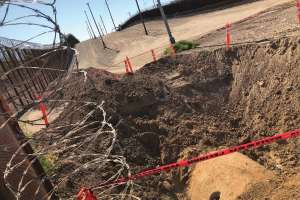
The problem: failing drainlines under four roughly 300-foot-long 90-foot-wide barracks at a U.S. Air Force base in San Antonio. “Toilets and drains in the showers were falling out the bottom of each building,” says Ronnie Barron Sr., the company’s founder and owner.
The task at hand: hydroexcavate channels under each drainline, and each building had nine or 10 drainlines running across the width of the structures. But to make it really interesting, each channel required walls angled at 45 degrees to protect workers — both Pro Serve hydroexcavators and contractors replacing the lines — if the walls happened to collapse.
To understand the scope of the challenge, envision an 8-foot-deep channel shaped like a V, with the arms of the V sloped at 45-degree angles. The bottom of the channel was about 5 feet wide and the top was roughly 30 feet wide. And if that wasn’t daunting enough, the closest Pro Serve could get its vacuum trucks was about 85 feet from the barracks.
One contractor had already failed to get the job done, which is why Pro Serve got the call. And when the U.S. Army Corps of Engineers, which had jurisdiction over the project, mandated 45-degree walls, that meant exactly 45 degrees, not 40 or 50, Baron points out.
“They checked the angle about every 10 feet,” he says, noting there was no margin for error. “And cutting an exact 45-degree angle in dirt for 90 feet is not easy. … It takes a real deft touch to hydroexcavate at an angle. I think we’re one of the few companies in the region with the expertise to do that. We’re blessed with some really great operators.”
The project took several months to complete and required four vacuum/hydroexcavators and about 15 employees. “It was a tough job,” Baron notes. “But we got it done.”