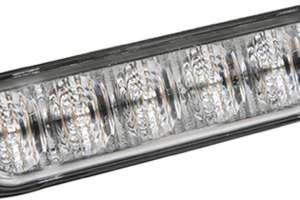
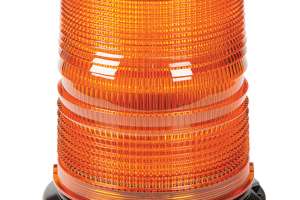
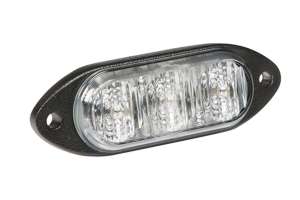
To ensure the visibility and safety of everyone on the road, the Society of Automotive Engineers mandates that vehicles such as construction and utility trucks are equipped with hazard and warning lights. Whether roof-mounted beacons or directional surface mounted to the vehicle’s body or grille, these flashing strobe lights capture the attention of motorists and pedestrians and warn of a potentially hazardous activity or situation.
Available in several colors — amber, white and blue — and a variety of pulsating strobe effects, these lights come in several SAE classes and mounting styles depending on how quickly the vehicle will be moving.
Now, however, as the lighting world continues to transition to LEDs, these hazard and warning lights are now available in low electrical consumption, long life models that far exceed traditional halogen or gas-discharge options.
Making this move even more attractive for fleet managers are the plummeting prices of LED technology, which have decreased to the point that many vehicles that require Class 2 lights are instead being outfitted with brighter, Class 1 options given the minimal price differential.
“Today, the entire hazard and warning light industry is undergoing a significant sea change — namely, the industry’s shift to LED technology,” says Chris Cammack of Grote Industries, a U.S.-based manufacturer of vehicle lighting and safety systems.
“The reason for this migration comes down to three factors: energy efficiency, longer service life and brightness,” Cammack says. “LEDs consume less power than any other lighting technology on the market and are powered by low voltage, allowing for minimal draw of electrical current from the vehicle’s battery.”
BETTER QUALITY AND LONGER-LASTING
By contrast, halogen lights draw an excessive amount of current, which can eventually lead to draining the vehicle’s battery. In addition, they are known for poor energy efficiency, with halogen lights losing as much as 95 percent of their energy to heat.
Gas-discharge strobe lights are equally inefficient. However, unlike halogen lights, it is not due to excessive current draw, but instead the intense and concentrated heat generated by the strobe, which can significantly shorten the service life of the flash tube.
LEDs, on the other hand, consume only 25 to 35 percent of the power of gas-discharge strobe and halogen lights. As a result, LED strobe lights have a service life that is 10 times longer, often lasting 70,000 hours or more.
With most of the world transitioning to LEDs, the quality has continued to improve as well. In the early days of LEDs, they were not bright enough to meet SAE requirements for luminous intensity of hazard and warning lights, measured in candelas. However, technology has advanced and LEDs are now as bright — if not brighter — than the average strobe or halogen light.
“LEDs today are much brighter,” Cammack says. “Today, they are more than bright enough to meet the SAE standard for candela over 100 feet.”
PRICING HAS CHANGED
Another barrier to early adoption was the initial price point, another aspect that has dramatically changed in the past decade.
“The cost to upgrade to LED strobe lights was prohibitive, at least initially,” Cammack says. “Fortunately, the prices have come down significantly in the past 10 years, and now they are about the same.”
In fact, Cammack believes LED models will soon become less expensive as fewer manufacturers make models with outdated technology. Companies like Grote Industries have phased out other technologies in favor of LED only.
“Fewer companies are manufacturing gas-discharged strobe warning lights, so the price of those units is actually going up,” Cammack says. “In a couple of years, it will actually cost more for a gas-discharge or halogen strobe.”
For manufacturers such as Grote Industries, the options are virtually unlimited. The company offers class 1-3 permanent, vacuum and magnetically mounted beacon lights in both regular and high profiles and a myriad of strobe patterns. Most of the company’s LED offerings only draw 0.4-0.35 amps at 12 volts DC.
The company also offers LED directional surface-mount strobes in 3, 6 and 12 diode options that feature 12 different selectable flash patterns in either of two phases, including “steady-on.” These too, require only about 0.1 amps per diode.
Cammack adds that it is important when upgrading to LED strobe lights to be cautious when purchasing inexpensive, imported products. Although they may be cheaper initially, some overseas suppliers use lower-quality LED components. Moreover, it can become an issue of warranty claims arise.
ABOUT THE AUTHOR
Del Williams is a technical writer based in Torrance, California. He writes about health, business, technology and educational issues, and he has an M.A. in English from California State University Dominguez Hills.