
While he’s out on job sites, Lucian Witmer occasionally pulls out a new tool to help his dad’s business. It’s not something for digging holes or connecting pipes. It takes pictures, but it also transforms those pictures into a new tool for promoting the business.
What he uses is a drone.
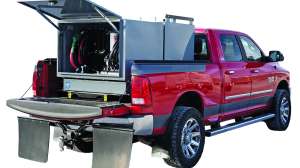
Witmer is also hoping to expand his Lucian Allen Photography business. Meantime he works for his dad, Dervin, and his dad’s two businesses: Dig-It Excavating and Pump That Septic, both based in Cassopolis, Michigan.
Witmer has been pursuing photography seriously for a few years, and he shares his experience with drones and how they can be useful to contractors.
One note about regulations: You may have heard about federal licensing requirements for drones and drone pilots. Those rules had been unsettled because of a federal appeals court decision last year in favor of a model aircraft pilot who challenged the Federal Aviation Administration’s authority. But a more recent court decision upheld the FAA’s authority to police drone use, and new regulations are expected later this year. For more information, your best bet is to look at the FAA website covering drones, known to the FAA as unmanned aircraft systems: www.faa.gov/uas.
See an example of the drone work Witmer does below:
Dig Different: What do you use the drone for?
Witmer: The most common scenario is shooting footage for social media posts and for our website. When I have spare time during a job, I pull out the drone. If the owner is present, I ask for permission to fly, and I’ve never had anyone turn me down. Still photos may go up on Instagram, and I might also shoot a short video clip for our website or Facebook page.
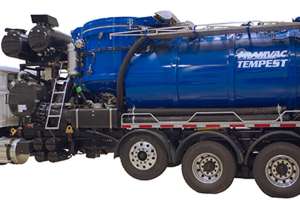
For example, we have a hydroexcavator, and I took some photos of that cleaning out a lift station. I also shot one of our big commercial jobs, installing a wastewater system at a credit union headquarters. I like to shoot stuff where there’s cool scenery. So if we’re pumping somebody on Lake Michigan — something cool like that — I like to get the drone out.
Dig Different: How did you get your start with drones?
Witmer: My dad’s older brother Davey, who lives in Pennsylvania, introduced me to them. He’s into photography and flying, and drones combine those interests. For the commercial job I shot, Honor Credit Union, I used my uncle’s drone. He shipped it to me from Pennsylvania. I bought my own drone after that, a 3DR Solo that was made to accept a GoPro camera. I sold that drone, and now I have a DJI Phantom 4 Pro that came with its own camera.
Dig Different: How much does a drone cost?
Witmer: A good one will cost about $1,000. My Phantom was about $1,500 used and came with an iPad Mini to show video from the camera. The same drone ready to fly would cost about $1,800 new. You may also be able to get last year’s model for a lot less.
Dig Different: How hard is it to fly a drone?
Witmer: It does take some practice. Figure about five hours to become comfortable with it. I started flying in a cornfield where I could fly slowly and get used to the controls. It also helps if you play video games or fly radio-controlled aircraft. I rarely play video games, but I have flown RC planes.
You have to remember to look at the drone, too, so you can see obstacles. You can’t always see those on the video screen. I flew my previous drone into a tree once. That damaged one of the motors that stabilize the camera. And I think I smashed it into a skid-steer one time when I was filming a driveway installation. My Phantom has sensors to automatically avoid obstacles, but those can still mess up, and they can be turned off.
Almost all drones, even many older models, have GPS sensors, so they will hold position even in a wind, and they will return to the launch point and land automatically if they lose contact with the controller. But the control range is good. I’ve flown mine about a mile away and never lost signal.
Dig Different: What should you generally look for in a drone?
Witmer: The camera should provide at least high-definition images. Some offer 4K (a newer standard with higher resolution), but for many uses, such as posting on the internet, having that much resolution is overkill. HD works just fine, but you want to make sure it has a good camera. My Phantom has a 20-megapixel camera.
You also want a drone that’s easier to fly. Some drones allow camera movement independent of how the drone is moving, and that can make steering tricky because suddenly what you think is forward on your screen is really sideways. And some professional drones are meant to be flown by two people, one piloting the drone and the other operating the camera.
Someone starting out in drones should consider the DJI Mavic Pro. It’s compact, and although I haven’t flown it, reviews from people who have flown it are good. And it connects to a smartphone to let you see video from the camera.
Dig Different: What about drones with more than four rotors?
Witmer: Those are intended to lift heavier loads, maybe 18 pounds, for high-end video cameras used for movies. Smaller drones like mine are lightweight so you can throw it in a backpack.
Dig Different: How long do the batteries last?
Witmer: Flight time keeps getting better and better. My first drone would fly only 10 to 15 minutes on a charge. My Phantom can fly for 30 minutes, or so they say on paper. On average, my flights are 10 to 15 minutes, and that’s usually plenty of time to get some good pictures.
You can’t run the batteries all the way down before flying home, though, because drone batteries must have some charge in them in order to be recharged. I set my controller to beep at me when the battery level reaches 30 percent.
Dig-It Excavating was also featured in the November/December 2016 issue of Dig Different magazine. Check it out here.
Continue reading for free